Understanding the SID
Re: Understanding the SID
Oscillator register, even bits:
Oscillator register, odd bits:
;---
Frequency register, even bits: Frequency register, odd bits:
Odd thing is, that the SID really has three 8 bit frequency registers per oscillator channel.
When the CPU writes a byte into frequency register latches bit 15..8,
frequency register latches bit 23..16 are written with '0'.
Frequency register, even bits: Frequency register, odd bits:
Odd thing is, that the SID really has three 8 bit frequency registers per oscillator channel.
When the CPU writes a byte into frequency register latches bit 15..8,
frequency register latches bit 23..16 are written with '0'.
Re: Understanding the SID
BigEd wrote:
The width and length of a transistor directly relates to on-resistance, so it sounds like the 8-series part has a weighting function applied to the inputs - does that fit the facts?
Still I can't explain the wider transistors...
I think that the muffled sound for combined waveforms and noise lockups were two of the problems that Rob Yannes tried to address in the newer chip model.
Re: Understanding the SID
Is there any general knowledge that the relative loudness of the triangle vs the sawtooth changed when the chip changed from 6-series to 8-series?
Re: Understanding the SID
As far as I can remeber there is no mention of something like this anywhere. I can try to make some samplings and see if there is a difference of amplitudes between waveforms. But I'm wondering... isn't the signal still digital at this point?
Re: Understanding the SID
Oh - maybe it is!
Re: Understanding the SID
Generation of osc_rst drawn a bit different:
Generation of osc_rst, this time with logic gates:
V3 is bit 23 from oscillator 3 latch which goes into
osc_rst generation of oscillator 1: I now feel a need to mention that the inverters I did draw at the outputs
of the oscillator odd bit latches actually are located at the north east
corner of an oscillator adder cell, decided to draw it this way
because IMHO this is helpful to understand the adder from the
logic design point of view.
Exactly like that.
osc_rst generation of oscillator 1: I now feel a need to mention that the inverters I did draw at the outputs
of the oscillator odd bit latches actually are located at the north east
corner of an oscillator adder cell, decided to draw it this way
because IMHO this is helpful to understand the adder from the
logic design point of view.
Quote:
This means that the oscillator is reset when test bit is set or when sync bit is set
and the sync source voice's MSB switches from low to high.
Re: Understanding the SID
Now to take a look at the pulse width stuff.
Pulse with latches, even bits: Pulse with latches, odd bits: The pulse width comparators are nothing but a carry chain
like in the 7480... with the sum logic missing, of course. The concept goes like this:
the adder does osc_23..12 + /pw_11..0 + 1.
Means, the carry input of the lowest bit of the adder is tied to 5V.
Because pw_11..0 is inverted before it is passed into the adder
(ones complement), and we also add 1, the adder calculates
osc_23..12 - pw_11..0.
The CMP instruction in the 6502 works somewhat similar,
so the carry output of that adder carry chain is
'0', if osc_23..12 < pw_1..0.
Else, it is '1'.
Generation of 'pulse': If carry=1, or if test=1, then pulse=1 (what would set the DAC to $FFF).
Pulse with latches, even bits: Pulse with latches, odd bits: The pulse width comparators are nothing but a carry chain
like in the 7480... with the sum logic missing, of course. The concept goes like this:
the adder does osc_23..12 + /pw_11..0 + 1.
Means, the carry input of the lowest bit of the adder is tied to 5V.
Because pw_11..0 is inverted before it is passed into the adder
(ones complement), and we also add 1, the adder calculates
osc_23..12 - pw_11..0.
The CMP instruction in the 6502 works somewhat similar,
so the carry output of that adder carry chain is
'0', if osc_23..12 < pw_1..0.
Else, it is '1'.
Generation of 'pulse': If carry=1, or if test=1, then pulse=1 (what would set the DAC to $FFF).
Re: Understanding the SID
Did a sampling of the output of both chips for every possible waveform. Selecting the noise along with other type of waves produces no output so the pictures show only the following combinations:
In other news I've fitted the transistor list into the perfect6502 emulation engine and the results look good, confirming the validity of the work done so far
. There is only one of the three voices implemented and the emulation covers only the digital behaviour of transistors. If anyone want to have a look the code is available in the libsidplayfp repository (https://sourceforge.net/p/sidplay-resid ... rfect6581/)
- Triangle
- Sawtooth
- Triangle+Sawtooth
- Pulse
- Triangle+Pulse
- Sawtooth+Pulse
- Triangle+Sawtooth+Pulse
- Noise
In other news I've fitted the transistor list into the perfect6502 emulation engine and the results look good, confirming the validity of the work done so far
Re: Understanding the SID
Thanks for publishing your code - more transistor-level modelling is always a good thing!
Re: Understanding the SID
Generation of TriXOR:
From the logic design point of view, it looks like V3 really gets inverted there...
but I don't know, why.
Generation of the Saw_bits:
but I don't know, why.
Generation of the Saw_bits:
Re: Understanding the SID
Now for the bus interface.
First the circuitry which generates the internal inverted and non_inverted address lines
Ax_low and Ax_high from the external Ax address bus.
It makes creative use of super buffers: From the logic design point of view, it's something like this: If sid_rst = 1, then Ax_high = 0 and Ax_low = 0.
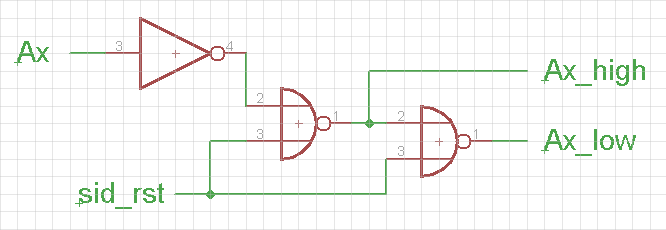
Else, Ax_high = Ax and AX_low = /Ax.
;---
The circuitry which generates /read and /write also makes creative use of super buffers: Logic design point of view: For write cycles, the falling edge of R/W is delayed.
//Considering the C64 bus timing, it would be interesting to compare the 6522 and 6526 bus interface...
Note, that /write is forced to '0' if sid_rst = 1.
When taking a look at the data bus buffers later, it becomes evident that the internal data bus
is forced to $00 while sid_rst = 1.
So during a RESET, if sid_rst = 1, all the NOR address decoder gates tied to /write
will go active because all their address inputs are 0.
This forces a write of $00 into _all_ of the registers that could be written from the bus.
Nice trick.
;---
Now a code snippet from vice 2.4 > resid > resid.cc
But after dissecting the bus interface circuitry of 6581R3 and 8580R5,
I'd say that the bus interfaces just have different geometries,
but they seem to be identical at transistor level from the
logic design point of view.
In other words: we were unable to find any proof that there might be something
like a one cycle write delay on the 8580.
;---
Also, vice 2.4 resid source code implicates, that when writing a register,
the byte also stays on the internal data bus, and if you try to read a register
that can't be read you are just "getting that byte back".
But after $2000..$4000 clock cycles, bits that were 1 on the internal data bus
are "fading" to 0.
BTW: don't get confused by the overly simplified schematics from the logic point of view above,
they are just there to show how things are working in general.
Trying to build a 6502 compatible bus interface for a peripheral chip can give you some grey hairs,
especially when trying to aim for speed.
When I did an experimental TTL implementation of the 6522... but I'm getting off topic.
First the circuitry which generates the internal inverted and non_inverted address lines
Ax_low and Ax_high from the external Ax address bus.
It makes creative use of super buffers: From the logic design point of view, it's something like this: If sid_rst = 1, then Ax_high = 0 and Ax_low = 0.
Else, Ax_high = Ax and AX_low = /Ax.
;---
The circuitry which generates /read and /write also makes creative use of super buffers: Logic design point of view: For write cycles, the falling edge of R/W is delayed.
//Considering the C64 bus timing, it would be interesting to compare the 6522 and 6526 bus interface...
Note, that /write is forced to '0' if sid_rst = 1.
When taking a look at the data bus buffers later, it becomes evident that the internal data bus
is forced to $00 while sid_rst = 1.
So during a RESET, if sid_rst = 1, all the NOR address decoder gates tied to /write
will go active because all their address inputs are 0.
This forces a write of $00 into _all_ of the registers that could be written from the bus.
Nice trick.
;---
Now a code snippet from vice 2.4 > resid > resid.cc
Code: Select all
// Write registers.
// Writes are one cycle delayed on the MOS8580. This is only modeled for
// single cycle clocking.
// ----------------------------------------------------------------------------
void SID::write(reg8 offset, reg8 value)
{
write_address = offset;
bus_value = value;
bus_value_ttl = 0x4000;
if (sid_model == MOS8580) {
// One cycle pipeline delay on the MOS8580; delay write.
write_pipeline = 1;
}
else {
// No pipeline delay on the MOS6581; write immediately.
write();
}
}
I'd say that the bus interfaces just have different geometries,
but they seem to be identical at transistor level from the
logic design point of view.
In other words: we were unable to find any proof that there might be something
like a one cycle write delay on the 8580.
;---
Also, vice 2.4 resid source code implicates, that when writing a register,
the byte also stays on the internal data bus, and if you try to read a register
that can't be read you are just "getting that byte back".
But after $2000..$4000 clock cycles, bits that were 1 on the internal data bus
are "fading" to 0.
BTW: don't get confused by the overly simplified schematics from the logic point of view above,
they are just there to show how things are working in general.
Trying to build a 6502 compatible bus interface for a peripheral chip can give you some grey hairs,
especially when trying to aim for speed.
When I did an experimental TTL implementation of the 6522... but I'm getting off topic.
Re: Understanding the SID
Buffer from external data bus Dx to internal data bus DBx for writing registers:
Note, that sid_rst = 1 places $00 on the internal data bus DBX if /write = 0
for writing all registers that can be written from the bus with $00 at RESET. ;---
Buffer from internal data bus DBx to external data bus Dx for reading registers:
Note, that sid_rst = 1 places $00 on the internal data bus DBX if /write = 0
for writing all registers that can be written from the bus with $00 at RESET. ;---
Buffer from internal data bus DBx to external data bus Dx for reading registers:
Re: Understanding the SID
The register which reads the upper 8 Bits of the Osc 3 DAC output:
;---
One bit of the three control registers: IMHO they just had to build it that way because capacitive load on the CTLx lines could be big...
if a CTLx line drives 12 waveform switches, for instance.
I think the flipflop won't work reliable when connecting CTLx directly to the output
of the second inverter which holds the bit in the flipflop if sid_clk1 = 1.
One bit of the three control registers: IMHO they just had to build it that way because capacitive load on the CTLx lines could be big...
if a CTLx line drives 12 waveform switches, for instance.
I think the flipflop won't work reliable when connecting CTLx directly to the output
of the second inverter which holds the bit in the flipflop if sid_clk1 = 1.
Re: Understanding the SID
Now for the DAC buffer:
It's a _digital_ non_inverting buffer,
built from a normal inverting buffer and an inverting super buffer.
Means, we could assume that the buffer gives out either nearly 0V, or nearly 5V.
"Nearly" depends on the on_resistance of the FETs at the output and the output current.
For the input, I think we could assume a treshold between 0.8V..2.0V,
where "treshold" is the turning point between low and high. ;---
Waveform selectors:
Evil. Eeevil... In the 8580, osc_23 is buffered by a flipflop before it enters that "Sawtooth" switch.
In the 6581, it is not.
The Pulse line which is switched to the DAC buffer inputs in pulse width mode
has a push/pull output, while everything else that could be switched to the
DAC buffer inputs just has a pullup plus an open drain FET switching to GND as an output.
Means, on the 6581, it might be possible that if the "Sawtooth" and "Pulse"
selector switches are closed, the Pulse line might probably override the output
of the osc_23 flipflop... causing _really_ odd effects.
;---
BTW: in the 6581 and the 8580, the noise selector switches really connect to
the LFSR bits 0,2,5,9,11,14,18,20 in the same order. Checked this...
It's a _digital_ non_inverting buffer,
built from a normal inverting buffer and an inverting super buffer.
Means, we could assume that the buffer gives out either nearly 0V, or nearly 5V.
"Nearly" depends on the on_resistance of the FETs at the output and the output current.
For the input, I think we could assume a treshold between 0.8V..2.0V,
where "treshold" is the turning point between low and high. ;---
Waveform selectors:
Evil. Eeevil... In the 8580, osc_23 is buffered by a flipflop before it enters that "Sawtooth" switch.
In the 6581, it is not.
The Pulse line which is switched to the DAC buffer inputs in pulse width mode
has a push/pull output, while everything else that could be switched to the
DAC buffer inputs just has a pullup plus an open drain FET switching to GND as an output.
Means, on the 6581, it might be possible that if the "Sawtooth" and "Pulse"
selector switches are closed, the Pulse line might probably override the output
of the osc_23 flipflop... causing _really_ odd effects.
;---
BTW: in the 6581 and the 8580, the noise selector switches really connect to
the LFSR bits 0,2,5,9,11,14,18,20 in the same order. Checked this...
Re: Understanding the SID
ttlworks wrote:
Means, on the 6581, it might be possible that if the "Sawtooth" and "Pulse"
selector switches are closed, the Pulse line might probably override the output
of the osc_23 flipflop... causing _really_ odd effects.
selector switches are closed, the Pulse line might probably override the output
of the osc_23 flipflop... causing _really_ odd effects.