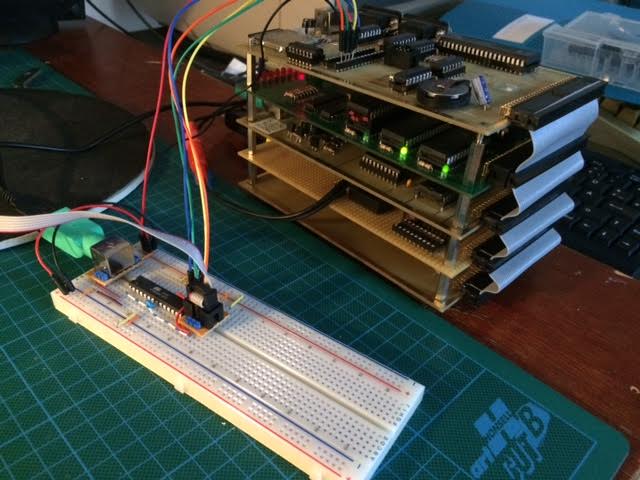
I've been using the Aires ZIF sockets for years. I simply stack a couple extra 28-pin DIP sockets into the PCB's mounted DIP socket and then plug the ZIF socket into it. This elevates the ZIF socket above the PCB by roughly a 1/2-inch, so it clears other parts and/or connectors.
https://www.mouser.com/datasheet/2/35/1 ... 337360.pdf
They are a bit pricey, depending on your POV... but they have come down in price over the past few years. Of course, once I'm done with software changes, I pull the ZIF socket assembly and just go back to a standard EEPROM directly into the PCB socket.
Prototype Construction Tips
-
floobydust

- Posts: 1394
- Joined: 05 Mar 2013
-
GARTHWILSON

- Forum Moderator
- Posts: 8773
- Joined: 30 Aug 2002
- Location: Southern California
- Contact:
Re: Prototype Construction Tips
drogon wrote:
6502 on stripboard: https://unicorn.drogon.net/ruby-03.jpg
I've used scores of Radio Shack 276-170 solder-type breadboards over the years for analog stuff:
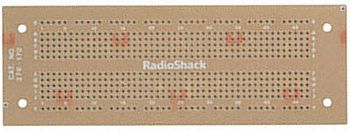
It duplicates the pattern on the solderless breadboards they've sold.
Some nicer options I discovered in recent years are shown at http://www.busboard.com/KIT-BB1660-SB1660 . Here's one of them:
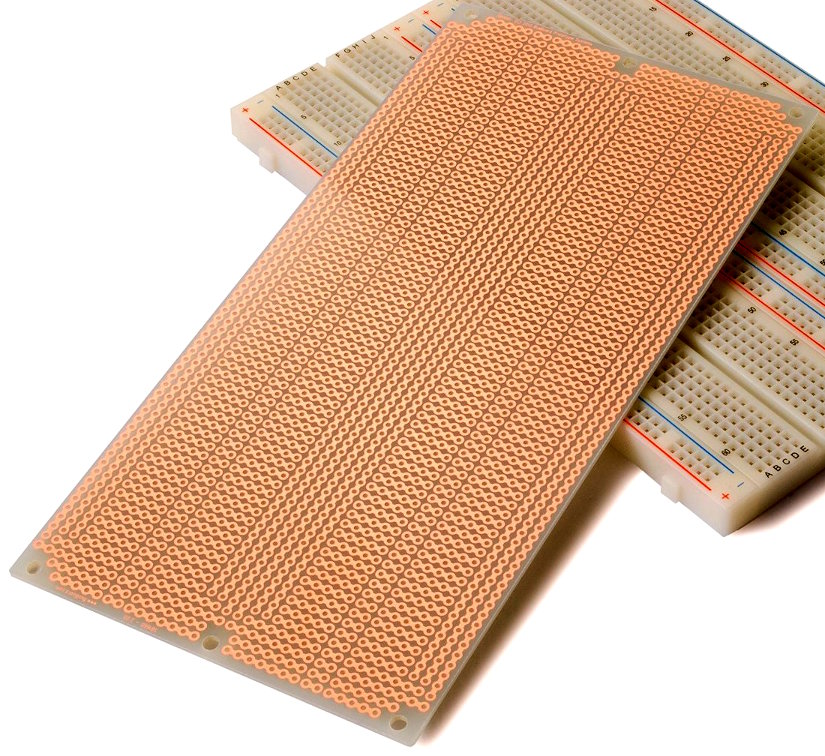
(These are from the bottom of the "Custom PC Boards" section of my 6502 primer.)
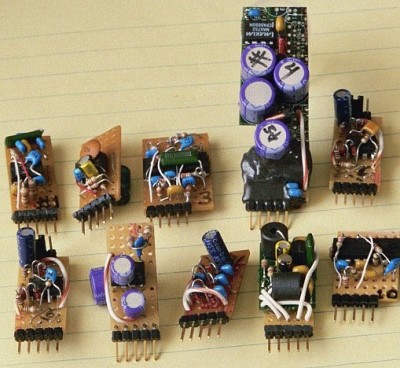
Reusable modules are great. Goals for a home-made computer tend to quickly become too lofty to carry them out in your lifetime—or change faster than you can build. It helps to have various sections ready-made (hence my memory modules, and other tiny ones I hope to offer). For my own use, I have a lot of reusable tiny analog modules so I don't have to keep re-building them for every breadboard. This is about one-third of them:
http://WilsonMinesCo.com/ lots of 6502 resources
The "second front page" is http://wilsonminesco.com/links.html .
What's an additional VIA among friends, anyhow?
The "second front page" is http://wilsonminesco.com/links.html .
What's an additional VIA among friends, anyhow?

Re: Prototype Construction Tips
I've been using (for 40 years now) Miller model 103 wire strippers to strip WW (and other) wire. Seem to last forever.
The WW wire I got from ebay seems fine, but it was so long ago I can no longer look up who I bought it from.
YES!
This is a great idea and one I have used a lot, especially in microcontroller work. Saves so much time, effort and mess. Works with digital stuff too.
The WW wire I got from ebay seems fine, but it was so long ago I can no longer look up who I bought it from.
GARTHWILSON wrote:
Reusable modules are great. Goals for a home-made computer tend to quickly become too lofty to carry them out in your lifetime—or change faster than you can build. It helps to have various sections ready-made (hence my memory modules, and other tiny ones I hope to offer). For my own use, I have a lot of reusable tiny analog modules so I don't have to keep re-building them for every breadboard. This is about one-third of them:
This is a great idea and one I have used a lot, especially in microcontroller work. Saves so much time, effort and mess. Works with digital stuff too.
Bill
-
BigDumbDinosaur

- Posts: 9426
- Joined: 28 May 2009
- Location: Midwestern USA (JB Pritzker’s dystopia)
- Contact:
Re: Prototype Construction Tips
Mike Naberezny wrote:
Quote:
The datasheet says it is recommended for high-vibration environments.
 As far as I know, we're not in a seismically-active part of the world.
x86? We ain't got no x86. We don't NEED no stinking x86!
-
GARTHWILSON
- Forum Moderator
- Posts: 8773
- Joined: 30 Aug 2002
- Location: Southern California
- Contact:
Re: Prototype Construction Tips
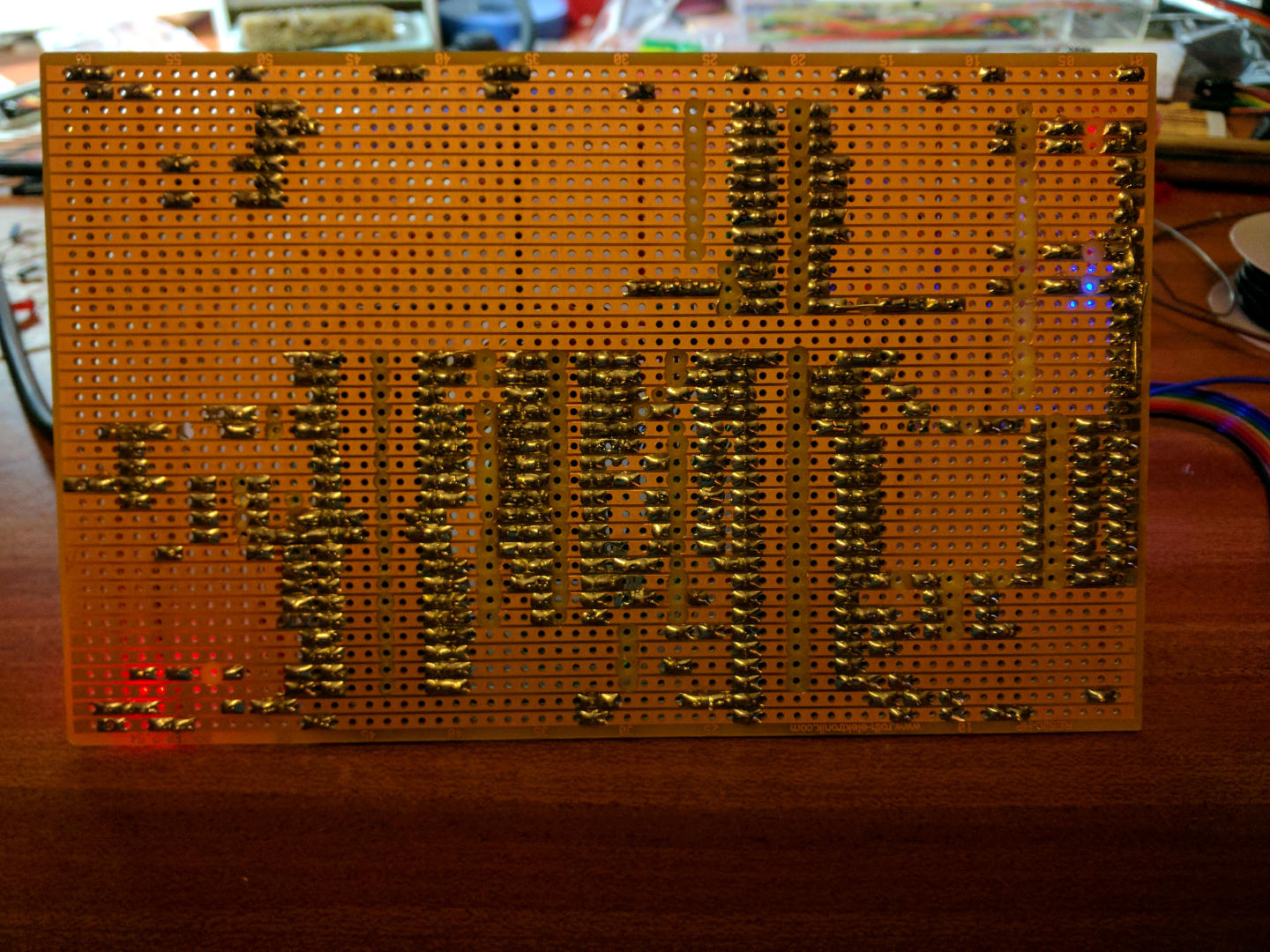
Here's another, for pin headers of .025" square posts with a standard .230" length at one end and longer pins on the other end. I used these for the mezzanine on my workbench computer, both on the mezzanine shown here (before there was anything on it), and down on the main board where the long end of the pins were used for wire-wrapping (between the 40-pin DIP sockets) and I soldered a socket to the shorter end:
The second row is near the right edge of the above picture, and blurry. This following picture shows it slightly better, behind the blue trimmer which is for adjusting the LCD viewing angle:
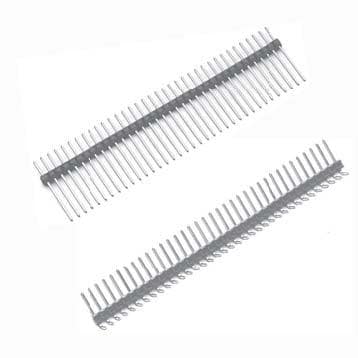
Here are some Mouser links to single-row ones:
.235" at one end, .410" at the other end
.235" at one end, .610" at the other end
.235" at one end, .910" at the other end
They're kind of expensive, but if you're only doing one-off projects, the time they save you is well worth their price.
You can also get dual-row ones which are good for plugging IDCs onto. This picture shows a couple with red insulators (after the same mezzanine had some circuitry built onto it:
Here are some Mouser links to single-row ones:
.235" at one end, .410" at the other end
.235" at one end, .610" at the other end
.235" at one end, .910" at the other end
They're kind of expensive, but if you're only doing one-off projects, the time they save you is well worth their price.
You can also get dual-row ones which are good for plugging IDCs onto. This picture shows a couple with red insulators (after the same mezzanine had some circuitry built onto it:
http://WilsonMinesCo.com/ lots of 6502 resources
The "second front page" is http://wilsonminesco.com/links.html .
What's an additional VIA among friends, anyhow?
The "second front page" is http://wilsonminesco.com/links.html .
What's an additional VIA among friends, anyhow?

Re: Prototype Construction Tips
GARTHWILSON wrote:
Reusable modules are great. Goals for a home-made computer tend to quickly become too lofty to carry them out in your lifetime—or change faster than you can build. It helps to have various sections ready-made (hence my memory modules, and other tiny ones I hope to offer). For my own use, I have a lot of reusable tiny analog modules so I don't have to keep re-building them for every breadboard. This is about one-third of them:
Cat; the other white meat.
Re: Prototype Construction Tips
Mike Naberezny wrote:
If it turns out that the EJECT-A-DIP is mechanically compatible with a DIP plug, that could be a nice upgrade to keep the DIP plug locked in.
- Attachments
-
-

Re: Prototype Construction Tips
Anyone gone so far as to use the book-of-pages approach to multiboard wirewrapped prototypes, as used by the Amiga team?

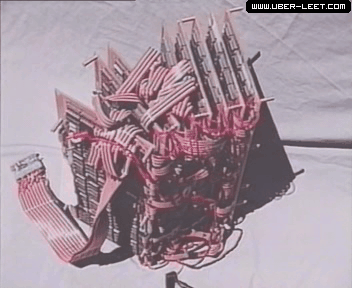
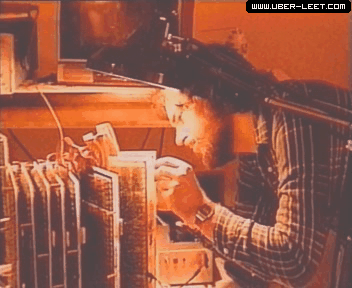
(Images from this page, ultimately from the 1992 History of The Amiga documentary "created on an Amiga 2000")
(Images from this page, ultimately from the 1992 History of The Amiga documentary "created on an Amiga 2000")
Re: Prototype Construction Tips
As also used by Seymour Cray for commercial products!

Re: Prototype Construction Tips
Daryl's SBC4 is another instance of the book-of-pages approach. ( Probably that's where Seymour got the idea!  )
Seriously, I like the fact that the "book" can be spread open to grant access to both sides of any individual board.
)
Seriously, I like the fact that the "book" can be spread open to grant access to both sides of any individual board. 
Furthermore, ribbon cable + IDC's are easier to design and build with, compared with connectors soldered into a rigid backplane. Cheaper, too.
(Of course, it's strongly recommended that ground lines be interspersed with the signal lines, regardless of whether your "backplane" is flexible or rigid.)
-- Jeff
)- MM2a.jpg (72.46 KiB) Viewed 2216 times
Furthermore, ribbon cable + IDC's are easier to design and build with, compared with connectors soldered into a rigid backplane. Cheaper, too.
(Of course, it's strongly recommended that ground lines be interspersed with the signal lines, regardless of whether your "backplane" is flexible or rigid.)
-- Jeff
In 1988 my 65C02 got six new registers and 44 new full-speed instructions!
https://laughtonelectronics.com/Arcana/ ... mmary.html
https://laughtonelectronics.com/Arcana/ ... mmary.html