

I'm going to look at getting some genuine Kynar wire soon. Just need to find some that doesn't require me to mortgage my house. LOL
So, what strippers are you guys using? Especially for the 30AWG stuff. I use either my WW tool or a $4 cheapo pair that isn't very comfortable to use.
Also, anyone here try using CAT5 cable (solid core) for any soldering projects? Seems like it would be too brittle but it's pretty cheap considering CAT5 cable is often sold by the foot and you get 8 wires in that foot.
Prototype Construction Tips
Re: Prototype Construction Tips
Cat; the other white meat.

Re: Prototype Construction Tips
I use CAT5 for protoboards and it works great. The one advantage it has over smaller wires I tried is that it is too big to slip through the holes in the board, so it stays put when you are trying to solder it.
-
Mike Naberezny

- Site Admin
- Posts: 294
- Joined: 30 Aug 2002
- Location: Northern California
- Contact:
Re: Prototype Construction Tips
cbmeeks wrote:
So, what strippers are you guys using? Especially for the 30AWG stuff. I use either my WW tool or a $4 cheapo pair that isn't very comfortable to use.
- Mike Naberezny (mike@naberezny.com) http://6502.org
-
Oneironaut

- Posts: 734
- Joined: 25 May 2015
- Location: Gillies, Ontario, Canada
- Contact:
Re: Prototype Construction Tips
Breadboards and CAT-5 wire.
That's kinda my thing.
Prototypes exceeding 40MHz.
Brad
That's kinda my thing.
Prototypes exceeding 40MHz.
Brad

Re: Prototype Construction Tips
Mike Naberezny wrote:
-Floopy
-
Mike Naberezny
- Site Admin
- Posts: 294
- Joined: 30 Aug 2002
- Location: Northern California
- Contact:
Re: Prototype Construction Tips
Floopy wrote:
What's the name of the DIP socket? I have never seen one like it.
- Mike Naberezny (mike@naberezny.com) http://6502.org
-
GARTHWILSON

- Forum Moderator
- Posts: 8773
- Joined: 30 Aug 2002
- Location: Southern California
- Contact:
Re: Prototype Construction Tips
cbmeeks wrote:
I'm going to look at getting some genuine Kynar wire soon. Just need to find some that doesn't require me to mortgage my house. LOL
So, what strippers are you guys using? Especially for the 30AWG stuff.
So, what strippers are you guys using? Especially for the 30AWG stuff.
http://WilsonMinesCo.com/ lots of 6502 resources
The "second front page" is http://wilsonminesco.com/links.html .
What's an additional VIA among friends, anyhow?
The "second front page" is http://wilsonminesco.com/links.html .
What's an additional VIA among friends, anyhow?
Re: Prototype Construction Tips
Mike Naberezny wrote:
There's a normal DIP socket soldered to the board. ZIF sockets are expensive so I only have a few of them. When I am developing, I stick a ZIF socket into the normal DIP socket temporarily. This lets me easily change out EPROMs (or usually my EPROM emulator's cable). I then move the ZIF socket to the next project when I'm done.
Thanks for the tip!
-Floopy
-
BigDumbDinosaur

- Posts: 9426
- Joined: 28 May 2009
- Location: Midwestern USA (JB Pritzker’s dystopia)
- Contact:
Re: Prototype Construction Tips
Mike Naberezny wrote:
Floopy wrote:
What's the name of the DIP socket? I have never seen one like it.
x86? We ain't got no x86. We don't NEED no stinking x86!
-
DerTrueForce
- Posts: 483
- Joined: 04 Jun 2016
- Location: Australia
Re: Prototype Construction Tips
I couldn't get my ZIF socket out of my first prototype(desoldering braid hasn't worked for me so far), so I used a double-wipe socket, but I don't push the EEPROM all the way in, just enough for it to hold in there, so I don't have to involve my IC puller. It stands quite tall, but that's in a board that won't be portable at the moment.
I'll probably end up putting an F-RAM on the final board instead of an EEPROM, and write it initially using the built-in monitor of the 65C265.
I'll probably end up putting an F-RAM on the final board instead of an EEPROM, and write it initially using the built-in monitor of the 65C265.
-
BigDumbDinosaur
- Posts: 9426
- Joined: 28 May 2009
- Location: Midwestern USA (JB Pritzker’s dystopia)
- Contact:
Re: Prototype Construction Tips
DerTrueForce wrote:
I couldn't get my ZIF socket out of my first prototype(desoldering braid hasn't worked for me so far), so I used a double-wipe socket, but I don't push the EEPROM all the way in, just enough for it to hold in there, so I don't have to involve my IC puller. It stands quite tall, but that's in a board that won't be portable at the moment.
I'll probably end up putting an F-RAM on the final board instead of an EEPROM, and write it initially using the built-in monitor of the 65C265.
I'll probably end up putting an F-RAM on the final board instead of an EEPROM, and write it initially using the built-in monitor of the 65C265.
- Attachments
-
- 12024-dip-collet-solder-tail-socket-275008.pdf
- Eject-A-DIP Socket
- (642.23 KiB) Downloaded 174 times
x86? We ain't got no x86. We don't NEED no stinking x86!

Re: Prototype Construction Tips
It may be worthwhile noting that this sort of perfboard is quite alien this Eastern side of the Atlantic... Or maybe it's just th culture of the environment I started out in, who knows, as after nearly 40 years in electronics the first time I encountered it was a few years back when I was sent a new Raspberry Pi "proto plate" from Adafruit which had (to me) a most odd arrangement of pads and tracks.
Where I was, if you wanted to prototype something, or even build something more permanent than on a breadboard, using veroboard (stripboard) was the done-thing.
And a quick search (on RS and Farnell), doesn't find any either (or I just don't know the right name for it) - plenty of stripboard (or Veroboard as a generic name as they're a popular manufacturer of it) which is what I was brought up on - which is what I recently built up my little 6502 project on, because, why not?
The last wire-wrap 6502 I did was on RS part number: 435-434 - still being sold today: https://uk.rs-online.com/web/p/eurocards/0435434/ and I'd have bought it, (and soldered wires to it, having lost all my wire-wrap kit years ago), if it weren't for the cost.
I remember lots of magazine articles too (Everyday electronics, Practical Electronics, etc.) all using stripboard too - giving the track break patterns on one side, components on the other - even Fritzing now has a stripboard layout...
So maybe this is another European/US difference in the prototype electronics department - any insight to stripboard use in the US?
6502 on stripboard: https://unicorn.drogon.net/ruby-03.jpg
Cheers,
-Gordon
Where I was, if you wanted to prototype something, or even build something more permanent than on a breadboard, using veroboard (stripboard) was the done-thing.
And a quick search (on RS and Farnell), doesn't find any either (or I just don't know the right name for it) - plenty of stripboard (or Veroboard as a generic name as they're a popular manufacturer of it) which is what I was brought up on - which is what I recently built up my little 6502 project on, because, why not?
The last wire-wrap 6502 I did was on RS part number: 435-434 - still being sold today: https://uk.rs-online.com/web/p/eurocards/0435434/ and I'd have bought it, (and soldered wires to it, having lost all my wire-wrap kit years ago), if it weren't for the cost.
I remember lots of magazine articles too (Everyday electronics, Practical Electronics, etc.) all using stripboard too - giving the track break patterns on one side, components on the other - even Fritzing now has a stripboard layout...
So maybe this is another European/US difference in the prototype electronics department - any insight to stripboard use in the US?
6502 on stripboard: https://unicorn.drogon.net/ruby-03.jpg
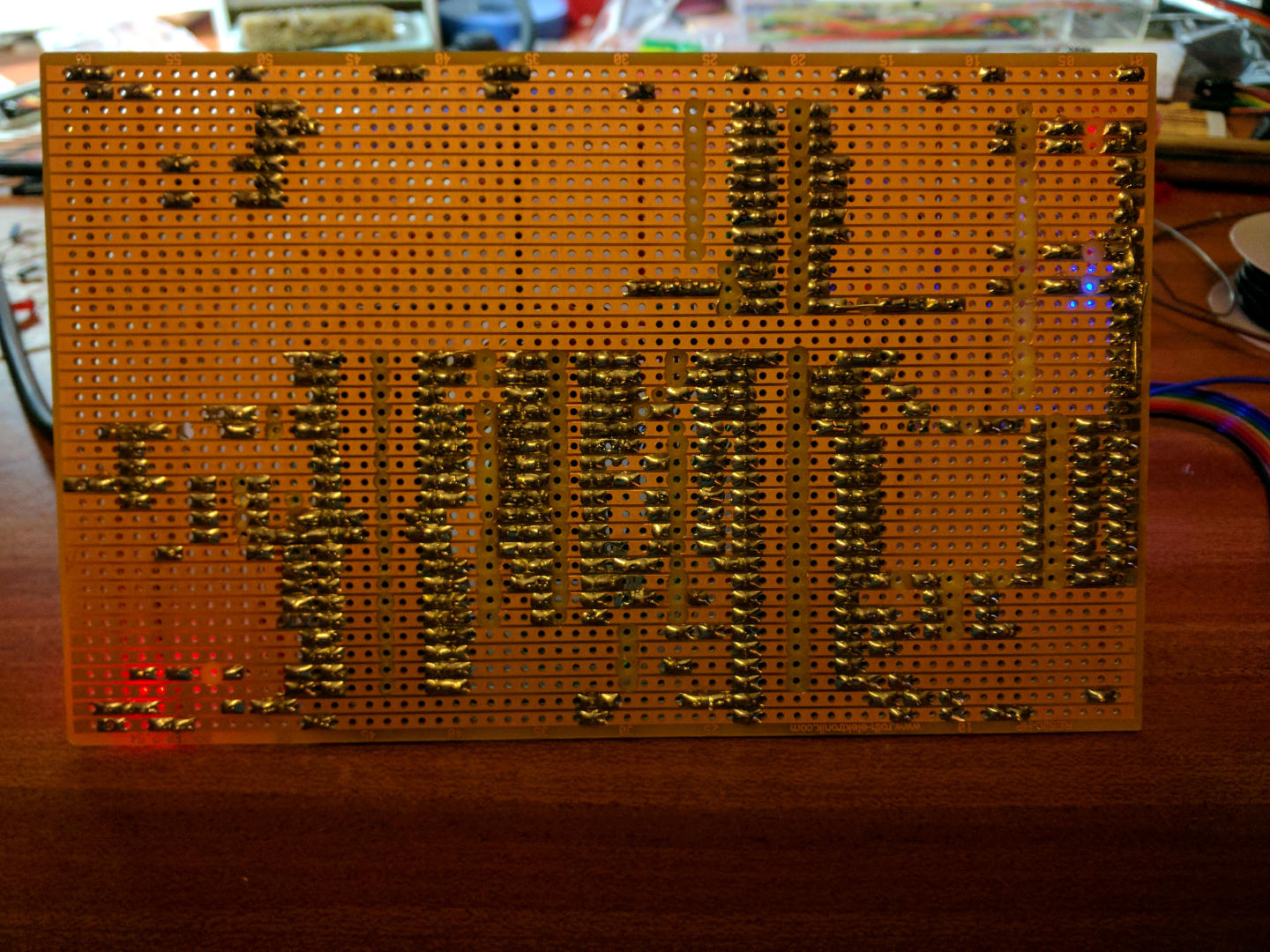
Cheers,
-Gordon
--
Gordon Henderson.
See my Ruby 6502 and 65816 SBC projects here: https://projects.drogon.net/ruby/
Gordon Henderson.
See my Ruby 6502 and 65816 SBC projects here: https://projects.drogon.net/ruby/
Re: Prototype Construction Tips
drogon wrote:
The last wire-wrap 6502 I did was on RS part number: 435-434
For Eurocard size boards from RS, I'd be using the RE060-HP or RE200-HP boards at about 1/5 of the price.
Re: Prototype Construction Tips
Martin A wrote:
drogon wrote:
The last wire-wrap 6502 I did was on RS part number: 435-434
For Eurocard size boards from RS, I'd be using the RE060-HP or RE200-HP boards at about 1/5 of the price.
So there you go - just knowing the right name is half the battle - search for perfboard- nothing. Ah well.
I'll still use stripboard though - mostly because I have a stack of it here, still...
Cheers,
-Gordon
--
Gordon Henderson.
See my Ruby 6502 and 65816 SBC projects here: https://projects.drogon.net/ruby/
Gordon Henderson.
See my Ruby 6502 and 65816 SBC projects here: https://projects.drogon.net/ruby/
-
Mike Naberezny
- Site Admin
- Posts: 294
- Joined: 30 Aug 2002
- Location: Northern California
- Contact:
Re: Prototype Construction Tips
BigDumbDinosaur wrote:
POC V2.2, when it gets built, will use one of the attached for the ROM. It's only slightly larger than a standard DIP-28 × .600" socket.
When I saw this, I immediately thought of "DIP plugs" (like CWR-130-40-0000). They are ribbon cable connectors that plug into a normal DIP socket. They're commonly used with EPROM emulators. A 40-pin DIP plug is also used on the Commodore SuperPET. That computer consists of a normal Commodore 8032 board and a large expansion board. The expansion board interfaces to the 8032 board by a ribbon cable that plugs into the 8032 board's 6502 socket with a DIP plug. After I put up my SuperPET pages, a few people asked me if I could fix their SuperPETs and shipped them to me. On two occasions, the DIP plug came loose from the 6502 socket during shipment. If it turns out that the EJECT-A-DIP is mechanically compatible with a DIP plug, that could be a nice upgrade to keep the DIP plug locked in.
- Mike Naberezny (mike@naberezny.com) http://6502.org