

There's a relatively recent tabulation of dev boards at
https://www.joelw.id.au/FPGA/CheapFPGADevelopmentBoards
and JensEP has found a couple on ebay in the $30 range with Xilinx Spartan 6 LX9 chips on board, with USB interface, LEDs and buttons (but no big RAM) - search for Xilinx Spartan 6 XC6SLX9 or similar. At time of writing there are offerings from sellers 'eepizza' and 'cantonelectronic' - see this post which also links to a couple of Altera Cyclone IV boards (EP4CE6.)
Survey of FPGA dev boards
Re: Survey of FPGA dev boards
Enso has made his own board, for sale here.
Grant's MultiComp design is here.
Jason's Matchbox board is here. [As noted below, this has 32-bit wide SRAM, accessible as 16-bit wide but not on a byte boundary - unless you use only half of it or make a more sophisticated memory controller on the FPGA.]
Grant's MultiComp design is here.
Jason's Matchbox board is here. [As noted below, this has 32-bit wide SRAM, accessible as 16-bit wide but not on a byte boundary - unless you use only half of it or make a more sophisticated memory controller on the FPGA.]
Last edited by BigEd on Tue Nov 03, 2015 10:16 am, edited 1 time in total.
Re: Survey of FPGA dev boards
Ed,
Although the Matchbox board has a 32-bit RAM interface, it is implemented with a pair of 16-bit SRAMs, with the same control signals (CS, OE, WE, UBS, LBS) going to each SRAM,
This unfortunately means that byte writes are not possible, making it harder to implement 32 bit processors.

I did ask Jason if it was possible to fix this in the next manufacturing run, but the board is too tightly packed to change this without pretty much starting again.
Dave
Although the Matchbox board has a 32-bit RAM interface, it is implemented with a pair of 16-bit SRAMs, with the same control signals (CS, OE, WE, UBS, LBS) going to each SRAM,
This unfortunately means that byte writes are not possible, making it harder to implement 32 bit processors.
I did ask Jason if it was possible to fix this in the next manufacturing run, but the board is too tightly packed to change this without pretty much starting again.
Dave
Last edited by hoglet on Wed Nov 04, 2015 7:36 am, edited 1 time in total.
Re: Survey of FPGA dev boards
Interesting limitation, noted. (We should start a new thread if we're to embark on a discussion about more sophisticated memory interfaces.)

Re: Survey of FPGA dev boards
At the risk of being perceived as a self-promoting ***hole, I would like to mention that OberonStation does it right. All the control signals of the two SRAMS are brought to separate FPGA pins, allowing for clean 32-bit with byte access, 16-bit or 8-bit operation. It feels good to do something right, at least once in a while -- I was tempted to save a few wires at one point...
In theory, there is no difference between theory and practice. In practice, there is. ...Jan van de Snepscheut
Re: Survey of FPGA dev boards
I mentioned in the DIP-format FPGA board thread that there is now an open source toolchain for Lattice FPGAs. Here are a couple of dev boards with Lattice parts:
The myStorm is an FPGA+ARM with lots of 5V-tolerant I/O and a Pi-friendly stackability, a project in progress and expected within a couple of months:
https://folknologylabs.wordpress.com/20 ... /#comments
https://hackaday.io/project/12930-mysto ... -dev-board
Will maybe be about $30
The Lattice iCEstick FPGA Evaluation Kit is a little board with USB connector and 16 DIP-ish 3V I/Os:
http://www.latticesemi.com/icestick
http://www.mouser.co.uk/new/Lattice-Sem ... stick-kit/
About $15
The myStorm is an FPGA+ARM with lots of 5V-tolerant I/O and a Pi-friendly stackability, a project in progress and expected within a couple of months:
https://folknologylabs.wordpress.com/20 ... /#comments
https://hackaday.io/project/12930-mysto ... -dev-board
Will maybe be about $30
The Lattice iCEstick FPGA Evaluation Kit is a little board with USB connector and 16 DIP-ish 3V I/Os:
http://www.latticesemi.com/icestick
http://www.mouser.co.uk/new/Lattice-Sem ... stick-kit/
About $15
Re: Survey of FPGA dev boards
Very nearly ready to purchase, the ZX-Uno retro emulation platform, which looks like an FPGA/RAM/video/audio dev board with an expansion port.
Links and details at
http://stardot.org.uk/forums/viewtopic. ... 00#p144000
(The expansion port has a rather unusual layout, and is almost certainly not 5V tolerant. The RAM is byte width. The VGA signals are on a non-standard pinout.)
Links and details at
http://stardot.org.uk/forums/viewtopic. ... 00#p144000
Quote:
ZX-Uno should be available in September 2016 at a price of ~70EUR Paypal.
Quote:
FPGA Xilinx Spartan XC6SLX9-2TQG144C
Static Memory 512Kb, AS7C34096A-10TIN
Slot for SD Cards
Expansion port with 3 male pin strips
Micro-USB power connector
PCB Size: 86x56 mm. (Compatible with Raspberry Pi 1 cases although some machining is needed).
Static Memory 512Kb, AS7C34096A-10TIN
Slot for SD Cards
Expansion port with 3 male pin strips
Micro-USB power connector
PCB Size: 86x56 mm. (Compatible with Raspberry Pi 1 cases although some machining is needed).
Re: Survey of FPGA dev boards
Rob mentioned the CMOD A7 in another thread - it's a 48-pin breadboardable module, with a choice of two rather new Xilinx FPGAs - up from our usual Spartan 6 to the Artix 7 generation and with 10k or 20k 6-input LUTs. It's programmable over USB, and has 512kByte of 8nS SRAM (fast, but only 8 bits wide) - the FPGA also has up to 200kByte (Xilinx pdf) of on-chip RAM.
It can be powered by USB or by the pins, with 3V3 or 5V supply (PDF datasheet), but as is now normal the I/Os are not 5V tolerant.
Seems to be $75 or so.
(One thing about the newer FPGAs from Xilinx is that you can no longer use the ISE software, you have to use the Vivado software - both available at no cost but I'm not sure how usable and reliable Vivado is, especially from the command line.)
6502.org wrote:
It can be powered by USB or by the pins, with 3V3 or 5V supply (PDF datasheet), but as is now normal the I/Os are not 5V tolerant.
Seems to be $75 or so.
(One thing about the newer FPGAs from Xilinx is that you can no longer use the ISE software, you have to use the Vivado software - both available at no cost but I'm not sure how usable and reliable Vivado is, especially from the command line.)
-
jac_goudsmit

- Posts: 229
- Joined: 23 Jun 2011
- Location: Rancho Cucamonga, California
- Contact:
Re: Survey of FPGA dev boards
BigEd wrote:
(One thing about the newer FPGAs from Xilinx is that you can no longer use the ISE software, you have to use the Vivado software - both available at no cost but I'm not sure how usable and reliable Vivado is, especially from the command line.)
Vivado does have a command line interface (a Tcl interpreter; I think Quartus has one too) and it can import ISE projects no problem, as far as I can tell.
(All the above was based on a few evenings of tinkering with the Digilent Arty with the P1V (Virtual Propeller) design by Parallax. https://github.com/JacGoudsmit/P1V).
===Jac
Re: Survey of FPGA dev boards
Thanks! I remember when ISE was deprecated and Vivado arrived there was much distress. Hopefully it's much better now than when introduced.
Re: Survey of FPGA dev boards
jac_goudsmit wrote:
(All the above was based on a few evenings of tinkering with the Digilent Arty with the P1V (Virtual Propeller) design by Parallax. https://github.com/JacGoudsmit/P1V).
===Jac
===Jac
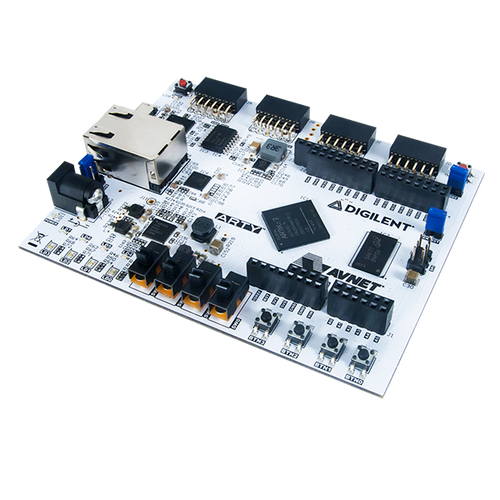
Quote:
- 33,280 logic cells in 5200 slices (each slice contains four 6-input LUTs and 8 flip-flops);
1,800 Kbits of fast block RAM;
90 DSP slices;
Internal clock speeds exceeding 450MHz;
Programmable over JTAG and Quad-SPI Flash
256MB DDR3L with a 16-bit bus @ 667MHz
16MB Quad-SPI Flash
Powered from USB or any 7V-15V source
10/100 Mbps Ethernet
USB-UART Bridge
(I did previously buy a board with a ChipScope voucher - haven't used the resulting licence but at least I have it.)

Re: Survey of FPGA dev boards
That Arty board looks quite capable for a reasonable price.
Re: Survey of FPGA dev boards
It certainly does! The DDR3L seems a bit intimidating to me, but perhaps not to you! (The reference implies you can use a supplied interface module to get to an AXI4 (AMBA) interface, so perhaps that's fine.)
Re: Survey of FPGA dev boards
The DDR3 would be very intimidating if I had to interface it myself, but having working hardware and a Xilinx wizard to do the critical bits inside the FPGA makes it a lot easier.