Hi Norby,
first let me elaborate on the last point. Here a drawing on which I base the explanation
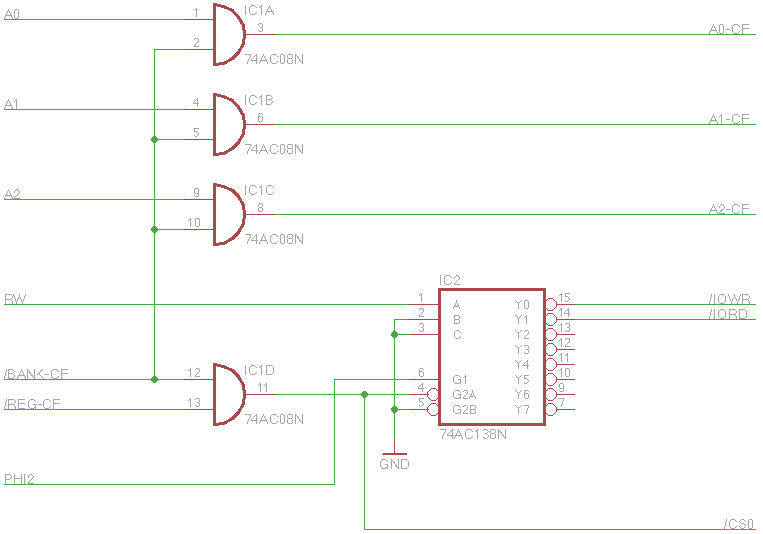
- Fake a DMA using one Bank
- DMA-Fake.png (8.9 KiB) Viewed 2292 times
/REG-CF is the normal select signal to access the registers of the IDE Task File and is only asserted (low) when you normally access the registers in PIO mode. The /BANK-CF is asserted whenever you want to access the DATA Register. /BANK-CF is asserted for one entire bank, but due to the AND gates whatever address within the bank is accessed it always selects the Data register of the Task File. So you can use the MVN or MVP instructions to transfer the sector buffer to/from memory.
As for busses in Eagle I used them, but only for signals with suffixes, so I named the Bus like A[0..15]. But did not know you can specify a free list of signal names, separated with comma, and even mix and match both, signals with suffixes and individual names in one bus. That's really a cool feature. Then together with the labels it makes even a complex schematic neat and clean. Thanks for the hint.
I did not find the time to redraw all signals and busses using your trick. But nevertheless, so you don't have to wait too long, here the preliminary drawings of my design
First the core with the CPU, Memory, Keyboard, DP-RAM (Video), Clock and Reset circuit
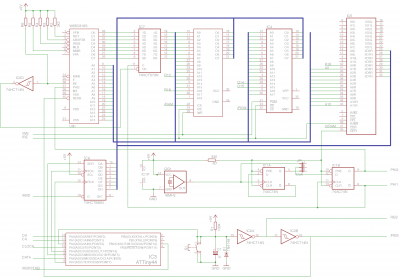
- SBBC Main Parts
As next follows decoder, the internal IO required to emulate the Apple II and other logic packed into GALs
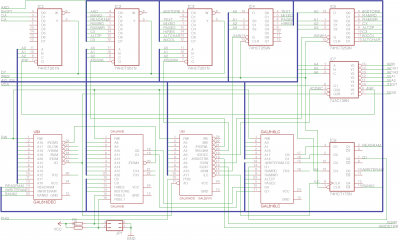
- SBBC Internal IO
And the last drawing contains the IO connected to the IO Extension slot
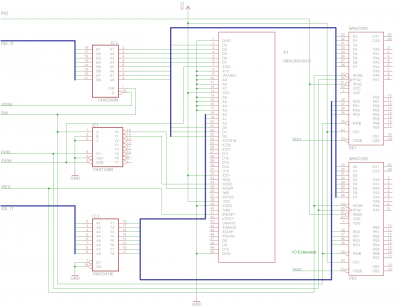
- SBBC External IO (IO Expansion Bus)
The two SC2691 (UART) are not drawn yet, but are not required to get an idea of my design. I use GALs instead of a CPLD (I have not yet jumped into this cold water) and as it is at the moment they are used very inefficiently. You could achieve the same result with just 3 GALs. This is mainly because I built the SBBC step by step before I had the final design and made many design changes during the soldering sessions. However it does have all the features I wanted it to have from the beginning. These were PS/2 Keyboard, VGA Display and a mode that emulates an Apple IIe. E.g. I never wanted to decode the full 16Mbyte address space (I need only 512kbyte RAM). Even better, instead of a real 16-bit IDE I use the CF-Cards in 8-bit IDE mode which made the interface a piece of cake.
Regards
Peter


 , the first sheet with the CPU is done thanks to your library. In the meantime I found the time to read through the Eagle handbook so I started to do my own devices, e.g. my GALs. Regarding Eagle, I see that you have a BUS throughout your schematic, I suppose you have not really defined the BUS with the names of all signals? Is that correct? So you just draw a connection to it without having it really connected to it. Also I have gone through your newest design, looks good. I suggest that you use the unused FF in the 74AC74 as an optional pre-scaler. I.e. the second FF always divides the oscillator clock by 2 and you can optionally select the output of this FF or the oscillator as the input of the FF that generates PHI1 and PHI2. So in case you suspect the clock speed as the reason for a failure you always can select half the clock without changing the design. Furthermore I always find it a good idea to have some RAM with battery backup, so you can "park" some handwritten code during the debugging of the ROM. I did not do so in my SBBC case, but now after having the IDE CF-Card interface up and running it would have saved me a lot of time (especially friday I was chasing some problems which at the end were all caused by typing errors in the source code (labels) and spontaneous changes in parts of code that affected code run afterwards.