

In this earlier post I mentioned some dev boards I knew about.
I see now that there's a list up on the gameduino site which they intend to keep up to date.
Edit: much more up to date, this survey. Thanks to Dave for that.
Boards mentioned there range from $40 to $200. (For some you might need a programming cable at extra cost.)
Edit: Also Enterpoint make dev boards and FPGA modules, and OHO make FPGA modules (also here and here)
Also worth looking out for spartan 6 products which seem to offer twice the performance of spartan 3. See this post further down.
Edit: a more recent thread on DIP format boards:
viewtopic.php?f=10&t=4217
Survey of FPGA dev boards
Survey of FPGA dev boards
Last edited by BigEd on Wed Aug 03, 2016 9:13 pm, edited 4 times in total.
-
ElEctric_EyE
- Posts: 3260
- Joined: 02 Mar 2009
- Location: OH, USA
Hah, I thought you forgot about this BigEd.
But then, I see you let someone else do all the work for you!
More people, hobbyists in particular need to start learning HDL at the earliest stages. I say hobbyists, because we are the ones who do it out of love for the challenge. Not just because it's a 9-5 job. And look at me, I am stuck on schematic usage, because it is what I have learned first.
These boards, and mine, are great tools to becoming masters of the digital age. They are like the Radio Shack 500-in-1 electronic kits of old, except much, much more potent.
But then, I see you let someone else do all the work for you!
More people, hobbyists in particular need to start learning HDL at the earliest stages. I say hobbyists, because we are the ones who do it out of love for the challenge. Not just because it's a 9-5 job. And look at me, I am stuck on schematic usage, because it is what I have learned first.
These boards, and mine, are great tools to becoming masters of the digital age. They are like the Radio Shack 500-in-1 electronic kits of old, except much, much more potent.
Great analogy - I had one of those, but probably only 100-in-1. In Europe at least, there was also a Philips EE education kit series, which involved spring-fixings for wires in a hardboard substrate. It made the circuit match the circuit diagram nicely, and had rather a good instruction book, which dealt with all sorts of topics beyond the kit's immediate capability.
I hankered after a denshi block kit but never had one - I see you can still get them.
(All very off-topic and more fitting to the nostalgia section...)
Back on topic, that page with the dev boards links to a nice getting-started page with links to HDL resources.
I hankered after a denshi block kit but never had one - I see you can still get them.
(All very off-topic and more fitting to the nostalgia section...)
Back on topic, that page with the dev boards links to a nice getting-started page with links to HDL resources.
BigEd wrote:
In Europe at least, there was also a Philips EE education kit series, which involved spring-fixings for wires in a hardboard substrate. It made the circuit match the circuit diagram nicely, and had rather a good instruction book, which dealt with all sorts of topics beyond the kit's immediate capability.
André
Edit: sorry for getting off topic ... just igore or open a new thread :-)
One of the blogs I'm following is dangerousprototypes.com and this post is important on creating video with FPGA's:
http://dangerousprototypes.com/2011/03/ ... and-fpgas/
They are working on CoolRunner II and XC9500XL CPLD development boards and they will probably end up on Seeedstudio.com for sale.
http://dangerousprototypes.com/docs/CPL ... _tutorials
You can also download the CPLD application handbook from Xilinx. I'll be reading the blog to see what they are doing.
http://dangerousprototypes.com/2011/03/ ... -handbook/
There are a lot of devices out there and these won't be the last but I'm trying to find the best suitable hardware.
http://dangerousprototypes.com/2011/03/ ... and-fpgas/
They are working on CoolRunner II and XC9500XL CPLD development boards and they will probably end up on Seeedstudio.com for sale.
http://dangerousprototypes.com/docs/CPL ... _tutorials
You can also download the CPLD application handbook from Xilinx. I'll be reading the blog to see what they are doing.
http://dangerousprototypes.com/2011/03/ ... -handbook/
There are a lot of devices out there and these won't be the last but I'm trying to find the best suitable hardware.
This is good info: do you think it's worth a new topic 'Survey of video circuits'? (Not strictly 6502-related, but so long as it's applicable to 6502)
There's a note on the gameduino site about monochrome VGA using just two resistors and an FPGA, and several mentions of different approaches in previous threads.
(Feel free to start the topic!)
There's a note on the gameduino site about monochrome VGA using just two resistors and an FPGA, and several mentions of different approaches in previous threads.
(Feel free to start the topic!)
-
BitWise

- In Memoriam
- Posts: 996
- Joined: 02 Mar 2004
- Location: Berkshire, UK
- Contact:
Some more links on video generation that people might find interesting here:
http://www.microchip.com/forums/tm.aspx?m=385013
http://www.microchip.com/forums/tm.aspx?m=385013
Andrew Jacobs
6502 & PIC Stuff - http://www.obelisk.me.uk/
Cross-Platform 6502/65C02/65816 Macro Assembler - http://www.obelisk.me.uk/dev65/
Open Source Projects - https://github.com/andrew-jacobs
6502 & PIC Stuff - http://www.obelisk.me.uk/
Cross-Platform 6502/65C02/65816 Macro Assembler - http://www.obelisk.me.uk/dev65/
Open Source Projects - https://github.com/andrew-jacobs
Re: Survey of FPGA dev boards
BigEd wrote:
In this earlier post I mentioned some dev boards I knew about.
http://www.digilentinc.com/Products/Det ... od=S3BOARD
It has 1 MB of SRAM which is a lot of memory.
xilinx spartan 6 dev boards
elsewhere: We've since found a couple of possibilities for less outlay:
Enterpoint's Drigmorn3 for $270 / EUR200 / GBP160
Features:
Features:
Features:
Like the LX9, but
Arlet wrote:
Yeah, too bad I don't have a Spartan-6 board.... Digilent has one, but it's $349, which is a bit on the high side.
Enterpoint's Drigmorn3 for $270 / EUR200 / GBP160
Features:
- spartan6 LX16
40 i/o which are 5V tolerant
20 i/o at 3.3V
an LCD
USB
ethernet
16bit wide SDRAM
memory card interface
PS/2 connectors

Features:
- Includes SDK and ChipScope license (on-FPGA logic analyser)
Spartan-6 XC6SLX9-2CSG324C FPGA (has 32 block RAMs, 2kbyte each)
64 MB LPDDR SDRAM (16-bit wide)
128 Mb Multi-I/O SPI Flash
10/100 Ethernet PHY
USB-to-UART port
On-board USB JTAG circuitry
Two 2x6 PMOD expansion ports, each giving 8 general purpose I/Os
Single-chip, 3-rail power with Power Good indicator
Programmable clock chip, initially setup for 40, 67 and 100MHz
Features:
Like the LX9, but
- minus ChipScope license
plus LCD,
plus more I/O
plus 8051 on board
plus some windows-only configuration utility ?!
plus battery-powered possibility (on-board Li-ion cell)
Mixed news from Xess - they've discontinued their cheapest offering, but the now-cheapest is reduced to $55. It's a 40-pin module with a 16-bit wide SDRAM onboard - and the whole design is open source (including SDRAM controller). Downsides: it's 3.3v I/O, it's spartan3 generation, and postage costs will make it less cheap to those outside North America.
BigEd wrote:
Mixed news from Xess - they've discontinued their cheapest offering, but the now-cheapest is reduced to $55. It's a 40-pin module with a 16-bit wide SDRAM onboard - and the whole design is open source (including SDRAM controller). Downsides: it's 3.3v I/O, it's spartan3 generation, and postage costs will make it less cheap to those outside North America.
(Edit: I now see this Altera board I've just 'discovered' is in fact mentioned already in the compendium linked in the head post. Ah well.)
I'm stuck into Xilinx tools and parts, but I've just come across this $49 dev kit based on an Altera FPGA, with a high-density 80-way edge connector with perhaps 60 I/Os from the FPGA:
(16-bit wide RAM, USB-connected, offering a serial interface.)
Here are the lab notes (pdf) for a small system on chip.
Like Xilinx, Altera have a free tool set for windows and linux.
I'm stuck into Xilinx tools and parts, but I've just come across this $49 dev kit based on an Altera FPGA, with a high-density 80-way edge connector with perhaps 60 I/Os from the FPGA:
6502.org wrote:
(16-bit wide RAM, USB-connected, offering a serial interface.)
Here are the lab notes (pdf) for a small system on chip.
Like Xilinx, Altera have a free tool set for windows and linux.
Re: Survey of FPGA dev boards
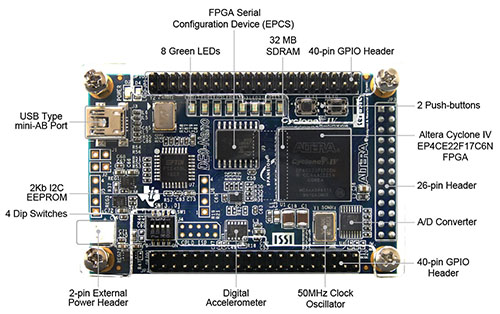
John Kortink ('windfall' here) has brought the Terasic DE0-Nano board to our attention: it's Altera based, with a 32MByte SDRAM on a 16-bit wide bus, total of 72 GPIO on two 40-pin connectors.
It's USB-powered at 5V but the I/Os are 3V3. One of the demos in the User Manual (pdf) has the memory clocking at 100MHz.
http://www.digikey.co.uk/product-detail ... ND/2625112
http://uk.farnell.com/jsp/search/produc ... ku=2076463
It's USB-powered at 5V but the I/Os are 3V3. One of the demos in the User Manual (pdf) has the memory clocking at 100MHz.
http://www.digikey.co.uk/product-detail ... ND/2625112
http://uk.farnell.com/jsp/search/produc ... ku=2076463
Re:
BigEd wrote:
Like Xilinx, Altera have a free tool set for windows and linux.
"32 bit Intel executables? That's /so/ 20th Century..."