
Ed, you're right. The monitor can't just simply spit out characters, although it does at times, if it's going to scroll up and down.
So I've searched HESMON with regard to video matrix pointer ($D018, bits 4-7), the default video matrix area is @$0400. HESMON stores a #$17, which bit 4 does not change the default for using $0400.
My zero page blockRAM covers the bottom 4K. So this is good for compatibility as the C-64 40x25 video matrix will be from $0000_0400-$0000_07E7. That will be 40 characters across at 16bits each and 25 characters down at 16bits each, i.e. 640x400. That will leave 40x5 (640x80) at the bottom of the screen that will be available for some "stuff".
As for HESMON, it originally resided @$0000_C000-$0000_CFFF. I will have to move it to $FFFF_C000-$FFFF_CFFF. Next step is to find all references to $Cxxx (for variables and such) within the program, as I will have to manually change them to $FFFF_Cxxx. As65 (I'll refer to Bitwises' 65Org16 assember as As65 from here on out) will want to convert those addresses to $0000_Cxxx.
Software for the 65Org16.x (formerly 6502 SoC Project)
-
ElEctric_EyE
- Posts: 3260
- Joined: 02 Mar 2009
- Location: OH, USA
I found only 1 instance in the original HESMON code where it stores a value within it's own boundary and it's strange. It stores a #$20 and changes an opcode from a JMP to a JSR, and there is no other instance to change it back to a JMP...
When I get closer to tearing apart this code I'll be keeping my eye open for an indirect indexed pointing to $0400.
Now I am off to commenting all JMP's and JSR's to external routines. Most are Kernal, just a few branches to Basic.
EDIT: Looking at the last page of the 1982 Owner's Manual I find some useful info:
When I get closer to tearing apart this code I'll be keeping my eye open for an indirect indexed pointing to $0400.
Now I am off to commenting all JMP's and JSR's to external routines. Most are Kernal, just a few branches to Basic.
EDIT: Looking at the last page of the 1982 Owner's Manual I find some useful info:
Code: Select all
HESMON uses 33 bytes near the bottom of the machine stack ($120-$141) for its variable storage.-
teamtempest
- Posts: 443
- Joined: 08 Nov 2009
- Location: Minnesota
- Contact:
Quote:
I found only 1 instance in the original HESMON code where it stores a value within it's own boundary and it's strange. It stores a #$20 and changes an opcode from a JMP to a JSR, and there is no other instance to change it back to a JMP...
When I get closer to tearing apart this code I'll be keeping my eye open for an indirect indexed pointing to $0400.
Now I am off to commenting all JMP's and JSR's to external routines. Most are Kernal, just a few branches to Basic.
When I get closer to tearing apart this code I'll be keeping my eye open for an indirect indexed pointing to $0400.
Now I am off to commenting all JMP's and JSR's to external routines. Most are Kernal, just a few branches to Basic.
If in cartridge ROM form HESMON does map itself into where the 4K RAM block normally appears at $C000-$CFFF then essentially there would be no RAM at all visible from $A000-$FFFF. It's all ROMs and I/O.
Dunno exactly why a ROM cartridge would want to replace a JMP with a JSR, but maybe that was a later addition after the ROM was downloaded. Or some kind of self-test, perhaps.
You might check to see whether the code plays around with memory location $1, the memory mapping "register".

ElEctric_EyE wrote:
I found only 1 instance in the original HESMON code where it stores a value within it's own boundary and it's strange. It stores a #$20 and changes an opcode from a JMP to a JSR, and there is no other instance to change it back to a JMP...
-
ElEctric_EyE
- Posts: 3260
- Joined: 02 Mar 2009
- Location: OH, USA
I must've had too many windows open when I said HESMON was replacing a $4C (JMP) with a $20 (JSR). After looking at it again, it is storing a $20 where a $20 already is... Still a curiousity but I don't have time for it right now.
It does store a #$37 at location $01, enabling Basic, Kernal ROMs and I/O. Also this is an image that I stored years ago on a C64 5 1/4" floppy right alongside of Micromon. I'm not sure how I got it, although I think I typed it in from Compute! or Compute's Gazette and the image does work in VICE.
...I have only to make a separate table for the text strings and opcodes, and As65 will be able to assemble it and create the .bin for the bin2coe to create the ROM. Then I'll try substituting 2 routines with 2 of mine, namely character in and character out, and maybe will see some sort of life.
__________________________________________________________________________________________________________________________
In the meantime today I spent a greater portion trying to figure out a problem I am having with my ATTBUTE routine. It involves using a LDA COLTABLE,X. COLTABLE=$FFFFC980. The original code does not work. It's plotting all zero values. I've tried replacing the label with the actual address, also tried changing the address to $FFFFE000 (middle of nowhere within 16K blockRAM) with no luck...
Today, I found out what does work: If I replace LDA COLTABLE,X with LDA COLTABLE, LDA COLTABLE+1, LDA COLTABLE+2 it does lookup and plot the correct color, so no problem with blockRAM (there was one with 8Kx16). I'm thinking there's a problem with the 65Org16 core using Absolute Indexed with X. I will double check this against Arlet's original...
BTW, when it comes time to make room for HESMON and original zero page variables, I will be moving my routines from $FFFFC000 to $FFFFD000 and moving all my zero page variables to $00000100. Posting this now makes me realize I need to re-allocate all original stack variables from $0100-$01FF to $00010000-$0001FFFF...
teamtempest wrote:
...It's all ROMs and I/O...You might check to see whether the code plays around with memory location $1, the memory mapping "register".
...I have only to make a separate table for the text strings and opcodes, and As65 will be able to assemble it and create the .bin for the bin2coe to create the ROM. Then I'll try substituting 2 routines with 2 of mine, namely character in and character out, and maybe will see some sort of life.
__________________________________________________________________________________________________________________________
In the meantime today I spent a greater portion trying to figure out a problem I am having with my ATTBUTE routine. It involves using a LDA COLTABLE,X. COLTABLE=$FFFFC980. The original code does not work. It's plotting all zero values. I've tried replacing the label with the actual address, also tried changing the address to $FFFFE000 (middle of nowhere within 16K blockRAM) with no luck...
Code: Select all
ATTBUTE     LDA CHRATTR	      ;get color from bits 0,1,2,3
	          AND #$000F
	          ASL A
	          ASL A		          ;multiple by 4 for easy indexing
	          TAX
	          LDA COLTABLE,X
	          STA PXLCOL1
	          INX
	          LDA COLTABLE,X
	          STA PXLCOL2
	          INX
	          LDA COLTABLE,X
STA PXLCOL3BTW, when it comes time to make room for HESMON and original zero page variables, I will be moving my routines from $FFFFC000 to $FFFFD000 and moving all my zero page variables to $00000100. Posting this now makes me realize I need to re-allocate all original stack variables from $0100-$01FF to $00010000-$0001FFFF...
-
ElEctric_EyE
- Posts: 3260
- Joined: 02 Mar 2009
- Location: OH, USA
ElEctric_EyE wrote:
...In the meantime today I spent a greater portion trying to figure out a problem I am having with my ATTBUTE routine. It involves using a LDA COLTABLE,X. COLTABLE=$FFFFC980. The original code does not work. It's plotting all zero values. I've tried replacing the label with the actual address, also tried changing the address to $FFFFE000 (middle of nowhere within 16K blockRAM) with no luck...
I am observing an opcode $B5 (LDA ZP,x) when it should be an opcode $BD (LDA a,x). Bitwise, please help!
-
BitWise

- In Memoriam
- Posts: 996
- Joined: 02 Mar 2004
- Location: Berkshire, UK
- Contact:
Is address argument to the LDX ...,X an external symbol or a constant value?
You can insert a '|' or '!' before the address to force the assembler to generate an ABS,X mode rather a ZP,X
For example LDA |$80,X should generate BD 80 00 instead of B5 80. The same should work for the 65Org16 mode.
You can insert a '|' or '!' before the address to force the assembler to generate an ABS,X mode rather a ZP,X
For example LDA |$80,X should generate BD 80 00 instead of B5 80. The same should work for the 65Org16 mode.
Andrew Jacobs
6502 & PIC Stuff - http://www.obelisk.me.uk/
Cross-Platform 6502/65C02/65816 Macro Assembler - http://www.obelisk.me.uk/dev65/
Open Source Projects - https://github.com/andrew-jacobs
6502 & PIC Stuff - http://www.obelisk.me.uk/
Cross-Platform 6502/65C02/65816 Macro Assembler - http://www.obelisk.me.uk/dev65/
Open Source Projects - https://github.com/andrew-jacobs
-
ElEctric_EyE
- Posts: 3260
- Joined: 02 Mar 2009
- Location: OH, USA
Thanks for a quick response  Not an LDX...,X. It is an LDA ...,X.
Last test I used a constant of $FFFFE000,X no labels... Instead of translating the LDA $FFFFE000,X to a 00BD, FFFF, E000; it is translating it to 00B5,E000 according to my hex editor.
BitWise wrote:
Is address argument to the LDX ...,X an external symbol or a constant value?...
Last test I used a constant of $FFFFE000,X no labels... Instead of translating the LDA $FFFFE000,X to a 00BD, FFFF, E000; it is translating it to 00B5,E000 according to my hex editor.
-
ElEctric_EyE
- Posts: 3260
- Joined: 02 Mar 2009
- Location: OH, USA
I've done some more digging into the original 8bit C-64 Hashmon code...
Using VICE C-64 emulator on PC and running the Hashmon code is proving invaluable. I instantly found the main loop using the VICE monitor. It starts @ $C24D and is a very short loop with just a few other JSRs JMP's that branch out. I still need to follow these to their ends, but right now I am aiming for a startup screen that jives with the original Hashmon. This will at least prove my output character routine is sufficient. Also, I've found within the main loop, Hashmon reads characters typed in from the keyboard stored at $39.
There are 2 Indirect JMP's within the 4K worth of code which concern me:
a JMP ($00C1), and a JMP ($0120). I will figure them out eventually.
I found the Indirect Indexed screen matrix pointer @$D1, $D2. Directly related is the $F3, $F4 Indirect Indexed pointer to screen color RAM. These are some of the "constant" variables which are very important. Not so much the screen color RAM though.
I am finding there is alot I would like to delete from the original code. Maybe trim it to 1/2 the size it is. No need for tape storage etc... Alot of variables saved for basic and kernal, which are not needed here.
Using VICE C-64 emulator on PC and running the Hashmon code is proving invaluable. I instantly found the main loop using the VICE monitor. It starts @ $C24D and is a very short loop with just a few other JSRs JMP's that branch out. I still need to follow these to their ends, but right now I am aiming for a startup screen that jives with the original Hashmon. This will at least prove my output character routine is sufficient. Also, I've found within the main loop, Hashmon reads characters typed in from the keyboard stored at $39.
There are 2 Indirect JMP's within the 4K worth of code which concern me:
a JMP ($00C1), and a JMP ($0120). I will figure them out eventually.
I found the Indirect Indexed screen matrix pointer @$D1, $D2. Directly related is the $F3, $F4 Indirect Indexed pointer to screen color RAM. These are some of the "constant" variables which are very important. Not so much the screen color RAM though.
I am finding there is alot I would like to delete from the original code. Maybe trim it to 1/2 the size it is. No need for tape storage etc... Alot of variables saved for basic and kernal, which are not needed here.
-
ElEctric_EyE
- Posts: 3260
- Joined: 02 Mar 2009
- Location: OH, USA
BitWise wrote:
...You can insert a '|' or '!' before the address to force the assembler to generate an ABS,X mode rather a ZP,X
For example LDA |$80,X should generate BD 80 00 instead of B5 80. The same should work for the 65Org16 mode.
For example LDA |$80,X should generate BD 80 00 instead of B5 80. The same should work for the 65Org16 mode.
-
ElEctric_EyE
- Posts: 3260
- Joined: 02 Mar 2009
- Location: OH, USA
I've come across 6 instances like the one below. These are the last inconsistencies I have left before fully translating HESMON from 8bit 6502 to 16bit 65Org16. This example below is a pic taken from VICE running the original HESMON image and disassembling itself. This is just abit of some tricky coding here. Check out the BEQ's. Almost like the BIT $3AE6 ($2C, $E6, $3A)is non function
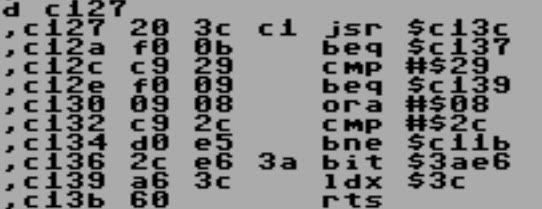 When the CPU sees a BEQ $C137, it looks like this:

Code: Select all
eC127:
          	JSR eC13C
          	BEQ eC137
          	CMP #$29
          	BEQ eC139
          	ORA #$08
          	CMP #$2C
          	BNE eC11B
          	BIT $3AE6
eC139:
          	LDX $3C
RTS-
teamtempest
- Posts: 443
- Joined: 08 Nov 2009
- Location: Minnesota
- Contact:
Quote:
I've come across 6 instances like the one below
-
ElEctric_EyE
- Posts: 3260
- Joined: 02 Mar 2009
- Location: OH, USA
-
ElEctric_EyE
- Posts: 3260
- Joined: 02 Mar 2009
- Location: OH, USA
Thinking back to the equivalent $FFD2 CHROUT routine on the C-64, I think I've got my routine down pretty close. And thanks to TeamTempest for contributing.
Sorry for the length, but I have now incorporated the PLTPOS and ATTBUTE routines within the PLTCHR routine. Plot Enable is now a bit value...
Also, all 16bits of the databus are used to define a character for the 8bit video TFT. The bit placements are commented within the assembly. Simply put, the lower 7 bits define the ASCII character, and bits 8thru15 are character plot enable, size, color and font attributes (1,3,4, & 1 bits respectively)...
The PLTCHR routine still needs just abit of final fine tuning to detect when to increment the Y Plot value, after reaching max X with variable character sizes, in order to continue plotting to the second and consecutive lines. Working...
I thought I would post the code now, even though it is incomplete, in order to show how many ASLs and LSR's are needed.
Sorry for the length, but I have now incorporated the PLTPOS and ATTBUTE routines within the PLTCHR routine. Plot Enable is now a bit value...
Also, all 16bits of the databus are used to define a character for the 8bit video TFT. The bit placements are commented within the assembly. Simply put, the lower 7 bits define the ASCII character, and bits 8thru15 are character plot enable, size, color and font attributes (1,3,4, & 1 bits respectively)...
The PLTCHR routine still needs just abit of final fine tuning to detect when to increment the Y Plot value, after reaching max X with variable character sizes, in order to continue plotting to the second and consecutive lines. Working...
I thought I would post the code now, even though it is incomplete, in order to show how many ASLs and LSR's are needed.
Code: Select all
PLTCHR      STA CHR           ; Plot Character Subroutine variable (1-7) H and V size
            TYA               ; save all reg's
            PHA
            TXA
            PHA

ATTBUTE     AND #%00000111100000000
	          LSR A             ;get color VALUE from bits 8,9,10,11
            LSR A
            LSR A
            LSR A
            LSR A
            LSR A             ;multiply by 4 for easy indexing
	          TAX
	          LDA COLTABLE,X
	          STA PXLCOL1
	          INX
	          LDA COLTABLE,X
	          STA PXLCOL2
	          INX
	          LDA COLTABLE,X
	          STA PXLCOL3

	          LDA CHR           ;check bits 12,13,14 for size
	          AND #%0111000000000000
	          LSR A
	          LSR A
	          LSR A
	          LSR A
            LSR A
            LSR A
            LSR A
            LSR A
            LSR A
            LSR A
            LSR A
            LSR A		          ;make size 1x through 7x, no size 0!
	          STA XWIDTH
	          STA YWIDTH

	          LDA CHR    	      ;check font bit 15, 1=C64 , 0=3x5
	          AND #%1000000000000000
	          CMP #$8000
	          BEQ n64
            LDA #$08
            STA PATROW
            STA CHRXLEN
            STA CHRYLEN

            LDA #$CA00
            STA CHRBASE
		        LDA #$0080
		        STA SENTINEL
	          JMP porc

n64	        LDA #$04
            STA CHRXLEN
            LDA #$05
            STA PATROW
	          STA CHRYLEN
            LDA #$CD00
            STA CHRBASE
		        LDA #$0800
		        STA SENTINEL

porc        LDA CHR		        ;test PE bit 7 for plot or clear
            AND #%0000000010000000
            CMP #$80
		        BNE plot2
	          LDA SCRCOL1
	          STA TMPCOL1
	          LDA SCRCOL2
	          STA TMPCOL2
	          LDA SCRCOL3
	          STA TMPCOL3
	          JMP PLTPOS
plot2	      LDA PXLCOL1
	          STA TMPCOL1
	          LDA PXLCOL2
	          STA TMPCOL2
	          LDA PXLCOL3
	          STA TMPCOL3

PLTPOS      LDA #$2A          ;set x address
	          STA DCOM
            LDA XPOS
            PHA
            LSR A
            LSR A
            LSR A
            LSR A
            LSR A
            LSR A
            LSR A
            LSR A
            STA DDAT          ;X START MSB
            PLA
            AND #$00FF
            STA DDAT          ;X START LSB

            LDA XPOS
            CLC
            LDX XWIDTH
AC          ADC CHRXLEN
            DEX
            BNE AC
            STA XPOS          ;UPDATE X POSITION
            INC XPOS          ;NEXT CHR WILL GO HERE
            SEC
            SBC #$01
            PHA
            LSR A
            LSR A
            LSR A
            LSR A
            LSR A
            LSR A
            LSR A
            LSR A
            STA DDAT          ;X END MSB
            PLA
            AND #$00FF
            STA DDAT          ;X END LSB

            LDA #$2B          ;set y address
            STA DCOM
	          LDA YPOS
            PHA
            LSR A
            LSR A
            LSR A
            LSR A
            LSR A
            LSR A
            LSR A
            LSR A
            STA DDAT          ;Y START MSB
            PLA
            AND #$00FF
            STA DDAT          ;Y START LSB

            LDA YPOS
            CLC
            LDX YWIDTH
AD          ADC CHRYLEN
            DEX
            BNE AD
            SEC
            SBC #$01
            PHA
            LSR A
            LSR A
            LSR A
            LSR A
            LSR A
            LSR A
            LSR A
            LSR A
            STA DDAT          ;Y END MSB
            PLA
            AND #$00FF
            STA DDAT          ;Y END LSB

CACALC      LDA #$2C          ; Prepare TFT to Plot
            STA DCOM

            LDA CHR
            AND #$7F          ; an ascii char ? - ATTRIBUTE INFO
            CMP #$0D
            BNE nnull
            LDX #$00
            STX XCHRPOS
            INC YCHRPOS
            LDA #$00          ; make undefined char's a defined zero (space character)
nnull       SEC
            SBC #$20
            ASL A             ; * 2
            ASL A             ; * 4
            ASL A             ; * 8
            CLC
            ADC CHRBASE       ; add pointer to base either CA00 (C64)  or CD00(3x5) (carry clear)
            TAY

loop7       LDA XWIDTH        ; plot row repeat count (1-7)
            STA PIXROW
loop4       LDA CHARPIX,Y     ; $FFFFCA00(c64) or $FFFFCD00(3x5)
            ASL A             ;
            ASL A             ;
            ASL A             ;
            ASL A             ;
            ASL A             ;
            ASL A             ;
            ASL A             ;
            ASL A             ; shift out upper 8 bits, don't care for 8-bit byte character font
            ORA SENTINEL      ; $0080 (C64) or $0800 (3x5)

            ASL A             ; get a pixel
loop5       PHA               ; save remaining pixel row data
            LDX YWIDTH        ; plot column repeat count (1-7) (same as PLTHGT?)
            BCC xwnp          ; b: clear ('blank')

xwp         LDA TMPCOL1
            STA DDAT          ; plot RED pixel TFT data
            LDA TMPCOL2
            STA DDAT          ; plot GREEN pixel TFT data
            LDA TMPCOL3
            STA DDAT          ; plot BLUE pixel TFT data
            DEX
            BNE xwp
            BEQ nxtpix        ; b: forced

xwnp        LDA SCRCOL1
            STA DDAT          ; plot RED "blank" pixel TFT data
            LDA SCRCOL2
            STA DDAT          ; plot GREEN "blank" pixel TFT data
            LDA SCRCOL3
            STA DDAT          ; plot BLUE "blank" pixel TFT data
            DEX
            BNE xwnp

nxtpix      PLA               ; get pixel row data back
            ASL A             ; another pixel to plot ?
            BNE loop5         ; b: yes (sentinel still hasn't shifted out)

            DEC PIXROW        ; repeat this row ?
            BNE loop4         ; b: yes

            INY
            DEC PATROW        ; another pattern row to plot ?
            BNE loop7         ; b: yes

            PLA
            TAX
            PLA
            TAY               ;reload reg's
            RTS