
Can anyone explain how the clock circuit works. I can't seem to find Harry The Bastards website anywhere, which supposedly will explain it.
Thanks
Harry The Bastard
-
Nightmaretony
- In Memoriam
- Posts: 618
- Joined: 27 Jun 2003
- Location: Meadowbrook
- Contact:
www.archive.org has it on there, at least the code, dont know bout the rest....
"My biggest dream in life? Building black plywood Habitrails"
-
GARTHWILSON

- Forum Moderator
- Posts: 8773
- Joined: 30 Aug 2002
- Location: Southern California
- Contact:
-
BitWise

- In Memoriam
- Posts: 996
- Joined: 02 Mar 2004
- Location: Berkshire, UK
- Contact:
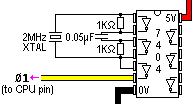
He's referring to this circuit:
Andrew Jacobs
6502 & PIC Stuff - http://www.obelisk.me.uk/
Cross-Platform 6502/65C02/65816 Macro Assembler - http://www.obelisk.me.uk/dev65/
Open Source Projects - https://github.com/andrew-jacobs
6502 & PIC Stuff - http://www.obelisk.me.uk/
Cross-Platform 6502/65C02/65816 Macro Assembler - http://www.obelisk.me.uk/dev65/
Open Source Projects - https://github.com/andrew-jacobs
-
Nightmaretony
- In Memoriam
- Posts: 618
- Joined: 27 Jun 2003
- Location: Meadowbrook
- Contact:
That clock circuit is the standard crystal circuit. It is used on the arcade game Space Invaders. Stable and cheap to make. Basically, it is a simple loop with the signal inverting over one end of the loop to the other in a dynamic way. I dont pretend to understand exactly how it works, though.
http://www.hanssummers.com/radio/penning/index.htm
shows the schematic hand drawn
http://www.hanssummers.com/radio/penning/index.htm
shows the schematic hand drawn
"My biggest dream in life? Building black plywood Habitrails"
-
blackadder
- Posts: 24
- Joined: 20 Mar 2006
Here's a page with some info
http://www.gaby.de/z80/uexosc.htm
http://www.gaby.de/z80/uexosc.htm
It is essentially a 180-degree phase-shift oscillator -- in this configuration, a Colpitts oscillator. The two inverters provide (over-)unity gain for the otherwise analog signal coming from the crystal. The fact that it's over-unity gain means that the signal is being clipped at the Vcc/GND rails -- thus, a digital output. Inside the circuit, however, the crystal acts as a band-pass filter, selecting only the frequency of the desired oscillation. The signal thus fed back to the initial inverter should approximate a real sine wave.
fachat wrote:
Considering that it uses half a '04 and additional board space for a crystal, I'd rather stay with my approach of using a clock generator (available in various frequencies) in a DIL14 case (with only the 4 edge pins used).
That's probably why I didn't catch it...
Andre
That's probably why I didn't catch it...
Andre

Long time C64 user, pro software developer, wanting to get into 6502 hardware as a hobby now that I have settled down a bit in life.
I've been looking at the 65816's datasheet from WDC, and it specifies that the maximum clock slew must be 5ns. Most of the TTL oscillators I see on web stores quote slews of 10ns for the kind of clock speeds the 65816 is normally used at (ie sub-20MHz). Are you using some sort of clock waveform shaping, am I looking at the wrong parts, or is the datasheet a bit too conservative?
Don't bother -- I can already answer this one, since I have built a 65816-based system already.
The answer is, anything slower than 5ns slew on the clock input WILL cause the CPU to perform in a very flakey manner. Expect many crashes, and even memory locations being overwritten randomly. In short, unless you're driving the clock input with F-series logic, don't even think it will work. Because it won't.
It is best to drive the clock input with one of those pre-packaged CMOS clock oscillator cans; most of those already meet the 5ns slew rate requirement (though just barely).
The answer is, anything slower than 5ns slew on the clock input WILL cause the CPU to perform in a very flakey manner. Expect many crashes, and even memory locations being overwritten randomly. In short, unless you're driving the clock input with F-series logic, don't even think it will work. Because it won't.
It is best to drive the clock input with one of those pre-packaged CMOS clock oscillator cans; most of those already meet the 5ns slew rate requirement (though just barely).
-
GARTHWILSON
- Forum Moderator
- Posts: 8773
- Joined: 30 Aug 2002
- Location: Southern California
- Contact:
There's more discussion of the 5ns stuff at:
viewtopic.php?t=646
viewtopic.php?p=5655
viewtopic.php?t=786
although the last one has links to two other discussions that it's now saying don't exist:
http://www.6502.org/forum/viewtopic.php?p=895
http://www.6502.org/forum/viewtopic.php?t=195
so I'd like to find out from Mike what's happening-- what the numbers at the end mean, and if they change.
viewtopic.php?t=646
viewtopic.php?p=5655
viewtopic.php?t=786
although the last one has links to two other discussions that it's now saying don't exist:
http://www.6502.org/forum/viewtopic.php?p=895
http://www.6502.org/forum/viewtopic.php?t=195
so I'd like to find out from Mike what's happening-- what the numbers at the end mean, and if they change.
Thank you for the info! Sounds like the way to go then is a simple can TTL oscillator with say a 74F04 to shape the waveform? But then, except for the passives, we're sortof back to Harry's design...
One last question about Harry's design if I may. I'm a bit confused by the combination of digital and analog circuitry he uses so I can't tell - is the resulting clock frequency going to be that of the crystal, or half it? Also, I'm thinking of making my first board run at 4 MHz or below, so I don't have to worry about RF interference between circuit traces (or more likely wires in my wirewrap) Could his circuit handle that frequency as-is? I suspect so, but from reading this forum it seems like the clock is the 65xx's achilles heel (and linear electronics is not my forte right now) so I might as well save myself the headache and ask
One last question about Harry's design if I may. I'm a bit confused by the combination of digital and analog circuitry he uses so I can't tell - is the resulting clock frequency going to be that of the crystal, or half it? Also, I'm thinking of making my first board run at 4 MHz or below, so I don't have to worry about RF interference between circuit traces (or more likely wires in my wirewrap
) Could his circuit handle that frequency as-is? I suspect so, but from reading this forum it seems like the clock is the 65xx's achilles heel (and linear electronics is not my forte right now) so I might as well save myself the headache and ask