Page 1 of 1
The 7561 chip in Commodore calculators is 6502 based.. ?
Posted: Tue Feb 24, 2026 1:00 pm
by orac81
So there is this thread on Lemon64 about hacking the old CBM Calculators:
https://www.lemon64.com/forum/viewtopic.php?t=84313
After the discussion about the 6500/1 here, I believe the 7561 MCU is likely to be similar, but I would like to hear what people here think. As discussed in this thread, it would be interesting if it was possible to dump the 7561 contents in a similar way to the 6500/1.
viewtopic.php?f=1&t=8556
This is part of my last post on the Lemon64 thread:
(snip)
..All Calculators post 1973ish had an MCU chip with CPU, ROM & RAM! Look at the first CPU, the intel 4004, specifically made for the Busicom calculator. It had 2300 transistors, not dissimilar in quantity to the 3600 transistors in the 6502. The calculator had about 1.25k rom, and a few bytes of ram, which actually is a much greater transistor count than the CPU. As the functions get more complex, the 6502 is actually more efficient, a better ISA needs less ROM!
So early CBM calculators used TI chips, and Jack was annoyed at being overcharged by TI, so then he brought MOS. Rather than continue to pay TI money, why wouldn't they design their own? And why would you not use the ready to go 6502 core, like they did in the 6500/1 and other things? Note that the 6500/1 needs no external RAM/ROM, its all on chip, mask programmable.
None of the later CBM calcs are the same as the TI calcs , which would be the case if they copied/licensed them. The bugs/hacks I pointed out at the start of this thread only exist in CBM calcs of that time.
It might even be the first million selling 6502 computer.
So, based on this history, I think these chips are likely to be 6502 based.
Prove me wrong!
Re: The 7561 chip in Commodore calculators is 6502 based..
Posted: Tue Feb 24, 2026 4:00 pm
by BigEd
As others have opined in the lemon64 thread, I would say no, it won't be 6502-based. And for the same reasons they give. Can't prove it, don't need to! I think the burden of proof would be on you. Much later, it made sense to use general microprocessor cores in calculators.
Re: The 7561 chip in Commodore calculators is 6502 based..
Posted: Tue Feb 24, 2026 9:55 pm
by orac81
Its a fair point. I do have a few of the old calcs, but they are working, so I was a bit reluctant to destroy them. I have decapped a ceramic chip before, but not a plastic one. Is the die embedded in the plastic?
Was an LCD version of the p50 or SR4912 produced? I only have seen LED versions, and the 9v batteries dont last, which might point to a more power hungry CPU in those models.
Re: The 7561 chip in Commodore calculators is 6502 based..
Posted: Tue Feb 24, 2026 10:18 pm
by BigEd
There's some risk in decapping: I donated the chip from my TI-57 for decapping but it broke in the process, so we didn't get good photos.
Re: The 7561 chip in Commodore calculators is 6502 based..
Posted: Wed Feb 25, 2026 9:51 am
by orac81
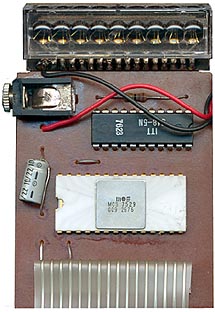
The chip in the 1974 advert is the 2529. Now if that chip has the same bug I found in the 7561, then its likely to be the same CPU/code. So if anyone has a calculator based on that chip, type:
[1] [EE] [1] [0] [-] [1] [=] displays 1 exp 00!
If that bug is not there, the chips *may* have different CPUs, or at least a rewritten ROM.
One thing, if you do get an SR4912 and decap the 7561, the rest if the calc would be good for a little portable 6502 conversion project! It has a keyboard, LED, 9v compartment, etc..

Edit: It seems the CBM SR7919 may be using the MOS 2529 (?) so if anyone has one and can try the "bug" above..
- cosr7919i.jpg (22.63 KiB) Viewed 753 times
Re: The 7561 chip in Commodore calculators is 6502 based..
Posted: Wed Feb 25, 2026 10:53 pm
by Martin_H
Programming any eight-bit microprocessor to be a scientific calculator is a challenging project. Besides the obvious hardware requirements, you'll need to code BCD functions for multiplication, division, square roots, trigonometry, and logarithms. The CORIDC algorithm or lookup tables will likely be your friend. I've pondered building an HP like RPM calculator using Forth as the runtime. But it's a non-trivial project and would likely take a fair bit of time.
It makes me wonder how those single chip scientific calculators of that era were made.
Re: The 7561 chip in Commodore calculators is 6502 based..
Posted: Thu Feb 26, 2026 1:04 am
by John West
It makes me wonder how those single chip scientific calculators of that era were made.
Ken Shirriff of course has a good write-up of the Sinclair scientific calculator
https://static.righto.com/calculator/si ... lator.html. There's a commented disassembly of the code (in a simulator) with explanations of the algorithms, and more detail of the hardware at
https://static.righto.com/calculator/TI ... lator.html It's a special-purpose processor designed to make calculators and nothing else.
Most calculators didn't go to that extreme and had a bit more ROM to work with (and consequently could be faster and more accurate). But that's the sort of thing calculator processors were doing: digit-serial operations on a small number of wide registers, no RAM, a tiny stack if there was one at all, and dedicated instructions for scanning the keyboard and display.
Re: The 7561 chip in Commodore calculators is 6502 based..
Posted: Thu Feb 26, 2026 6:12 am
by barnacle
Hah, my first calculator, built from a kit!
No-one ever borrowed it more than once, but I still have a handful of HP calculators around; I like their RPN operation.
Neil
Re: The 7561 chip in Commodore calculators is 6502 based..
Posted: Thu Feb 26, 2026 7:38 am
by BigEd
Thanks for the links to Ken's work! In the TI Datamath investigation, I think he didn't need to refer to photos of the chip in question ("die shots") but in the case of the Sinclair Scientific, he did. (In fact, the chip used was from one of mine - I bought two for the purpose.)
You can learn a lot by studying die shots. Sean Riddle has a page with links to a series of TI calculator chips
https://seanriddle.com/ticalcs.html
The TI-30 is of course a capable scientific calculator, and it's covered there.
Advantages of a bespoke CPU architecture:
- opcodes can be an appropriate length for the job, with fields and operands embedded in a way which makes decode easy.
- code ROM is exactly as big (in both dimensions) as is needed
- von Neumann architecture is simpler and is more efficient for a fixed purpose like this: no wasted cycles interleaving fetch with data reads and writes
- digit by digit computation very suitable for calculator application
- registers can all be right-sized for the calculator application
- flags can be defined for precisely the necessary purposes
- dedicated stack, if needed, can be right-sized
- can optimise for power, responsiveness, cost for the particular application
- display scanning and keyboard scanning can occur in lockstep with digit by digit calculation
Re: The 7561 chip in Commodore calculators is 6502 based..
Posted: Thu Feb 26, 2026 10:09 am
by orac81
Thanks for the links, interesting to see the reverse engineering of Sinclair's calc, amazing what you can do in 320 bytes. I remember my uncle building the kit of the first model, it was like a miracle back then.
The calculators started with the 4001 & busicom, then eventually TI went back to the z80 in the late 80s, going full circle back to general purpose CPUs!
Re: The 7561 chip in Commodore calculators is 6502 based..
Posted: Thu Feb 26, 2026 4:26 pm
by Martin_H
Thanks for the calculator deep dive links. It was interesting reading. BCD with extra wide registers really shine for a calculator application.
New crazy project idea. Write a TMS0801 VM and use the Sinclair ROM for my 6502 based calculator! Such a program would need very little RAM and ROM. A 6507, 6532, and a 6522 would be the main chips.
@Neil, I wanted to buy that kit, but being a poor high school student, I couldn't afford its price, and my parents were skeptical that it could work due to its low cost. So, I learned how to use a slide rule instead. I am probably among the last generation to learn to use a slide rule.
New new crazy project idea. Build an "automated" slide rule that uses two linear actuators and a microcontroller with a keypad for the input. One linear actuator controls the slide and the other the cursor.
Re: The 7561 chip in Commodore calculators is 6502 based..
Posted: Thu Feb 26, 2026 6:11 pm
by barnacle
I saved up a lot of milk and paper round money to get it.
I too know how a slip stick works and had many; short, long, circular, cylindrical... and I know my way around a book of log tables, too (made from trees with square roots, of course!)
I like the auto slide rule idea

Neil
Re: The 7561 chip in Commodore calculators is 6502 based..
Posted: Thu Feb 26, 2026 6:22 pm
by BigEd
I bought a couple of (little) books of log tables last year, realising that I didn't have any. Of course, they're not much use to me.
Re: The 7561 chip in Commodore calculators is 6502 based..
Posted: Fri Feb 27, 2026 1:47 pm
by orac81
They are quite useful to put under the legs of a table that needs leveling up.
Re: The 7561 chip in Commodore calculators is 6502 based..
Posted: Fri Feb 27, 2026 8:37 pm
by BigDumbDinosaur
They are quite useful to put under the legs of a table that needs leveling up.

I still have my old engineering reference book from 1966, which I acquired when I was in the Navy. It has the complete set of trig and log tables. Can’t say that I refer to it much these days. 