Page 1 of 1
VIA anomaly ~ single-clock single-step (blind interface)
Posted: Wed Feb 18, 2026 4:05 pm
by Michael
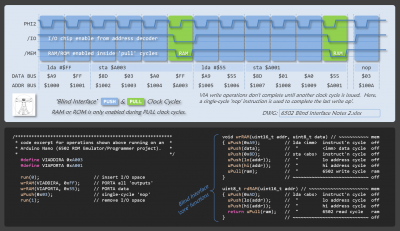
I use a microcontroller to access RAM and ROM a single clock cycle at a time on my ROM Emulator project and I noticed a problem accessing the VIA chip that way. I issue clock cycles that start and end in the high state to keep non-WDC CPUs static, which also leaves the CPU address and r/w lines active until the next clock cycle comes along. During memory read/write clock cycles the chip enable line goes low and high within the clock cycle which works fine for RAM and ROM but a read/write VIA clock cycle doesn't complete until I send another clock cycle of some sort.
So, the VIA clock cycle takes the clock lo. The CPU sets the address and r/w lines. The memory enable (RAM, ROM, or I/O) line goes low. The clock line goes high. The CPU puts data on the bus for a write cycle or reads the bus for a read cycle. The memory enable line (RAM, ROM, or I/O) goes high. The clock line remains high and the CPU address and r/w lines are still active.
Does the 65C22 VIA complete read/write transactions when the clock goes low rather than when the chip enable line is disabled?
TIA. Cheerful regards.
Re: VIA anomaly ~ single-clock single-step (blind interface)
Posted: Wed Feb 18, 2026 9:01 pm
by Dr Jefyll
During memory read/write clock cycles the chip enable line goes low and high within the clock cycle which works fine for RAM and ROM but a read/write VIA clock cycle doesn't complete until I send another clock cycle of some sort.
If you mean the VIA's chip enable line goes low and high
within the time Phi2 is high, then that's a problem. The address decoder which drives a VIA's CS mustn't be qualified by Phi2. (Edit: hmm, your diagrams show it's NOT qualified by Phi2.
-- Jeff
Re: VIA anomaly ~ single-clock single-step (blind interface)
Posted: Wed Feb 18, 2026 9:07 pm
by SamCoVT
You should review the timing diagrams on page 46 of WDC's w65c22 datasheet (the values for the timings are in the preceding pages). The address, chip select, and R/W* should be set BEFORE the rising edge of PHI2 and the data will be captured on the falling edge of PHI2. I think your NOP is just creating the falling edge the 65C22 is waiting for.
I think what you are doing is not a standard bus cycle the 65C22 understands, so the expected behavior is undefined. When you have PHI2 high, you are in the middle of a cycle, not between cycles.
Re: VIA anomaly ~ single-clock single-step (blind interface)
Posted: Wed Feb 18, 2026 10:12 pm
by BigDumbDinosaur
If you mean the VIA's chip enable line goes low and high within the time Phi2 is high, then that's a problem. The address decoder which drives a VIA's CS mustn't be qualified by Phi2. (Edit: hmm, your diagrams show it's NOT qualified by Phi2.
Re: VIA anomaly ~ single-clock single-step (blind interface)
Posted: Thu Feb 19, 2026 7:54 pm
by Michael
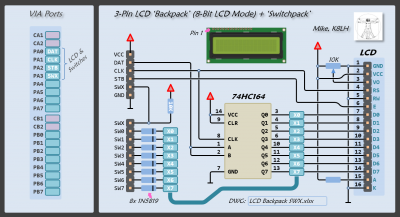
Thank you for helping me think through this, guys. Turns out the VIA chip enable is available past the end of a 'pull' clock sequence when ϕ2 remains high and the address lines remain active because the I/O chip enable comes from the address decoder and not from the low-level 'pull' function. So I just need to generate a single-cycle 'nop' at the end of a series of I/O operations. My test ROM Emulator LCD driver code (below) contains a strategically placed 'nop' instruction and now I can write to the LCD display from the uC in ROM Emulator mode as well as from the 6502 in normal 6502 RUN mode.
Cheerful regards...
Code: Select all
     #define line1 (0x80+0x00)        // set DDRAM command + line 1 address
     #define line2 (0x80+0x40)        // set DDRAM command + line 2 address
     #define line3 (0x80+0x14)        // set DDRAM command + line 3 address
     #define line4 (0x80+0x54)        // set DDRAM command + line 4 address

     LCD lcd;                         // create 'lcd' instance of 'LCD' class

     lcd.init();                      // 8-bit mode, cursor inc & off
     _delay_ms(1000);                 // wait 1-second
     lcd.print("3P8B Backpack v1");   // splash screen
     lcd.cmd(line2+2);                // line 2, tab 2
     lcd.print(F("8-MHz 65C02"));     // a "flash string helper" ROM string
Code: Select all
  /******************************************************************************        ;~~~~~~~~~~~~~~~~~~~~~~~~~~~~~~~~~~~~~~~~~~~~~~~~~~~~~~~~~~~~~~
   *  test LCD class - ROM Emulator mode - writing to LCD serial backpack.      *        ;~~~  6502 low level 3P8B LCD backpack drivers ~ M.McLaren  ~~~
   ******************************************************************************/       ;~~~~~~~~~~~~~~~~~~~~~~~~~~~~~~~~~~~~~~~~~~~~~~~~~~~~~~~~~~~~~~

   #define VIAPORTB  0xA000           //                                                 ;~~~        X         XXXXX   XXXXX                         ~~~
   #define VIAPORTA  0xA001           //                                                 ;~~~        X        X     X  X    X         (C) 2026       ~~~
   #define VIADDIRB  0xA002           //                                                 ;~~~        X        X        X     X      Mike McLaren     ~~~
   #define VIADDIRA  0xA003           //                                                 ;~~~        X        X        X     X          K8LH         ~~~
                                                                                         ;~~~        X        X        X     X                       ~~~
   #define clk 4                      // index for VIA PA4                               ;~~~        X        X     X  X    X       CA65 v2.13.3     ~~~
   #define stb 2                      // index for VIA PA2                               ;~~~        XXXXXXX   XXXXX   XXXXX                         ~~~
   #define dat 0                      // index for VIA PA0
                                                                                         .define dat     0           ; PA0 bit index
   class LCD : public Print           // use 'Print' features *******************        .define clk     1           ; PA1 bit index
   { public:                          //                                        *        .define stb     2           ; PA2 bit index
       void init();                   //                                        *        .define swx     3           ; PA3 bit index
       void cmd(uint8_t);             //                                        *
       size_t write(uint8_t);         //                                        *        lcdInit:                    ; ~~~~~~~~~~~~~~~~~~~~~~~~~~~~~~~~~
     private:                         //                                        *                lda DDRA            ; read current DDRA state       (4)
       bool rs = 0;                   // lcd 'RS' flag                          *                ora #(1<<stb | 1<<clk | 1<<dat)  ;                  (2)
   };                                 // ****************************************                sta DDRA            ; clk/dat/stb pins to outputs   (4)
                                                                                                 delayCy(100*msecs)  ; lcd power-on delay       (100000) 1-MHz clock
   void LCD::init()                   // ****************************************                wrCmd #$38          ; 8-bit, 2-line, 5x7 font     (234)
   { uReset();                        // reset 6502 (synchronize uC to cpu)     *                wrCmd #$0C          ; display on, cursor off      (234)
     run(0);                          // insert I/O into address space          *                wrCmd #$06          ; cursor inc, shift off       (234)
     wrRAM(VIADDIRA, (1 << clk) | (1 << stb) | (1 << dat));  // VIA outputs     *                wrCmd #$01          ; clear display               (234)
     _delay_ms(100);                  // LCD power-on delay                     *                delayCy(2*msecs)    ; required delay             (2000) 1-MHz clock
     cmd(0x38);                       // 8-bit interface, 2-lines, 5x7 font     *                rts                 ; ~~~~~~~~~~~~~~~~~~~~~~~~~~~~~~~~~
     cmd(0x0C);                       // display on, cursor & blink off         *
     cmd(0x06);                       // cursor inc, shift off                  *        lcdCmd:                     ; ~~~~~~~~~~~~~~~~~~~~~~~~~~~~~~~~~
     cmd(0x01);                       // clear display                          *                clc                 ; rs = 0 'command reg           (2)
     _delay_ms(2);                    // required delay                         *               .byte $89            ; skip over 'sec' instruction   (2) bit <imm>
   }                                  // ****************************************        lcdDat:                     ; ~~~~~~~~~~~~~~~~~~~~~~~~~~~~~~~~~
                                                                                                 sec                 ; rs = 1 'data reg              (2)
   void LCD::cmd(uint8_t c)           // ****************************************                sta work            ;                               (3)zp
   { rs = 0; write(c); rs = 1;        //                                        *        ;~~~                                                        ~~~
   }                                  // ****************************************        ;~~~   clock 8-bit 'work' byte into the shift register ic   ~~~
                                                                                         ;~~~                                                        ~~~
   size_t LCD::write(uint8_t data)    // ****************************************                ldx #8              ; bit counter                   (2)
   { for(uint8_t i = 8; i > 0 ; i--)  // load 74HC164 shift register            *                lda PORTA           ;                               (4)
     { wrRAM(VIAPORTA, 0 << clk | (bool)(data & 128) << dat);  //               *        lcd1:   and #~(1<<stb | 1<<clk | 1<<dat)  ;                 (2)
       wrRAM(VIAPORTA, 1 << clk | (bool)(data & 128) << dat);  //               *                rol work            ; move bit 7 into Carry         (5)zp
       data <<= 1;                    // prep next bit                          *                adc #$00            ; add bit, dat = 0 or 1         (2)
     }                                // re-task 'clk' pin for LCD 'RS' input   *                sta PORTA           ; clk = 0, dat = 0 or 1         (4)
     wrRAM(VIAPORTA, rs << clk | 1 << stb);  // strobe LCD 'E' pin              *                ora #(1<<clk)       ;                               (2)
     wrRAM(VIAPORTA, rs << clk | 0 << stb);  //  "                              *                sta PORTA           ; clk = 1, dat = 0 or 1         (4)
     uPush(0x03);                     // single-cycle 'nop' (I/O work-around)   *                dex                 ; done?                         (2)
     return 1;                        //                                        *                bne lcd1            ; no, branch (loop), else       (2)(3)
   }                                  // ****************************************        ;~~~                                                        ~~~
                                                                                         ;~~~   re-task 'clk' pin for LCD 'rs' input & strobe LCD    ~~~
                                                                                         ;~~~                                                        ~~~
                                                                                                 bit work            ; rs = 1 (data)?                (3)zp
                                                                                                 bmi strobe          ; yes, skip, else               (2)(3)
                                                                                                 eor #(1<<clk)       ; rs = 0 (command)              (2)
                                                                                         strobe: ora #(1<<stb)       ; lcd 'e' = 1                   (2)
                                                                                                 sta PORTA           ; strobe LCD 'E' pin            (4)
                                                                                                 eor #(1<<stb)       ;  "                            (2)
                                                                                                 sta PORTA           ;  "                            (4)
                                                                                                 rts                 ; ~~~~~~~~~~~~~~~~~~~~~~~~~~~~~~~~~