Page 1 of 2
How can I probe the 6502?
Posted: Thu Apr 08, 2021 4:58 am
by sprx128
Recently, I bought a 6502, and I want make a pc with it, but I think that mine is dead, so how can I test it, without another integrated or something too hard? Because I'm waiting for more stuff and in this moment, I just have the 6502, but I have too an Arduino and rpi3 and a lot of resistances and wires, and i don't know if I can use them
Re: How can I probe the 6502?
Posted: Thu Apr 08, 2021 6:17 am
by ojanhk
Hi, you could do a free run using a few resistor and led on a breadboard.
If you wire properly the different signals to VCC and GND, you just have to wire data bus so it always reads $EA(NOP).
If you have LEDs on the address bus, you should see it incrementing.
The only thing is you have to provide a clock signal, if it’s a recent 65c02, you can do it by hand with a button, but if it’s an older 6502 you’ll need to provide a real clock(can be a 555 timer).
Re: How can I probe the 6502?
Posted: Thu Apr 08, 2021 6:37 am
by BigDumbDinosaur
Recently, I bought a 6502, and I want make a pc with it, but I think that mine is dead, so how can I test it, without another integrated or something too hard? Because I'm waiting for more stuff and in this moment, I just have the 6502, but I have too an Arduino and rpi3 and a lot of resistances and wires, and i don't know if I can use them
From where did you purchase this 6502? Can you post a closeup photo of it so we can see the markings on it?
Re: How can I probe the 6502?
Posted: Thu Apr 08, 2021 7:25 am
by BigEd
Welcome, sprx128! As noted above, if you search for "NOP test" or "NOP generator" you'll get the information you need. But we're always happy to help with further questions.
As BDD implies, any IC which isn't sold as new by a major distributor will carry some risk of not being exactly what it's sold as. It might be slightly different or totally different. These risks are, if you like, built in to the very low prices. We've had many previous discussions on this phenomenon, so it would be nice not to hash it all out again here. See for example
Bargain chips bought online - buyer beware!
and perhaps
65xx parts sources, genuine and fake
Re: How can I probe the 6502?
Posted: Thu Apr 08, 2021 2:13 pm
by sprx128
I think that my 6502 it's fake because the letters of the top were make with laser.
Re: How can I probe the 6502?
Posted: Thu Apr 08, 2021 2:18 pm
by sprx128
Recently, I bought a 6502, and I want make a pc with it, but I think that mine is dead, so how can I test it, without another integrated or something too hard? Because I'm waiting for more stuff and in this moment, I just have the 6502, but I have too an Arduino and rpi3 and a lot of resistances and wires, and i don't know if I can use them
From where did you purchase this 6502? Can you post a closeup photo of it so we can see the markings on it?
Sure
Re: How can I probe the 6502?
Posted: Thu Apr 08, 2021 2:20 pm
by sprx128
Hi, you could do a free run using a few resistor and led on a breadboard.
If you wire properly the different signals to VCC and GND, you just have to wire data bus so it always reads $EA(NOP).
If you have LEDs on the address bus, you should see it incrementing.
The only thing is you have to provide a clock signal, if it’s a recent 65c02, you can do it by hand with a button, but if it’s an older 6502 you’ll need to provide a real clock(can be a 555 timer).
I don't have any problem with the clock I have a 555 and cd4017, but can you give me the esquematic?
Re: How can I probe the 6502?
Posted: Thu Apr 08, 2021 3:24 pm
by barrym95838
Hi, you could do a free run using a few resistor and led on a breadboard.
If you wire properly the different signals to VCC and GND, you just have to wire data bus so it always reads $EA(NOP).
If you have LEDs on the address bus, you should see it incrementing.
The only thing is you have to provide a clock signal, if it’s a recent 65c02, you can do it by hand with a button, but if it’s an older 6502 you’ll need to provide a real clock(can be a 555 timer).
I don't have any problem with the clock I have a 555 and cd4017, but can you give me the esquematic?
Garth has spent considerable effort on his excellent
primer pages, and I highly recommend them for beginners and experts alike.
Happy hacking!
Re: How can I probe the 6502?
Posted: Thu Apr 08, 2021 3:33 pm
by GARTHWILSON
Welcome.
I don't have any problem with the clock I have a 555 and cd4017, but can you give me the esquematic?
I'm on a short vacation, away from home, so I'll have to wait probably until at least tomorrow to provide any schematics. Are you in a part of the world where it's difficult to get parts? If so, what other parts do you have? The CD4000 (and 74Cxx) series is generally too slow at 5V for even the old NMOS 6502, and I don't recommend it. (This is covered in the "74xx Logic Families and Timing Margins" page of the 6502 primer which I strongly recommend you go through. (I see Mike recommended it while I was looking stuff up and writing. Thanks, Mike.) Section 6 is on clock generation. I see now that I should add a diagram there for a 74xx14 relaxation oscillator there with a single resistor and capacitor also, which is simpler than a 555 and has much better rise and fall times. (Looking at Wikipedia just now, I'm not finding such a diagram even there.) I can't think of any good reason to use a 555 anymore.
Re: How can I probe the 6502?
Posted: Thu Apr 08, 2021 5:06 pm
by BigEd
Just to note: just because a chip is relabelled doesn't mean it isn't something like what the label says. The resellers are doing whatever they feel helps them in the marketplace.
As far as I understand the anecdotal evidence, there's a fair chance that NMOS and CMOS 6502s will appear in each other's clothing. For some hobby purposes, it's not too important which one you have. For other purposes, it will matter.
Re: How can I probe the 6502?
Posted: Thu Apr 08, 2021 5:13 pm
by Martin A
Is there any info, printed or in the molding on the under side ?
Re: How can I probe the 6502?
Posted: Thu Apr 08, 2021 5:50 pm
by ojanhk
If you can’t wait until Garth comes back you can have a look there :
https://coronax.wordpress.com/2012/11/1 ... n-circles/
It helped me a lot when I started playing with 6502 a few years ago.
Re: How can I probe the 6502?
Posted: Thu Apr 08, 2021 6:47 pm
by BigDumbDinosaur
From where did you purchase this 6502? Can you post a closeup photo of it so we can see the markings on it?
Sure
Production of NMOS 6502s ceased many years ago, before the widespread use of laser marking. Most likely, you have a fake, and it may not even be a microprocessor at all.
As for Ø2 clock generation, the 555 timer is not a good choice, as said by Garth. The rise and fall times are slow. You would be better served with a CMOS clock oscillator.
Re: How can I probe the 6502?
Posted: Sat Apr 10, 2021 4:57 am
by GARTHWILSON
Section 6 is on clock generation. I see now that I should add a diagram there for a 74xx14 relaxation oscillator there with a single resistor and capacitor also, which is simpler than a 555 and has much better rise and fall times.
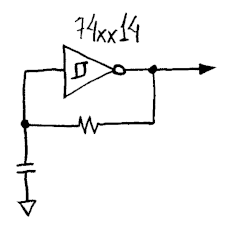
- 74xx14RCosc.gif (5.23 KiB) Viewed 1739 times
I see I did put in link to a forum topic covering it, in the third-to-last paragraph of the page. With a 74AC14, you should get a little under 1MHz with a 100pF capacitor and 8.2K resistor. The exact values for a given frequency, or the exact frequency you'll get from particular values, will depend partly on the size of the hysteresis of the Schmitt-trigger input relative to the output swing, and this may vary somewhat from one manufacturer to another and from one lot to another; so these are just starting points. Keep in mind that the frequency will be approximately inversely proportional to the capacitance multiplied by the resistance. For a 74HC14, the frequency may be just a tad lower than for the 74AC14. In the forum topic I linked to on that page, I showed how I had capacitor choices and a trimmer variable resistor too, to make a variable-frequency oscillator (VFO). It has a link to a newer, higher-frequency one as well. If you don't have a real frequency counter, you can get a close approximation from an oscilloscope, or your DMM might have a frequency-counter function, although for the DMM you'll probably need a divider to get down to the frequency range your DMM can handle, or at least buffer it with subsequent inverter section so the probes don't affect the frequency.
Re: How can I probe the 6502?
Posted: Sat Apr 10, 2021 6:55 am
by John West
Since you have an Arduino, it's worth keeping in mind that it can generate the clock too. There are advantages to this, for the initial "does it work at all?": you can connect address lines to its inputs, have it read them on each cycle, and print them in a nice readable format.