I had a look at that project a week ago or so; in my case I looked into the
version for the Arty FPGA board. I couldn't get the latest code from the Github repo to work but that's because he didn't update all the files. I'll probably fix it in my fork and then send a pull request. When I have time. Anyway, that's not your problem I'm sure, because you're working with an Altera board.
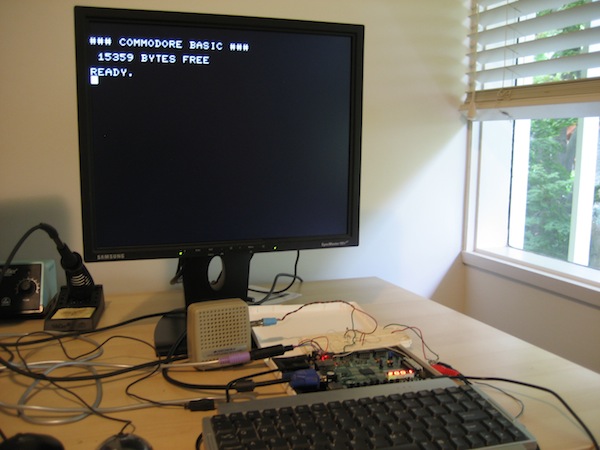
If your video is too dark, you probably did something wrong with the video bits. There are two bits (one for video, one for sync. Maybe the version for your board generates 3 bits: 1 for video, 1 for HSYNC and 1 for VSYNC; that's what you want for VGA anyway, right?). You should write your top level module such that the VGA D/A converters get the highest level of green (the D/A converters are probably 8 bits per color so green should probably be set to 8'xFF, but I'm not familiar with your board so Your Mileage May Vary) when the video bit is high, and zero when the video bit is low. Maybe you just connected the video bit to the top bit of the D/A converter instead of all the bits? That would only turn the video signal on to half brightness instead of maximum brightness.
As for the keyboard: It looks like you're using a USB keyboard with a PS/2 adapter? If so, are you sure your keyboard supports this? Many keyboards that were recently manufactured (in the last 10 years or so), don't support the PS/2 protocol anymore. Try connecting the keyboard with the PS/2 adapter to the PS/2 keyboard input of a PC (before you turn it on) and turn it on to see if it works. If not, use a different keyboard (or do some FPGA magic

). Also it looks like you're using a (green) Mouse converter plug, not a (purple) keyboard converter plug.
I can't explain why it's not showing all the memory and why you're getting the weird character as cursor instead of space/inverse space. Maybe you're trying to run it too fast and some signals don't make it to their destinations in time? Try lowering the top level clock frequency by inserting a PLL or a clock divider. The clock only has to be 1MHz to make it work like a real PET. Anything faster is a bonus.
And of course, see if you can reach Thomas Skibo; he may not be able to help you with Altera-specific issues (it appears he works with Xilinx FPGA's only) but he has more knowledge about the project than anyone
===Jac