Simple Question: 65c816 Memory Decode Logic

Let's talk about anything related to the 6502 microprocessor.
User avatar
BigDumbDinosaur
Posts: 9428
Joined: 28 May 2009
Location: Midwestern USA (JB Pritzker’s dystopia)
Contact:

Re: Simple Question: 65c816 Memory Decode Logic

Post by BigDumbDinosaur »

Dr Jefyll wrote:
Alright, here's a bare-bones schematic, based on the discussion above...Edit to the diagram: remove inverter between A15 and /CE,

That could be further reduced to a single quad NAND. Jus' sayin'...
x86?  We ain't got no x86.  We don't NEED no stinking x86!
Jmstein7
Posts: 379
Joined: 30 May 2021

Re: Simple Question: 65c816 Memory Decode Logic

Post by Jmstein7 »

BigDumbDinosaur wrote:
Jmstein7 wrote:
But, what wires connect to /OE and /CE (or /CS) on the chip? I.e., what wires get connected to Output Enable, Chip Enable, and, I guess, /RW?
Sorry for the earlier terse post. My wife called me to dinner right as I was posting and around here, a juicy chuck roast with corn-on-the-cob has priority over computers. :D
No problem - I fell asleep while putting my kids to sleep. :lol: Just got up, heading to work. To be continued!

Jon
User avatar
Dr Jefyll
Posts: 3526
Joined: 11 Dec 2009
Location: Ontario, Canada
Contact:

Re: Simple Question: 65c816 Memory Decode Logic

Post by Dr Jefyll »

As noted earlier, there's more than one "right answer" to the question. Here again is the "classic" schematic -- the arrangement which uses a pair of NAND gates to generate qualified /Read and /Write signals from Phi2 and the CPU's R/W output. I added the Truth Table for typical RAMs.
basic 816 glue_.png
Now here's a schematic which, by comparison, has both advantages and disadvantages. Therefore it's reasonable to make your choice according to prevailing priorities and circumstances.
basic 816 glue v2.png
The classic circuit requires more gates, but it may be a better choice if you're keen to run an old-ish RAM at the highest possible speed. /CE is what "wakes up" the chip and moves it from "power-down" to "selected," and the classic circuit allows /CE to go true ASAP. Then later when Phi2 rises we get the actual Read or Write. These four modes are shown in the Truth Table (and the "classic" version uses all four modes)

The new circuit is simpler but the RAM remains in "power-down" until Phi2 rises; then it transitions directly into either Read or Write. (The "selected" mode never occurs.) The lack of an advance wake-up results in a performance penalty which you may or may not deem significant.

It may seem odd that /OE is grounded; however, in the Truth Table you'll see that the state of /OE doesn't matter (it's a "don't care") if /WE is low. /WE and /CE alone are sufficient to select the three modes we need: power-down, read and write.

( Whether you do or don't choose the classic circuit is a general decision -- it has no specific bearing on the use of the '816 as opposed to '02 or 'C02. )

-- Jeff
Last edited by Dr Jefyll on Tue Sep 14, 2021 12:04 pm, edited 1 time in total.
In 1988 my 65C02 got six new registers and 44 new full-speed instructions!
https://laughtonelectronics.com/Arcana/ ... mmary.html
Jmstein7
Posts: 379
Joined: 30 May 2021

Re: Simple Question: 65c816 Memory Decode Logic

Post by Jmstein7 »

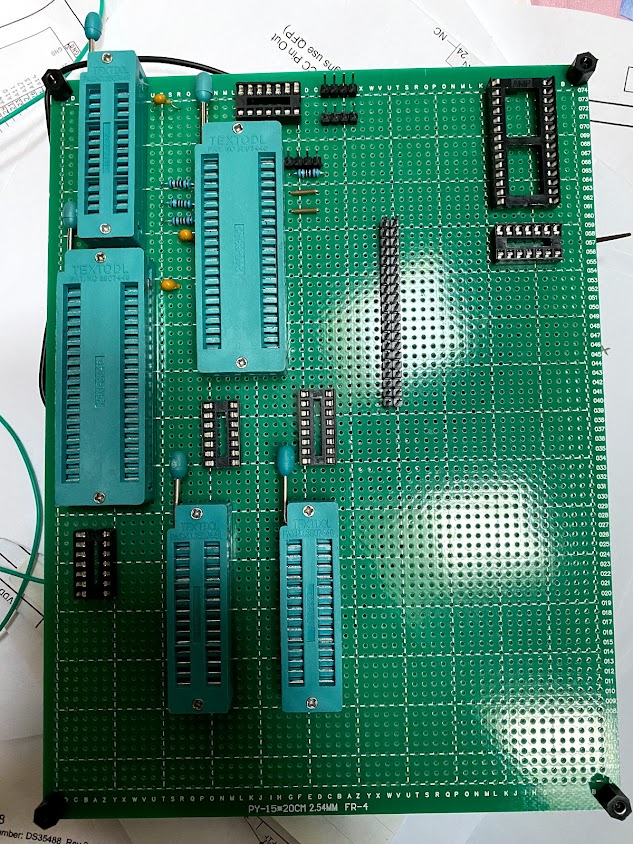
I laid this out late last night. I just have to label what everything is :lol:

Image

edit: I already see an error. Abort isn't tied high.
Post Reply