Page 2 of 2
Re: Simplest self-contained project
Posted: Sat Oct 12, 2013 8:23 am
by mkl0815
Bootstrapping is always like a hen-egg-problem. You need a ROM (or data in a RAM) to get your system started, but you need a working machine to write data to ROM or RAM.
By using a (E)EPROM programmer to get this done is like cheating because it don't gives an answer how the first system was brought to life.
This general problem gets down to the "real world" if we talk about an easy set of parts you can build your own system with. If you need a preprogrammed chip, then you need a source to get it. Even if we assume that everyone that uses our "6502 homebrew kit" already has any kind of computer. I think it would be good to divide the "kit" into several parts that could be exchanged by the person who uses it.
1) Power supply:
- USB adapter providing 5V and could also used for serial communication (FTDI breakout or something like that)
- own solution based on a LM7805 voltage regulator
2) Systemboard:
- breadboard based
- wirewrapped
- precreated PCB
3) Components:
- additional parts to the minimal configuration
- only a VIA for 16 I/O pins
- adding serial I/O for easy communication with a host system
- adding I/O for keyboard and display
4) Bootstrapping:
- (E)EPROM programmer for high flexibility
- preprogrammed ROM for easy use
- several bootstrapping methods for the pure lowlevel approach
The hard thing will be to take care that what ever you decide to use from the several project-parts that they fit together.
We would have a "box of bricks" someone can stick together his very own system.
Mario.
Re: Simplest self-contained project
Posted: Sat Oct 12, 2013 7:40 pm
by BigDumbDinosaur
There's only so much time allotted to all of us. My philosophy is to use that time to create the things that can't be readily purchased.
So you're now advocating purchasing a Raspberry PI and a few Arduinos ?


Depends on your objective. If it is to get *something* working with a minimum of effort, by all means get the PI or Arduino. You won't as learn much in the process, but that isn't your goal.
Re: Simplest self-contained project
Posted: Sat Oct 12, 2013 8:10 pm
by Arlet
Depends on your objective. If it is to get *something* working with a minimum of effort, by all means get the PI or Arduino. You won't learn much in the process, but that isn't your goal.
The statement "you won't learn much" is untrue, because it's too broad. You'll have to qualify that by saying "you won't learn much about
<topic>". Obviously, if you implement a solution using a Python script on the PI, you can learn a great deal about Python.
And if the goal is to completely understand 6502 bus cycles, you can probably learn more by making your own bootstrap loader from basic components, rather than just plugging in a EPROM, and connecting A0 to A0, and A1 to A1.
Re: Simplest self-contained project
Posted: Sat Oct 12, 2013 8:55 pm
by BigDumbDinosaur
The statement "you won't learn much" is untrue, because it's too broad.
It was supposed to be "You won't learn as much..." I edited the post.
Re: Simplest self-contained project
Posted: Sun Oct 13, 2013 5:56 am
by Arlet
It was supposed to be "You won't learn as much..." I edited the post.
My point remains the same, though. I agree you won't learn as much about
some things., but you can learn a lot more about
other things. Given that nobody has the time to learn all things, everybody needs to make a choice. Do we all need to make the same choice ? I think not. As long as people are learning useful things, it's fine. You can study computer systems at a dozen different levels, from solid state physics to high level programming abstractions, and at each level there's something to be learned, and at each level there's an opportunity to turn that knowledge into useful results.
Re: Simplest self-contained project
Posted: Fri Oct 18, 2013 7:27 pm
by jac_goudsmit
Re: Simplest self-contained project
Posted: Fri Jun 27, 2014 5:00 pm
by BigEd
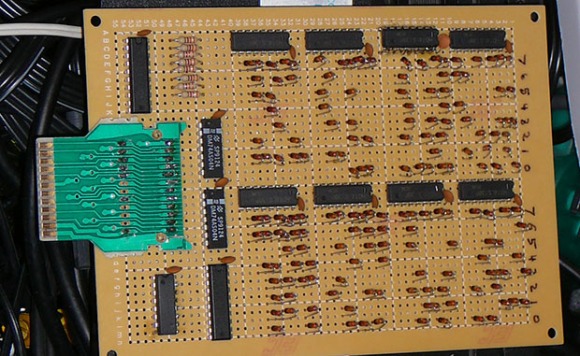
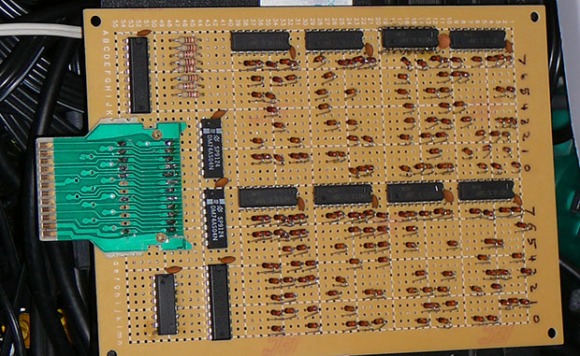
Another diode matrix ROM project via
Hackaday - this time 64 bytes, and working in a 6502 system (the Atari 2600)
http://atariage.com/forums/topic/226940 ... ?p=3018361
Re: Simplest self-contained project
Posted: Sat Jun 28, 2014 1:14 am
by Dr Jefyll
I like it!

This Wickeycolumbus fellow has got style -- and, needless to say, no small amount of whimsy! Most folks wouldn't bother to implement such a capricious notion. It takes determination to actually build something like this -- and likewise to write (solder?) a demo program that'll fit in 64 bytes!

That said, the hardware design has some fat that can be trimmed, even if the demo code doesn't. Here are my observations. (And I hope I'm not violating the spirit of the thing if I try to make an unabashedly impractical design more practical!)
- there are 74AS04 inverters downstream of the diode matrix because the diode count drops substantially when the logic sense is flipped. That's fine, but the inverters could be eliminated if the 74HC244 non-inverting buffer driving the data bus were replaced with a '240 inverting type instead.
- the other '244 buffer is intended to reduce loading on incoming signals from the Atari's address bus. Reasonable, since an array of 74LS138 decoders is attached. But if 74HCT138's were used instead then loading would be negligible and the '244 buffer could be eliminated.
- Finally, four of the '138 decoders could be eliminated if the diode matrix were organized as 32 words, each 16 bits wide, instead of 64 words each 8 bits wide. That means you'd always fetch 2 bytes at once, and would need a 2-to-1 multiplexer to choose between them. But a pair of 74HCT258's can do that -- and assume the tri-state duties of the '240 driving the data bus. So the net saving is 3 IC's -- or 6 altogether, including the points above.
cheers,
Jeff
Re: Simplest self-contained project
Posted: Mon Jun 30, 2014 10:21 pm
by BigDumbDinosaur
All those diodes remind me of a project on which I worked in the early 1970s. It involved decoding a 7 bit signal into the numerals 1-99 and displaying them on a matrix made up of incandescent lamps. It took a lot of diodes, usually 1N4004's.
Re: Simplest self-contained project
Posted: Mon Jun 30, 2014 10:28 pm
by nyef
All those diodes remind me of a project on which I worked in the early 1970s. It involved decoding a 7 bit signal into the numerals 1-99 and displaying them on a matrix made up of incandescent lamps. It took a lot of diodes, usually 1N4004's.
Was this one of those cases where the diodes were used to create logic gates, before using transistors in order to make gates really took off?
Re: Simplest self-contained project
Posted: Tue Jul 01, 2014 1:04 am
by BigDumbDinosaur
All those diodes remind me of a project on which I worked in the early 1970s. It involved decoding a 7 bit signal into the numerals 1-99 and displaying them on a matrix made up of incandescent lamps. It took a lot of diodes, usually 1N4004's.
Was this one of those cases where the diodes were used to create logic gates, before using transistors in order to make gates really took off?
No. It was a case of actual decoding. The entire circuit operated on AC line power, with the diodes actually driving the lamps.