
I was never into robots at all, though I did build a number of wire-control meccano gizmos; there was never a great interest if it wasn't at the 'Danger Will Robinson' level.
Though as part of a university Mechatronics course, the 'here's a tiny robot with sensors and motors randomly wired; make it work' part was an interesting challenge with a lot of inductive logic for it to work out which way it was going.
On the other hand, the deep oil-well drill steering mechanisms I designed for a few years probably count as robots; it's just that they're three miles underground trying to hit a six inch target with a six inch drill through solid rock (and did it, too).
Robots?
Re: Robots?
barnacle wrote:
the deep oil-well drill steering mechanisms I designed for a few years probably count as robots; it's just that they're three miles underground trying to hit a six inch target with a six inch drill through solid rock (and did it, too).
Alarm Siren wrote:
I've heard they changed the project a few years later and it is now greatly simplified, for example it now uses an off-the-shelf "maze runner" chassis, so no mechanical construction or freedom of design there any more. This was done 1. to make it cheaper and 2. so that they could enter the students into an inter-university challenge that required the use of these components. I understand why they changed it, but for the purposes of actual education I think the original version of the project as described above was superior, because the students had more creative input and had to engage in a greater variety of skills to build it.
BigEd wrote:
I think it's very difficult, when you're grown, to remember how it is when you didn't know what you know now. And even if you do remember, teaching is different from reliving your own journey. This is why there are courses to teach people to be teachers, or at least to start them off on the journey.

BigEd wrote:
And so any of us here can look at something simple and dismiss it, because it wouldn't tell us anything. Nor would it inspire us, because we're already greatly interested. We have to take a different perspective to see the value in it - and of course, some offerings are going to have more value than others. Lego has merits, Meccano has merits, and they are different.
drogon wrote:
Why robots? Simple. Engagement and instant feedback and that's what you need to hook some kids into the world of computing (electronics, and so on).
drogon wrote:
But make it high level - give kids a 6502 and assembly language manual to start with and you'll lose them a second later.
BillG wrote:
Hobby rocketry has grown up from when we were kids

Thanks everyone.
Chad
Re: Robots?
sburrow wrote:
BillG wrote:
Hobby rocketry has grown up from when we were kids
Our safety code requires us to stand down when an aircraft is nearby. So if they circle our field waiting for a launch, we cannot. Eventually, they give up and leave but sometimes they come back when they see rockets flying behind them.
Most model rockets use black powder motors. Mid and high power motors are generally APCP (ammonium perchlorate composite propellant); think the solid rocket boosters of the Space Shuttle. About two decades ago, the BATFE tried to regulate APCP as a low explosive. We raised money, sued and won! Because the larger motors can be dangerous is misused, we self-regulate. Certification is required to purchase and fly the larger motors.
There are lots of pictures on our club's web site. The links saying "sights and sounds" also have video clips. https://www.dars.org/gallery/photos.html
Re: Robots?
barnacle wrote:
On the other hand, the deep oil-well drill steering mechanisms I designed for a few years probably count as robots; it's just that they're three miles underground trying to hit a six inch target with a six inch drill through solid rock (and did it, too).
Bill
Re: Robots?
BillG wrote:
We have to coordinate with the FAA to reserve airspace when we fly high power rockets. They will issue a NOTAM so that pilots know to avoid us. A problem is that some private pilots out joyriding see a notice of an unmanned rocket launch event and say, "Cool! Let's fly over there and check it out."
Our safety code requires us to stand down when an aircraft is nearby. So if they circle our field waiting for a launch, we cannot. Eventually, they give up and leave but sometimes they come back when they see rockets flying behind them.
Most model rockets use black powder motors. Mid and high power motors are generally APCP (ammonium perchlorate composite propellant); think the solid rocket boosters of the Space Shuttle. About two decades ago, the BATFE tried to regulate APCP as a low explosive. We raised money, sued and won! Because the larger motors can be dangerous is misused, we self-regulate. Certification is required to purchase and fly the larger motors.
There are lots of pictures on our club's web site. The links saying "sights and sounds" also have video clips. https://www.dars.org/gallery/photos.html
Our safety code requires us to stand down when an aircraft is nearby. So if they circle our field waiting for a launch, we cannot. Eventually, they give up and leave but sometimes they come back when they see rockets flying behind them.
Most model rockets use black powder motors. Mid and high power motors are generally APCP (ammonium perchlorate composite propellant); think the solid rocket boosters of the Space Shuttle. About two decades ago, the BATFE tried to regulate APCP as a low explosive. We raised money, sued and won! Because the larger motors can be dangerous is misused, we self-regulate. Certification is required to purchase and fly the larger motors.
There are lots of pictures on our club's web site. The links saying "sights and sounds" also have video clips. https://www.dars.org/gallery/photos.html
Bill
Re: Robots?
If you're a reader of The Register you probably remember the Special Projects Bureau that held the record for the highest flying paper plane - about seventeen miles up. I was a member of the SPB that developed from that to the LOHAN project which was intended to launch a printed-plastic rocket plane at around 100,000 feet and have it self-navigate back to ground. Our back of the envelope calculations indicated from naught to just under mach 2 in seven seconds, and an extra 15,000 feet altitude before it started to come down. Unfortunately, plans were waiting on the FAA in the States to give permission when the project leader - Lester Haines - suddenly died of a heart attack and the project has been shelved ever since.
Neil
Neil
-
BigDumbDinosaur

- Posts: 9426
- Joined: 28 May 2009
- Location: Midwestern USA (JB Pritzker’s dystopia)
- Contact:
Re: Robots?
BillG wrote:
[FAA] will issue a NOTAM so that pilots know to avoid us. A problem is that some private pilots out joyriding see a notice of an unmanned rocket launch event and say, "Cool! Let's fly over there and check it out."
What do you call a pilot who flies in the vicinity of a rocket launch?
...
....
.....
Darwin award candidate.
x86? We ain't got no x86. We don't NEED no stinking x86!
Re: Robots?
plasmo wrote:
BillG wrote:
We have to coordinate with the FAA to reserve airspace when we fly high power rockets. They will issue a NOTAM so that pilots know to avoid us. A problem is that some private pilots out joyriding see a notice of an unmanned rocket launch event and say, "Cool! Let's fly over there and check it out."
Our safety code requires us to stand down when an aircraft is nearby. So if they circle our field waiting for a launch, we cannot. Eventually, they give up and leave but sometimes they come back when they see rockets flying behind them.
Most model rockets use black powder motors. Mid and high power motors are generally APCP (ammonium perchlorate composite propellant); think the solid rocket boosters of the Space Shuttle. About two decades ago, the BATFE tried to regulate APCP as a low explosive. We raised money, sued and won! Because the larger motors can be dangerous is misused, we self-regulate. Certification is required to purchase and fly the larger motors.
There are lots of pictures on our club's web site. The links saying "sights and sounds" also have video clips. https://www.dars.org/gallery/photos.html
Our safety code requires us to stand down when an aircraft is nearby. So if they circle our field waiting for a launch, we cannot. Eventually, they give up and leave but sometimes they come back when they see rockets flying behind them.
Most model rockets use black powder motors. Mid and high power motors are generally APCP (ammonium perchlorate composite propellant); think the solid rocket boosters of the Space Shuttle. About two decades ago, the BATFE tried to regulate APCP as a low explosive. We raised money, sued and won! Because the larger motors can be dangerous is misused, we self-regulate. Certification is required to purchase and fly the larger motors.
There are lots of pictures on our club's web site. The links saying "sights and sounds" also have video clips. https://www.dars.org/gallery/photos.html
Bill
Model rocketry was invented for a couple of reasons. The first was that many people were being killed or seriously injured in "rocket accidents" while stuffing match heads into a CO2 cartridge or handling hazardous chemicals. The idea of commercially available rocket motors meant that enthusiasts did not have to engage in the dangerous parts of building a rocket. Secondly, model rocketry was established as being distinct from fireworks to make it legal in more jurisdictions.
We moved when I was nine years old. While our house was being readied, we stayed with my grandparents for a couple of weeks. There, I got to see my uncle and his friends build model rockets. "I want to do that when I get older" was my reaction.
Re: Robots?
I have built many robots, both from kits and scratch built. My son and I initially started with Lego NXT and branched out from there. I think the appeal is the intersection of the physical world with computer programming. It really makes learning that topic fun for kids. Adults with programming chops like it too because it's soc different from other areas of programming.
Here's Tower of Hanoi on two mostly scratch built robots:
https://youtu.be/qDtgz4ywWKs
https://youtu.be/mpWOcOV-ib4
So far I have only used microcontrollers for their brains, although on my to do list is to use a 6502 SBC in one. The reason to use microcontrollers is their small size, I/O, RAM, and flash ROM integrated into a single package. An SBC can do all of those things, but requires a substantially larger power budget.
Here's Tower of Hanoi on two mostly scratch built robots:
https://youtu.be/qDtgz4ywWKs
https://youtu.be/mpWOcOV-ib4
So far I have only used microcontrollers for their brains, although on my to do list is to use a 6502 SBC in one. The reason to use microcontrollers is their small size, I/O, RAM, and flash ROM integrated into a single package. An SBC can do all of those things, but requires a substantially larger power budget.

Re: Robots?
sburrow wrote:
drogon wrote:
Why robots? Simple. Engagement and instant feedback and that's what you need to hook some kids into the world of computing (electronics, and so on).
sburrow wrote:
drogon wrote:
But make it high level - give kids a 6502 and assembly language manual to start with and you'll lose them a second later.
) When I started in computing and up to the mid 80's it was BASIC because that's what most schools (UK; Scotland) had available to them. You went to university to do Pascal, etc. then although some schools did experiment with COMAL and Pascal it wasn't until there were some more capable systems that BASIC started to fade. I found computing at university incredibly boring (but relatively easy) as it was Pascal, FORTRAN and COBOL. We did do some assembly, but meh... I went elsewhere and learned C, then I transferred to the engineering department after a couple of years and got to play with robots - and introduced the engineering department to high level languages (e.g. BASIC on the Aim 65) for control stuff... They were quite surprised at the time when I made some pneumatic pistons move, and be able to detect a jammed piston from a BASIC program... when in the past they'd used pneumatic logic, then TTL then some 8080 system programmed in hex..-Gordon
--
Gordon Henderson.
See my Ruby 6502 and 65816 SBC projects here: https://projects.drogon.net/ruby/
Gordon Henderson.
See my Ruby 6502 and 65816 SBC projects here: https://projects.drogon.net/ruby/
Re: Robots?
drogon wrote:
sburrow wrote:
Absolutely. Making a light bulb (that's a bulb, not LED - they were far too expensive) flash with a 2-transistor multivibrator was my "wow" moment in electronics.
Re: Robots?
Martin_H wrote:
drogon wrote:
sburrow wrote:
Absolutely. Making a light bulb (that's a bulb, not LED - they were far too expensive) flash with a 2-transistor multivibrator was my "wow" moment in electronics.
See e.g.
https://www.petervis.com/GCSE_Design_an ... ircuit.gif
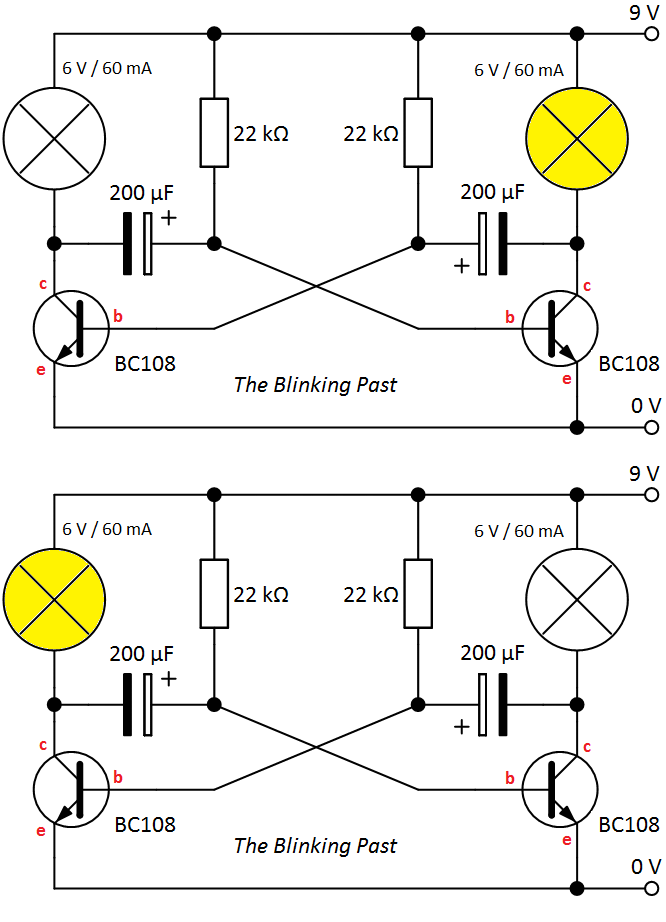
That's more or less exactly what I did - right down to the BC108's.
-Gordon
--
Gordon Henderson.
See my Ruby 6502 and 65816 SBC projects here: https://projects.drogon.net/ruby/
Gordon Henderson.
See my Ruby 6502 and 65816 SBC projects here: https://projects.drogon.net/ruby/
Re: Robots?
That's really neat. The digital logic and the power handling are the same transistors.
When I started experimenting with digital logic in the late 70's TTL IC's were available at Radios Shack. So I always used them as the starting point.
When I started experimenting with digital logic in the late 70's TTL IC's were available at Radios Shack. So I always used them as the starting point.
Re: Robots?
Martin_H wrote:
That's really neat. The digital logic and the power handling are the same transistors.
When I started experimenting with digital logic in the late 70's TTL IC's were available at Radios Shack. So I always used them as the starting point.
When I started experimenting with digital logic in the late 70's TTL IC's were available at Radios Shack. So I always used them as the starting point.
Things did pick up pace though and Maplin (one of the big mail order places) started to open shops, but only in cities. I soon moved to Edinburgh though and there was the wonders of "Browns Radio" - a veritable cave full of everything you wanted, but could never afford...
-G
--
Gordon Henderson.
See my Ruby 6502 and 65816 SBC projects here: https://projects.drogon.net/ruby/
Gordon Henderson.
See my Ruby 6502 and 65816 SBC projects here: https://projects.drogon.net/ruby/
Re: Robots?
It may have been a year or two later, but Tandy (UK branding for Radio Shack) popped up and had a shelf or two of fairly generic components - logic, analogue, passives. Eventually Maplin started to carry a similar range, cunningly informed by what projects were coming up in next month's magazines. Though ten years ago or so, I was informed in Maplin that a chip I had asked for had a suitable replacement, on the grounds that it had the same number of legs...
The back pages of Everyday Electronics were full of adverts from places like John Bull Electronics and Display Electronics and of course Henry's Radio... many places would see you a pound (weight) bag of components for not much money, which was usually what they were worth...
Neil
The back pages of Everyday Electronics were full of adverts from places like John Bull Electronics and Display Electronics and of course Henry's Radio... many places would see you a pound (weight) bag of components for not much money, which was usually what they were worth...
Neil