
Introduce yourself
Re: Introduce yourself
Hi Glitch, I like your screen name and avatar.
Re: Introduce yourself
glitch wrote:
Thanks for the welcomes! We're still in the middle of a work rush to try and get stuff out the door for R6501Q SBC kits and other non-vintage day job stuff, but I'll try and post about some of my other projects! One of the systems I spend a fair bit of time hacking on is the Ohio Scientific Challenger 3 given to me by a former employer/current friend. The C3 uses a 6502 for the main CPU, but also has a Z80 and 6800 that you can switch to under software control! I own a few 6502 machines but that's probably the one I hack on the most.
Dave at OSIweb is not aware of any.

Re: Introduce yourself
BillG wrote:
glitch wrote:
Did anyone ever bring up FLEX on the 6800? OSI disk hardware is rather, shall we say, unique.
Dave at OSIweb is not aware of any.
Dave at OSIweb is not aware of any.

Re: Introduce yourself
lowlevelguy wrote:
My interest hasn't gone away, but I can't find a good environment -- ideally, it would support character I/O. The aforementioned Easy 6502 comes close to that, but the fact that it's written in JavaScript disgusts me when I think of expanding it. I would have used the `run6502` program packaged with lib6502, if only it worked.
And, being written in Python, it's relatively easy to use as you see fit. For example, I have a unit test framework for assembly code that runs the assembled machine code in simulators using a generic machine offering the ability to deposit into memory, attach simulated character I/O, call code, examine the results, etc., and the interface to use py65 is nearly trivial.
Curt J. Sampson - github.com/0cjs

Re: Introduce yourself
(It would be great if these helpful and interesting side-discussions could be taken to their own respective threads, where each conversation could continue freely.)
-
fredericsegard

- Posts: 47
- Joined: 05 Aug 2020
- Location: Montreal, QC, Canada
- Contact:
Re: Introduce yourself
Introducing myself: I'm Fred, and I'm a 6502 addict... no... wait... wrong group!  I also go by the pseudonym MicroHobbyist on Reddit and my blog.
I studied electronics more than 30 years ago but almost forgot it all (to some extent). But I'm relearning. I've had some experience with Arduinos in the past few years. So that kept me up to speed on some concepts.
Out of nostalgia, I decided to build an SBC. Though I initially learned on a 6809, I chose the 6502 because it's still manufactured today by WDC. It took a while, but I'm getting things to work. Building it was a blast. Coding it was almost nightmarish, but managed to pull through. Now I'm stuck with interrupt issues that I must master.
Specs: 65C02, 28K RAM, 2K NVRAM & RTC, 2K IO map, 4K bank RAM window (512K chip), 28K ROM. I was thinking of increasing the bank RAM window to 8K.
I started a blog https://6502sbc.blogspot.com/ to document things a bit. It's not in-depth, but it does give an overview.
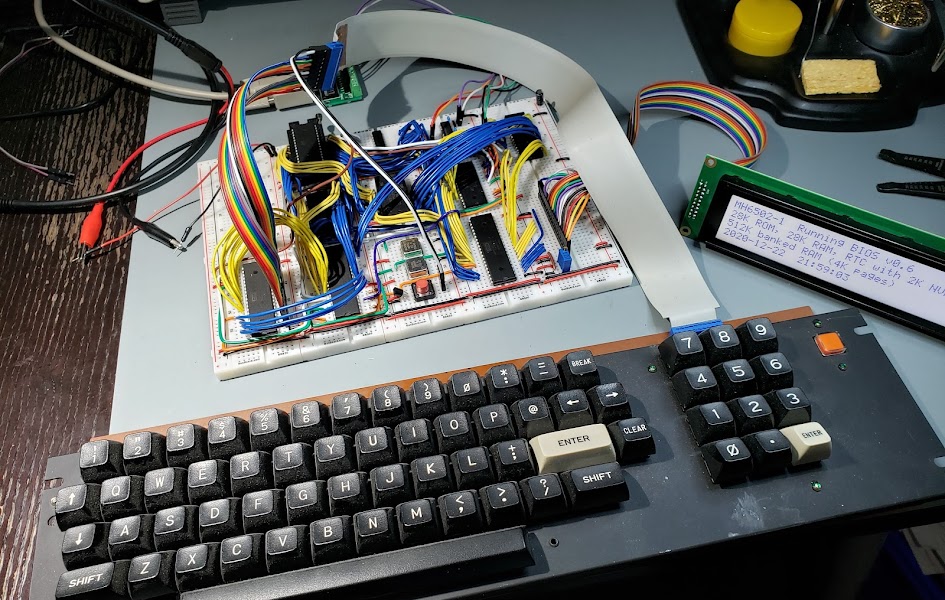
This picture depicts a TRS-80 Model III keyboard, but I recently changed my mind and decided to use "standard" PS/2 keyboards. My initial idea was to use the gutted Model III and use it as an enclosure for my 6502 SBC. I changed my mind, because of the footprint it takes. But I still think it would look cool.
I also go by the pseudonym MicroHobbyist on Reddit and my blog.I studied electronics more than 30 years ago but almost forgot it all (to some extent). But I'm relearning. I've had some experience with Arduinos in the past few years. So that kept me up to speed on some concepts.
Out of nostalgia, I decided to build an SBC. Though I initially learned on a 6809, I chose the 6502 because it's still manufactured today by WDC. It took a while, but I'm getting things to work. Building it was a blast. Coding it was almost nightmarish, but managed to pull through. Now I'm stuck with interrupt issues that I must master.
Specs: 65C02, 28K RAM, 2K NVRAM & RTC, 2K IO map, 4K bank RAM window (512K chip), 28K ROM. I was thinking of increasing the bank RAM window to 8K.
I started a blog https://6502sbc.blogspot.com/ to document things a bit. It's not in-depth, but it does give an overview.
This picture depicts a TRS-80 Model III keyboard, but I recently changed my mind and decided to use "standard" PS/2 keyboards. My initial idea was to use the gutted Model III and use it as an enclosure for my 6502 SBC. I changed my mind, because of the footprint it takes. But I still think it would look cool.
Re: Introduce yourself
Time to say hello, and get more involved.
I first encountered the 6502 at the very end of the 1970's, with a second-hand KIM-1. An Acorn Atom, then a BBC Micro soon followed. I learned a lot from all of them, but they are all sadly gone, and whatever proficiency I had with 6502 assembler is now extremely rusty!
But I'd like to get re-acquainted with the 6502, and some other 8-bit CPUs I missed the first time around. So, I've built Oscar Vermeulen's KIM-UNO emulation, followed by Jeff Tranter's versions of Grant Searle's 6809 SBC, one with a 6809, another with a Hitachi 6309. I also built 6502 and 65C02 versions of Andrew Jacob's enhancements to Mike McLaren's "3-chip 6502". All of these are really neat designs, which I heartily recommend.
Thanks to all the developers and contributors here, who so selflessly share their work and expertise.
Getting ready for some re-learning!
I first encountered the 6502 at the very end of the 1970's, with a second-hand KIM-1. An Acorn Atom, then a BBC Micro soon followed. I learned a lot from all of them, but they are all sadly gone, and whatever proficiency I had with 6502 assembler is now extremely rusty!
But I'd like to get re-acquainted with the 6502, and some other 8-bit CPUs I missed the first time around. So, I've built Oscar Vermeulen's KIM-UNO emulation, followed by Jeff Tranter's versions of Grant Searle's 6809 SBC, one with a 6809, another with a Hitachi 6309. I also built 6502 and 65C02 versions of Andrew Jacob's enhancements to Mike McLaren's "3-chip 6502". All of these are really neat designs, which I heartily recommend.
Thanks to all the developers and contributors here, who so selflessly share their work and expertise.
Getting ready for some re-learning!
Re: Introduce yourself
Welcome! Three successful builds already? That's great.
-
Sheep64

- In Memoriam
- Posts: 311
- Joined: 11 Aug 2020
- Location: A magnetic field
Re: Introduce yourself
I'm here anonymously for contractual reasons and appreciate administrators removing any identifying information about me. I may be absent for extended periods due to health, work or to implement ideas. I authorize any documents to be updated in my absence, such as instruction charts.
I started with computers in the golden age of 8 bit systems and I learned 6502 assembly badly. For example, I apparently lack many of the known idioms. I utterly abhor Wintel and therefore my transition to 16 bit computing was to Commodore Amiga. However, as a relatively early adopter, I strongly disliked being nickel and dimed for development tools. Unfortunately, I missed DICE because I assumed that it was too good to be true. Instead, I made the rare step of moving back to 6502 systems in the late 1980s. I briefly returned to Amiga and learned 68000 assembly (often using Devpac2 as my default text editor) before gaining heavy exposure to Unix variants including HP-UX, SunOS and IRIX. I have intermittently written Java since the Alpha release and some of my work has been included in the FreeBSD ports collection.
I have spent a disproportionate amount of time living/working in Internet cafes, hydroponics, house shares, squats and makerspaces. From this, I have met a very broad selection of people who are not techies. Despite living with multiple programmers, an associate professor from a Beijing university, a government official with a security clearance, a pastor, a Rastafarian, a video editor at MTV, numerous students (mechanical engineering, astrophysics, journalism) and numerous people in retail and catering, I did not expect the most influential people to be a dance student or a car mechanic. At work, customers have been equally diverse. At Internet cafes, this included gamers, backpackers, a farmhand, a costumer, the local ice hockey team, one of the most prolific writers of Quantum Leap erotica and people with multiple obscure medical conditions. In hydroponics, this included wannabe gangsters, actual gangsters, champion guinea pig breeders, curry addicts growing monstrous chili and multiple customers with terminal cancer.
Various versions of my shopping basket script have handled more than USD8 million and allowed an ex-boss to pay a mortgage in full within five years. Meanwhile, I was not particularly focused on money. I tried finding religion without success. I found motivational meetings equally lacking. However, I learned one very good piece of advice. Don't hang around with losers. Immerse yourself in experts who know more. From this, I credit my beauty pageant wins, cheerleading win and database field consultancy which included a rather intense period of business trips to Orlando, Amsterdam, Brussels, Zurich, Stockholm and elsewhere. Prior to an urgent visit to Sofia, I had four hours to learn upper case Cyrillic which saved me from getting lost. I can also read a tiny amount of Chinese. For example, I have a bag of 5mm orange LEDs and the literal translation of the label is "fire color" which is quite poetic.
I became DBA of the scheduling system of the world's largest renderfarm when my predecessor became a Mormon missionary. When working at such scale, downtime cost more than USD1000 per minute in lost software license utilization. That excludes electricity, hardware depreciation, office rental and salary. Despite this being more than 10 years ago, I still regard any computer system with less than 8TFLOPS and 160TB scratch space as medium size at best. I cloned the rather simplistic electronics of a low-cost commercial motion capture system which had been exhibited at SIGGRAPH. Thankfully, this only required a flip-flop and a chain of 4017s. This eliminated purchase of 17 synchronized cameras costing USD13000 each. It also contributed to my manager's Oscar nomination for special effects on The Dark Knight. I also worked on 1408, HP5 and I believe that my backup script maintains the master edit of B22.
I subsequently worked for an archiving/transcoding company and then a streaming video start-up where I was lead programmer. After USD2.1 million of investment, we developed a UDP multi-cast URL-space with stochastic caching proxies which replaces DNS + HTTPS. Unlike TCP, it handles 70% packet loss with ease. It also handles 2^17 pending requests with a single-threaded server using 1MB data segment and 4MB network buffers. The start-up failed spectacularly one week after after we delivered a prototype quantum resistant authentication algorithm. I heard a rumor that the algorithm was being used by a branch of the US Government without permission. My boss asked me to backport work to Apple II or similar. These ideas have been percolating ever since. After outlining 2K streaming video on 6502, I found a technique suitable for 4K video. I am currently working on 8K video and 3D sound.
Along the way, I received a lifetime dose of Adobe vector programs (it mostly affects the splines on my right side), appeared on television as a skateboarding contortionist, taught ballet, (with apologies) ghost wrote the software for three masters theses (dynamic JPEG construction, some color-space processing, Margolus-space cellular automata), proof-read a housemate's paper about ATM multi-cast Manhattan network satellite constellations, taught calculus to under-graduates, taught Unix and Java RMI to post-graduates, worked as a colorist on a horror film, declined an interview at Meridian Audio (I'm so glad that I wasn't involved with MQA) and regularly attended meetings for environmentalists, hackers, goths, furries and, um, clothing optional events.
A close friend from one of these meetings had extensive trouble with local youths and became an expert with ARM Linux CCTV systems. My friend subsequently became an expert with ARM Linux Kodi boxes with extensions such as Popcorn Time. Ignoring the legality of Popcorn Time and similar applications, it is embarrassing when a retired train engineer gets ahead of a Unix expert and streaming video programmer. This was one of many prompts for me to investigate the cliched combo of Raspberry Pi and Arduino which I had circled and avoided for more than three years. After dumping all of the systemd rubbish in Raspbian, it frees 90MB RAM. In addition to systemd being grossly insecure, it is a fantastic example of Not Invented Here busywork which offers no advantage over launchd used by Apple. In one week, I scripted a deamontools/runit clone. However, systemd has been an ongoing, full-time effort for multiple programmers for more than five years. It would have been quicker and more secure to write a Job Control Language. While people may suggest that I dump Raspbian and try RiscOS, many of these cheap, low-power RISC computers skip ECC and they will, for example, steadily corrupt cached directories. I am equally unimpressed with Arduino.
My ability with analog electronics extends to animatronic animal ears where a tilt switch controls an integrator which controls a VCO which is tuned to generate a pulse train suitable to drive an analog servo. Using 741 and 556, two ears may work independently. Unfortunately, I have been completely incapable of making a low power version using a microcontroller. Actually, I've had several false starts with microcontrollers. I learned PIC assembly and got software running in a test environment and development board but no further. Cypress Semiconductor ARM boards caused quite a rift with an ex-colleague. I couldn't get a blinky light working after four hours and my ex-colleague had no success after a further eight hours. After gaining confidence with a Raspberry Pi, I reluctantly made a third attempt with a clone Arduino Due (Atmel ARM). Within four hours, I had debug strings blinking in Morse code. Within two weeks, I had the link layer of a cell network protocol running at 1kHz. After bricking two clone Arduino Nano boards (Atmel AVR), I prototyped a mains power hydroponic light. I am now confident enough to solder 20MHz oscillators to DIP scale microcontrollers. I inadvertently used the wrong oscillator speed configuration and by the time I finished debugging, I had a re-implementation of the digital section of the Arduino library which is not subject to LPGL. People like David L. Jones are astounded that people use an API to access digital I/O pins but the linear arrangement allows #define START_BUTTON 5 and suchlike with no further consideration. Chuck Peddle claimed originality for Data Direction Registers commonly found in I/O chips and microcontrollers. It would be very worthwhile to bring the logical conclusion back to 6502/6522 systems.
In addition to disliking x86 and Microsoft, I am increasingly soured by Unix and, in particular, Linux RISC systems. I briefly investigated CollapseOS and Z80 but confirmed that Z80 is unworkable. I therefore make a second return to 6502. I am aware that I come with expectations from Amiga and Unix but I hope that I can separate arbitrary convention from essential complexity while excluding the influence of Big Tech. The latter is not to be under-estimated. I have become very dis-illusioned with open source and, in particular, the non-discriminatory licensing terms of FOSS which have been promoted by Big Tech and which has aided a dangerous level of centralization. (See Vintage Computer Festival: Jack and the Machine for rationale.)
Unfortunately, my health has declined considerably since 2014. I have a diagnosis for my condition but I have been repeatedly denied treatment. I have the reasonable expectation that I could compete as a Level 3 Cheerleader doing, for example, a back handspring. Instead, I have difficulty removing my shoes. This and further limitations can get quite tedious. (This is another reason for my objection to non-discriminatory licensing. People who have made a buck out of my unnecessary pain and suffering don't get my work for free.) In my impaired state, I have found that a constant stream of text-to-speech aids my concentration. However, this may be partly due to the hassle of pausing or restarting my scripts.
I hope to make a commercially viable 6502 system which is practical, easy to repair, self-hosting, fast and secure. Hopefully, it is not a last hurrah before I drop dead (possibly from a lifetime of absurdity). My contributions to the forum may be intermittent or delayed but I expect to be active for a minimum of three years.
I started with computers in the golden age of 8 bit systems and I learned 6502 assembly badly. For example, I apparently lack many of the known idioms. I utterly abhor Wintel and therefore my transition to 16 bit computing was to Commodore Amiga. However, as a relatively early adopter, I strongly disliked being nickel and dimed for development tools. Unfortunately, I missed DICE because I assumed that it was too good to be true. Instead, I made the rare step of moving back to 6502 systems in the late 1980s. I briefly returned to Amiga and learned 68000 assembly (often using Devpac2 as my default text editor) before gaining heavy exposure to Unix variants including HP-UX, SunOS and IRIX. I have intermittently written Java since the Alpha release and some of my work has been included in the FreeBSD ports collection.
I have spent a disproportionate amount of time living/working in Internet cafes, hydroponics, house shares, squats and makerspaces. From this, I have met a very broad selection of people who are not techies. Despite living with multiple programmers, an associate professor from a Beijing university, a government official with a security clearance, a pastor, a Rastafarian, a video editor at MTV, numerous students (mechanical engineering, astrophysics, journalism) and numerous people in retail and catering, I did not expect the most influential people to be a dance student or a car mechanic. At work, customers have been equally diverse. At Internet cafes, this included gamers, backpackers, a farmhand, a costumer, the local ice hockey team, one of the most prolific writers of Quantum Leap erotica and people with multiple obscure medical conditions. In hydroponics, this included wannabe gangsters, actual gangsters, champion guinea pig breeders, curry addicts growing monstrous chili and multiple customers with terminal cancer.
Various versions of my shopping basket script have handled more than USD8 million and allowed an ex-boss to pay a mortgage in full within five years. Meanwhile, I was not particularly focused on money. I tried finding religion without success. I found motivational meetings equally lacking. However, I learned one very good piece of advice. Don't hang around with losers. Immerse yourself in experts who know more. From this, I credit my beauty pageant wins, cheerleading win and database field consultancy which included a rather intense period of business trips to Orlando, Amsterdam, Brussels, Zurich, Stockholm and elsewhere. Prior to an urgent visit to Sofia, I had four hours to learn upper case Cyrillic which saved me from getting lost. I can also read a tiny amount of Chinese. For example, I have a bag of 5mm orange LEDs and the literal translation of the label is "fire color" which is quite poetic.
I became DBA of the scheduling system of the world's largest renderfarm when my predecessor became a Mormon missionary. When working at such scale, downtime cost more than USD1000 per minute in lost software license utilization. That excludes electricity, hardware depreciation, office rental and salary. Despite this being more than 10 years ago, I still regard any computer system with less than 8TFLOPS and 160TB scratch space as medium size at best. I cloned the rather simplistic electronics of a low-cost commercial motion capture system which had been exhibited at SIGGRAPH. Thankfully, this only required a flip-flop and a chain of 4017s. This eliminated purchase of 17 synchronized cameras costing USD13000 each. It also contributed to my manager's Oscar nomination for special effects on The Dark Knight. I also worked on 1408, HP5 and I believe that my backup script maintains the master edit of B22.
I subsequently worked for an archiving/transcoding company and then a streaming video start-up where I was lead programmer. After USD2.1 million of investment, we developed a UDP multi-cast URL-space with stochastic caching proxies which replaces DNS + HTTPS. Unlike TCP, it handles 70% packet loss with ease. It also handles 2^17 pending requests with a single-threaded server using 1MB data segment and 4MB network buffers. The start-up failed spectacularly one week after after we delivered a prototype quantum resistant authentication algorithm. I heard a rumor that the algorithm was being used by a branch of the US Government without permission. My boss asked me to backport work to Apple II or similar. These ideas have been percolating ever since. After outlining 2K streaming video on 6502, I found a technique suitable for 4K video. I am currently working on 8K video and 3D sound.
Along the way, I received a lifetime dose of Adobe vector programs (it mostly affects the splines on my right side), appeared on television as a skateboarding contortionist, taught ballet, (with apologies) ghost wrote the software for three masters theses (dynamic JPEG construction, some color-space processing, Margolus-space cellular automata), proof-read a housemate's paper about ATM multi-cast Manhattan network satellite constellations, taught calculus to under-graduates, taught Unix and Java RMI to post-graduates, worked as a colorist on a horror film, declined an interview at Meridian Audio (I'm so glad that I wasn't involved with MQA) and regularly attended meetings for environmentalists, hackers, goths, furries and, um, clothing optional events.
A close friend from one of these meetings had extensive trouble with local youths and became an expert with ARM Linux CCTV systems. My friend subsequently became an expert with ARM Linux Kodi boxes with extensions such as Popcorn Time. Ignoring the legality of Popcorn Time and similar applications, it is embarrassing when a retired train engineer gets ahead of a Unix expert and streaming video programmer. This was one of many prompts for me to investigate the cliched combo of Raspberry Pi and Arduino which I had circled and avoided for more than three years. After dumping all of the systemd rubbish in Raspbian, it frees 90MB RAM. In addition to systemd being grossly insecure, it is a fantastic example of Not Invented Here busywork which offers no advantage over launchd used by Apple. In one week, I scripted a deamontools/runit clone. However, systemd has been an ongoing, full-time effort for multiple programmers for more than five years. It would have been quicker and more secure to write a Job Control Language. While people may suggest that I dump Raspbian and try RiscOS, many of these cheap, low-power RISC computers skip ECC and they will, for example, steadily corrupt cached directories. I am equally unimpressed with Arduino.
My ability with analog electronics extends to animatronic animal ears where a tilt switch controls an integrator which controls a VCO which is tuned to generate a pulse train suitable to drive an analog servo. Using 741 and 556, two ears may work independently. Unfortunately, I have been completely incapable of making a low power version using a microcontroller. Actually, I've had several false starts with microcontrollers. I learned PIC assembly and got software running in a test environment and development board but no further. Cypress Semiconductor ARM boards caused quite a rift with an ex-colleague. I couldn't get a blinky light working after four hours and my ex-colleague had no success after a further eight hours. After gaining confidence with a Raspberry Pi, I reluctantly made a third attempt with a clone Arduino Due (Atmel ARM). Within four hours, I had debug strings blinking in Morse code. Within two weeks, I had the link layer of a cell network protocol running at 1kHz. After bricking two clone Arduino Nano boards (Atmel AVR), I prototyped a mains power hydroponic light. I am now confident enough to solder 20MHz oscillators to DIP scale microcontrollers. I inadvertently used the wrong oscillator speed configuration and by the time I finished debugging, I had a re-implementation of the digital section of the Arduino library which is not subject to LPGL. People like David L. Jones are astounded that people use an API to access digital I/O pins but the linear arrangement allows #define START_BUTTON 5 and suchlike with no further consideration. Chuck Peddle claimed originality for Data Direction Registers commonly found in I/O chips and microcontrollers. It would be very worthwhile to bring the logical conclusion back to 6502/6522 systems.
In addition to disliking x86 and Microsoft, I am increasingly soured by Unix and, in particular, Linux RISC systems. I briefly investigated CollapseOS and Z80 but confirmed that Z80 is unworkable. I therefore make a second return to 6502. I am aware that I come with expectations from Amiga and Unix but I hope that I can separate arbitrary convention from essential complexity while excluding the influence of Big Tech. The latter is not to be under-estimated. I have become very dis-illusioned with open source and, in particular, the non-discriminatory licensing terms of FOSS which have been promoted by Big Tech and which has aided a dangerous level of centralization. (See Vintage Computer Festival: Jack and the Machine for rationale.)
Unfortunately, my health has declined considerably since 2014. I have a diagnosis for my condition but I have been repeatedly denied treatment. I have the reasonable expectation that I could compete as a Level 3 Cheerleader doing, for example, a back handspring. Instead, I have difficulty removing my shoes. This and further limitations can get quite tedious. (This is another reason for my objection to non-discriminatory licensing. People who have made a buck out of my unnecessary pain and suffering don't get my work for free.) In my impaired state, I have found that a constant stream of text-to-speech aids my concentration. However, this may be partly due to the hassle of pausing or restarting my scripts.
I hope to make a commercially viable 6502 system which is practical, easy to repair, self-hosting, fast and secure. Hopefully, it is not a last hurrah before I drop dead (possibly from a lifetime of absurdity). My contributions to the forum may be intermittent or delayed but I expect to be active for a minimum of three years.
Re: Introduce yourself
I'm Hans, and my first (own) computer in the early eighties was a VIC-20, on which I did a bit of 6502 programming using VICMON, as well as some simple hardware mods. Since then, I've been programming for some 35 years on a wide variety of platforms, and the VIC-20 kind of faded into history for me, until I finally threw it out almost 20 years ago, thinking I would never be interested in playing with that old thing again.
... until a couple of years ago, when a colleague gave me a couple of VIC-20s to restore. I've subsequently bought a few more, and started making hardware mods for it, and now also reignited my interest in 6502 assembly.
I came here because I was looking for more info on @White Flame's "wfdis" disassembler, which I've used quite a lot both on my own old code (some of which I had preserved in old EPROMS) and on various other code.
... until a couple of years ago, when a colleague gave me a couple of VIC-20s to restore. I've subsequently bought a few more, and started making hardware mods for it, and now also reignited my interest in 6502 assembly.
I came here because I was looking for more info on @White Flame's "wfdis" disassembler, which I've used quite a lot both on my own old code (some of which I had preserved in old EPROMS) and on various other code.
Re: Introduce yourself
Welcome! Feel free to find a suitable thread for continuation, or to start a new thread. (Don't worry, all threads will be seen.)

Re: Introduce yourself
Hello,
my name is Alessio Ferri, I am a computer engineering student at Unibo. I always had an interest in microprocessors. When my father noticed my interest, he gifted me his book "Programmazione del 6502" by Rodeny Zacks ("Programming the 6502" if you need translation).
I never used a real computer with a 6502, so my experiences on the cpu are only Commodore64/NES simulators. All in all i appreciate the 6502 architecture.
EDIT
Moderators asked me to keep this thread more clean. I deleted some unneeded references to my project.
my name is Alessio Ferri, I am a computer engineering student at Unibo. I always had an interest in microprocessors. When my father noticed my interest, he gifted me his book "Programmazione del 6502" by Rodeny Zacks ("Programming the 6502" if you need translation).
I never used a real computer with a 6502, so my experiences on the cpu are only Commodore64/NES simulators. All in all i appreciate the 6502 architecture.
EDIT
Moderators asked me to keep this thread more clean. I deleted some unneeded references to my project.
Last edited by aleferri on Sun May 02, 2021 8:31 pm, edited 1 time in total.
Re: Introduce yourself
Welcome - it'll certainly be interesting to hear about your CPU, both the design of it and the implementation.
(I'm really really hoping we don't see anyone try to extend a technical discussion into this thread...)
(I'm really really hoping we don't see anyone try to extend a technical discussion into this thread...)
-
BigDumbDinosaur

- Posts: 9428
- Joined: 28 May 2009
- Location: Midwestern USA (JB Pritzker’s dystopia)
- Contact:
Re: Introduce yourself
aleferri wrote:
my name is Alessio Ferri, I am a computer engineering student at Unibo.
Welcome!
Quote:
I always had an interest in microprocessors. When my father noticed my interest, he gifted me his own book "Programmazione del 6502" by Rodeny Zacks ("Programming the 6502" if you need translation).
That book is a classic. I had no idea there was an Italian translation of it. The other classic of that book's time was Lance Leventhal's 6502 Assembly Language Programming. More recently, there is Programming the 65816, Including the 6502, 65C02, and 65802, published by Western Design Center. It's available for download and is highly recommended.
x86? We ain't got no x86. We don't NEED no stinking x86!

Re: Introduce yourself
Here's a quick howdy, some background and why I'm here...
I recently got an itch to build something during COVID, so I bought one of the VCF's 6502 Badge kits. Well that build went great. Powered up first try (much to my amazement ). That kicked in a renewed 6502 passion. Not being satisfied to just watch the LEDs scroll a message, I started on a tear to see how much I could get to run on it (I have 32K RAM). So I've been porting a number of classic programs to work on the "Badge". For what it's worth I got a version of KIM-1 Microchess to run, which is a bit of a kick. At any rate, I may be the only person in the world that cares, but it's been fun anyway. I'll post my results eventually so the handful of other folks that might possibly be interested will have access. It's still a bit of work-in-progress.
My background is:
- wrote my first program in BASIC on an ASR33 dialed up to TymShare in 1971 (August will be 50 years!)
- wrote my first machine language on a Xerox Sigma 9 (at college where we had IBM copiers for some strange irony)
- got my first Apple II ~'78 while in grad school. Wrote my first commercial program ~'80 for "Serendipity Systems"
- Worked a brief spell at Tandy ~81 during the era of the CoCo, TRS80 Model 100, etc.
- Later did a variety of software engineering/CompSci research roles at Xerox, HP, Agilent, Keysight, etc.
- Retired in 2020
I'm looking forward to catching up on 6502 developments and lore.
Regards,
Robert
I recently got an itch to build something during COVID, so I bought one of the VCF's 6502 Badge kits. Well that build went great. Powered up first try (much to my amazement
). That kicked in a renewed 6502 passion. Not being satisfied to just watch the LEDs scroll a message, I started on a tear to see how much I could get to run on it (I have 32K RAM). So I've been porting a number of classic programs to work on the "Badge". For what it's worth I got a version of KIM-1 Microchess to run, which is a bit of a kick. At any rate, I may be the only person in the world that cares, but it's been fun anyway. I'll post my results eventually so the handful of other folks that might possibly be interested will have access. It's still a bit of work-in-progress.My background is:
- wrote my first program in BASIC on an ASR33 dialed up to TymShare in 1971 (August will be 50 years!)
- wrote my first machine language on a Xerox Sigma 9 (at college where we had IBM copiers for some strange irony)
- got my first Apple II ~'78 while in grad school. Wrote my first commercial program ~'80 for "Serendipity Systems"
- Worked a brief spell at Tandy ~81 during the era of the CoCo, TRS80 Model 100, etc.
- Later did a variety of software engineering/CompSci research roles at Xerox, HP, Agilent, Keysight, etc.
- Retired in 2020
I'm looking forward to catching up on 6502 developments and lore.
Regards,
Robert