Issue with ATF22V10C

Topics relating to PALs, CPLDs, FPGAs, and other PLDs used for the support or creation of 65-family processors, both hardware and HDL.
Risc
Posts: 4
Joined: 28 Jul 2020

Re: Issue with ATF22V10C

Post by Risc »

Thanks! I'm new to CPLD's. I'm curious; How can you tell if a device can contain a particular logic function? I mean, it's easy to determine whether the number of pins is sufficient or not for outside operation. But how can you tell that the particular implementation will "fit" in a certain device? Reading the datasheet tells me I have 10 macrocells - whatever fits in a macrocell comes with experience I guess?

EDIT:

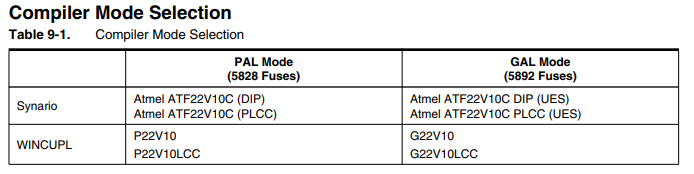
Hmm yes, the compiler mode is present in the datasheet as you say like this:
Image

But WinCupl also needs "pinnodes", which according to the manual should be defined as well:
Image

Any guess where I can find the correct number of pinnodes for this device?

EDIT 2: I'm an idiot. Of course it doesn't "need" pinnodes - it's up to me to use them if I want to *facepalm*. Nothing to see here, move along ;)
User avatar
BigDumbDinosaur
Posts: 9426
Joined: 28 May 2009
Location: Midwestern USA (JB Pritzker’s dystopia)
Contact:

Re: Issue with ATF22V10C

Post by BigDumbDinosaur »

Risc wrote:
But WinCupl also needs "pinnodes", which according to the manual should be defined as well:
Image

Any guess where I can find the correct number of pinnodes for this device?

EDIT 2: I'm an idiot. Of course it doesn't "need" pinnodes - it's up to me to use them if I want to *facepalm*. Nothing to see here, move along ;)
Pin nodes are logic nodes that are "buried" and are not attached to physical pin. Pin nodes may be used in a variety of ways, such as to declare a register that maintains state. For example:

Code: Select all

pinnode   = [blatch0..3];                         /* bank address registers               */
The above defines is a 4-bit register used to latch the 65C816's bank bits. Later on, the register is used thusly:

Code: Select all

[blatch0..3].LE = bavalid & !wsext;               /* open latches, unless in wait-state */
[blatch0..3].L  = [D0..3] & bavalid & !wsext;     /* capture bank, unless in wait-state */
SPLDs (GALs) generally do not have buried logic capabilities, which means you have to use actual pins in place of pin nodes, which has both performance and logic effects. If a logic path requires the use of a physical pin as a node then total propagation time will be greater than the device's advertised capabilities—vendors specify prop time as pin-to-pin. Also, such a pin is no longer available as an output, unless the intermediate steps of the logic being implemented can be externally used.

If your logic is going to be of any complexity and maintaining state is part of it you are better off using a CPLD. If you attempt to declare a pin node with a device that has no support for it you will get a compile-time error.
x86?  We ain't got no x86.  We don't NEED no stinking x86!
Chromatix
Posts: 1462
Joined: 21 May 2018

Re: Issue with ATF22V10C

Post by Chromatix »

The ATF750 series is a small CPLD which has the form factor and pinout of a 22V10, but adds a bank of buried flipflops and internal nodes to the standard 22V10's pin-oriented ones.

All GALs are based on a logic structure known as "sum of products". Each input is buffered to produce a copy and its complement, then a product term is just an AND over some combination of inputs and their complements, and the product terms are ORed together to compute the sum of products. Each such sum is then presented as one of the inputs to the macrocell, the details of which varies between device types. The number of product terms summed to each input also varies; in a 22V10 the central output pins have more terms available than the outer ones, and various auxiliary signals may have only one or two terms. Each macrocell and output pin is then fed back as an input (and complement) to the product term array.

If you don't feel like analysing all that by hand, the best way to figure out if a design will fit is to write the code implementing it, then try to compile it for the proposed device. The compiler will scream at you if it can't find a way to make it fit.
SteveD
Posts: 15
Joined: 18 Apr 2020
Location: Canberra, Australia

Re: Issue with ATF22V10C

Post by SteveD »

Hi Risc,
BigDumbDinosaur wrote:
atf22v10c.pdf
You tell WinCUPL which device you are using in the header of your design file. It's all explained in the help files that are part of WinCUPL. The correct device is g22v10.
is a useful starting point but I've found that the Atmel datasheet kinda assumes you know what a 22V10 does. I've found the Lattice datasheet to be a little more helpful http://web.mit.edu/6.115/www/document/gal22v10.pdf.

The macro cell itself is really just a D type flip flop plus a couple of multiplexers. The multiplexers allow the output to be either a combinational or sequential function. Lattice datasheet pg. 3 makes this clear and pg. 4 takes you through all the possible configurations. Note that these are selected during programming and cannot be changed once the chip is in use. The Atmel chip functions the same, just not as well documented.

Your original question was along the lines of "how can I tell if my function will fit?". Unfortunately it really depends on the complexity of your application.

My apologies if you already understand this bit. Looking at the Lattice pg. 5 you'll see the chip laid out schematically. The vertical lines are numbered 0 to 43. They are connected to either the chip inputs or to a macrocell. If the macrocell is configured to operate sequentially, i.e. flip flop, then the value is taken from the flip flops /Q output. If the macrocell is combinational then the value comes from the output pin itself, it basically gives you another input pin.

The vertical lines form complementary pairs, that is a signal plus its inverse. For example, vertical 0 is hardwired to pin 1, vertical 1 is pin 1 inverted (not pin 1). Verticals 2&3 are connected to feedback from macrocell 1, with vertical 2 being the opposite polarity to vertical 3. All up there are 22 input signals available in their positive and negative logic levels.

The horizontal lines (rows) labelled with four digit numbers form the AND/OR array. This is also known as the sum of products array. Each of these horizontal lines feeds into an AND gate. Each AND gate has 44 inputs, the verticals mentioned previously. The output of each AND gate is fed into a large OR gate. The OR gates vary in size between 8 and 16 inputs. Macrocells 1 & 10 (top & bottom) have the smallest OR gates (8 inputs). Macrocells 5&6 (middle) have the biggest, 16 inputs each. This difference can be important and is expanded later.

The way GAL's work is that there is a programmable fuse at each and every intersection between the vertical and horizontal lines.

Each fuse has a number and they are organised by row and column. The fuse number is given by the row plus the column number. For example, row 44 controls the output enable for pin 23. If I wanted to control this using pin 2 (active high) then I need to connect row 44 to column 4. This means fuse 48 needs to be programmed/connected. If I wanted to use pin 2 (active low) then I need to connect row 44 and column 5, i.e. fuse 49. If this was the only input used then the other 43 columns would be left disconnected. Whilst this sounds complicated you don't normally have to deal with the fuse map unless there is a problem.

The WinCUPL software takes your logic equations and works out which fuses it needs to connect, i.e. it does all the row/column calculations for you. You can always get to the data, WinCUPL puts this into one of its reports, I think it's the fuse map but don't have it handy right now.

Will your stuff fit? Try it and see. If you get warned about a function being too complex for a single macrocell you can either 1) move it to a macrocell with a larger OR gate or 2) combine the output of one macrocell with the inputs from another i.e. use 2 macrocells to give you more space in the AND/OR array.

I hope you find this stuff useful.
Post Reply