

Hi all - first post here.
I've got a couple of small 6502 systems running on Lattice ice40 FPGAs, built entirely with open-source tools. I've found these FPGAs to be inexpensive and easily accessible to the hobbyist since they come in packages you can solder by hand.
The first one is targeted at the readily-available Lattice icestick dev board:
https://github.com/emeb/icestick_6502
It's a bit constrained with only 4kB ROM and 4kB RAM, but it runs at 12MHz and has GPIO and a 9600bps serial port. You can plug it in, program it and talk to it with a terminal application over a USB/Serial link that's built into the devboard. Hardware design is via the FOSS icestorm toolchain and you can code for the 6502 ROM with cc65.
The second one is basically the same thing on a larger FPGA:
https://github.com/emeb/up5k_6502
This one has 4kB ROM and 32kB RAM (easily expandable to 15kB/128kB) but is otherwise similar to the icestick version. I've got it running on a Gnarly Grey upduino board so it's not quite as plug-n-play as the icestick version - no built-in programming and serial interface. I do know that someone else has successfully ported it to the 1bitsquared Icebreaker board though, and that one does have programming and serial interfaces built-in, plus LEDs and buttons.
I've got a few others that are unpublished at the moment, including one which is a full port of the OSI C1P/Superboard (my first computer - I am old). There are some PCB designs in the works to bring out keyboard, video and other I/O and I hope to have a tiny system with full BASIC and video running in the near future.
Small 6502 systems on Lattice ice40

Re: Small 6502 systems on Lattice ice40
Welcome! These sound like great projects. I'll have a good look when I'm back at a desktop.
Re: Small 6502 systems on Lattice ice40
Hi!
I'm aso experimenting with an Upduino board with the ice40up5k FPGA using the open source toolchain, learning verilog in the process.
My current computer is at https://github.com/dmsc/my6502 , it has:
- 6502 CPU, using Arlet Ottens core.
- A reloadable 16 bit timer module, at address $FE00.
- An UART at fixed 115200 baud rate, at address $FE20.
- An RGB led controller (with PWM, ramps and On/Off times), at address $FE40.
- 256 bytes of boot ROM at address $FF00 to $FFFF.
- 63.5k bytes of RAM, at address $0000 to $FDFF.
- VGA output with memory mapped bitmap, 320x204 pixels, at address $C000 to $DFFF.
I discovered that for the VGA output I needed an crystal clock, so he board needs one external oscilator to work.
emeb wrote:
Hi all - first post here.
I've got a couple of small 6502 systems running on Lattice ice40 FPGAs, built entirely with open-source tools. I've found these FPGAs to be inexpensive and easily accessible to the hobbyist since they come in packages you can solder by hand.
I've got a couple of small 6502 systems running on Lattice ice40 FPGAs, built entirely with open-source tools. I've found these FPGAs to be inexpensive and easily accessible to the hobbyist since they come in packages you can solder by hand.
My current computer is at https://github.com/dmsc/my6502 , it has:
- 6502 CPU, using Arlet Ottens core.
- A reloadable 16 bit timer module, at address $FE00.
- An UART at fixed 115200 baud rate, at address $FE20.
- An RGB led controller (with PWM, ramps and On/Off times), at address $FE40.
- 256 bytes of boot ROM at address $FF00 to $FFFF.
- 63.5k bytes of RAM, at address $0000 to $FDFF.
- VGA output with memory mapped bitmap, 320x204 pixels, at address $C000 to $DFFF.
I discovered that for the VGA output I needed an crystal clock, so he board needs one external oscilator to work.

Re: Small 6502 systems on Lattice ice40
Welcome, emeb!  And, emeb and dmsc -- it's exciting to see soft 65xx CPU's brought together with on-chip memory and peripherals!
( Speaking of peripherals, is anyone up to the task of creating a soft 6522? That chip is well known and extremely versatile -- I think a soft version might really generate some interest. )
cheers!
Jeff
And, emeb and dmsc -- it's exciting to see soft 65xx CPU's brought together with on-chip memory and peripherals!( Speaking of peripherals, is anyone up to the task of creating a soft 6522? That chip is well known and extremely versatile -- I think a soft version might really generate some interest. )
cheers!
Jeff
In 1988 my 65C02 got six new registers and 44 new full-speed instructions!
https://laughtonelectronics.com/Arcana/ ... mmary.html
https://laughtonelectronics.com/Arcana/ ... mmary.html
Re: Small 6502 systems on Lattice ice40
Dr Jefyll wrote:
Speaking of peripherals, is anyone up to the task of creating a soft 6522? That chip is well known and extremely versatile -- I think a soft version might really generate some interest.
Re: Small 6502 systems on Lattice ice40
Cool. Thanks!
In 1988 my 65C02 got six new registers and 44 new full-speed instructions!
https://laughtonelectronics.com/Arcana/ ... mmary.html
https://laughtonelectronics.com/Arcana/ ... mmary.html
Re: Small 6502 systems on Lattice ice40
emeb wrote:
Dr Jefyll wrote:
Speaking of peripherals, is anyone up to the task of creating a soft 6522? That chip is well known and extremely versatile -- I think a soft version might really generate some interest.
https://github.com/hoglet67/BeebFpga/bl ... /m6522.vhd
Re: Small 6502 systems on Lattice ice40
BigEd wrote:
emeb wrote:
Dr Jefyll wrote:
Speaking of peripherals, is anyone up to the task of creating a soft 6522? That chip is well known and extremely versatile -- I think a soft version might really generate some interest.
https://github.com/hoglet67/BeebFpga/bl ... /m6522.vhd
https://github.com/hoglet67/Ice40Beeb/b ... rc/m6522.v
The 6522 is very tricky to get right, and it probably isn't yet!
On the Ice40 theme, I've ported a number of 8-bit based Systems to the Mystorm BlackIce/BlackIce II boards, including the Acorn Atom and BBC Micro:
https://github.com/hoglet67?utf8=%E2%9C ... &language=
https://forum.mystorm.uk/?order=views
Both are currently using Arlet's core, and are working very nicely.
Dave
Re: Small 6502 systems on Lattice ice40
I've added a third project:
https://github.com/emeb/up5k_basic
This one is a minor extension of the larger Lattice Ultra Plus project which adds an 8k MS BASIC ROM which is connected via the ACIA. It's able to run simple programs, do floating point calculations, etc. The BASIC ROM image I used is for the OSI C1P/Superboard and was found on the osiweb.org site. I'm pretty sure that's still copyright by Microsoft so it's not really for free distribution, but for educational/hobbyist purposes it's fun to play with.
https://github.com/emeb/up5k_basic
This one is a minor extension of the larger Lattice Ultra Plus project which adds an 8k MS BASIC ROM which is connected via the ACIA. It's able to run simple programs, do floating point calculations, etc. The BASIC ROM image I used is for the OSI C1P/Superboard and was found on the osiweb.org site. I'm pretty sure that's still copyright by Microsoft so it's not really for free distribution, but for educational/hobbyist purposes it's fun to play with.
Re: Small 6502 systems on Lattice ice40
Now with video output
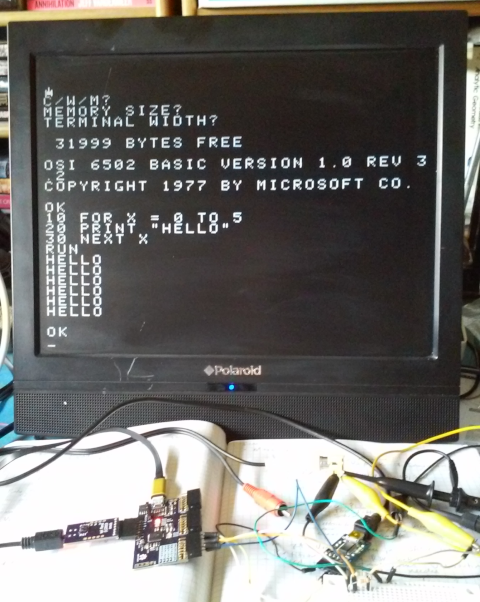
This is an improvement over the original OSI composite video system that eliminates the wasted text in the overscan area and allows a full 32 character/line display.
More here: https://github.com/emeb/up5k_basic
This is an improvement over the original OSI composite video system that eliminates the wasted text in the overscan area and allows a full 32 character/line display.
More here: https://github.com/emeb/up5k_basic
Re: Small 6502 systems on Lattice ice40
I've added more features:
- * Wishbone bridge to access the SPI & I2C hard IP cores on the iCE40 FPGA
* Access to the on-chip RGB LED PWM driver IP core
* 256 x 224 pixel graphics mode for the NTSC composite video output (with 4 selectable pages)
Re: Small 6502 systems on Lattice ice40
Great progress! Do you plan to drive a keyboard, somehow or other?
Re: Small 6502 systems on Lattice ice40
BigEd wrote:
Great progress! Do you plan to drive a keyboard, somehow or other?
After that I need to come up with a load/save approach for BASIC programs. The original OSI BASIC used 300bps serial FSK to cassette tape + LIST command to dump out raw text and then read it back in as phantom keypresses - seems pretty kludgey but anything more than that would require augmenting the BASIC code so I'll have to carefully consider this.
Re: Small 6502 systems on Lattice ice40
I quite like the save-basic-as-stream-of-bytes-from-a-listing approach of the OSI (and Compukit) machines. It's simple, it allows for program overlays, and the files can be read or written by programs without special knowledge of formats or tokenisation.
Re: Small 6502 systems on Lattice ice40
BigEd wrote:
I quite like the save-basic-as-stream-of-bytes-from-a-listing approach of the OSI (and Compukit) machines. It's simple, it allows for program overlays, and the files can be read or written by programs without special knowledge of formats or tokenisation.