

Wire-Wrap is a very good way to start. Today it is a bit expensive but still worth the reward I think. Probably you can find hints regarding WW in GARTHWILSONs primer section. IIRC Garth is still using WW.
Just a question: how do you plan to get your baby up and running?
I am asking because I see a couple of problems that may appear, like dumb wiring errors or silly mistakes in the software and the like. Then without a working interface (like using the VIA for parallel communication with say an Arduino or the like) it may get tough to detect what's going wrong.
Regards,
Arne
65C02 computer with composite video generation
Re: 65C02 computer with composite video generation
BigEd wrote:
A build log is a great idea, and I think it be fine as a continuation of this thread. It's nice if, when you have particular questions, you start a well-focussed thread on each question.
GaBuZoMeu wrote:
Just a question: how do you plan to get your baby up and running?
 The way I believe I'm going to "baby-step" my circuit is by first ignoring the video section entirely. I have already built a simple breadboard 6502 computer so the first thing I will do is basically copy what I have already done setting up the CPU, RAM, ROM, and VIA, with the added complexity of the address multiplexers in between. I will first use an Arduino to provide a very slow clock (even single step at first) to use an array of LEDs to inspect the address and data busses, then I will setup a serial communication between the circuit and my desktop computer to use my very simple OS. Then I will set up the video generation circuit with a minimal char ROM and I will make sure that the composite video signal is correct, using Arduino as ADC (still running at very low speeds naturally).
When everything is operating correctly, I will connect the 8MHz oscillator and test the system with a composite to VGA adapter, which I already used to test some experimental composite signals with Arduino.
It is a long way to go!
I already have a constructive question. I am totally new to wire wrapping, and I have never used it before. I went online to look for some WW sockets and I indeed found them to be quite expensive, particularly on big resellers. I went to Ebay with little luck, particularly with Italian sellers. Even 6 euros for a 14 pin socket

I found significantly cheaper sockets on UK Ebay, sold in 32 pins strips. The picture was not very clear, but they were sold as WW sockets and the dimensions matched the WW tool I got, so I bought them. Sadly, it turns out that the pins have a round section, not a square one as usually described in guides and online reference. To be honest, I was afraid of that from the picture, but since I never found round pins mentioned in online guides, I assumed I was wrong,
I have tried wrapping 30AWG wire on the pins with my tool, but the bond is terrible. A very small pull on the wire causes it to unwrap and the whole wrapping can easily slide along the pin.
I assumed the pins were unusable, then I realized I could get them to be a bit more "square" by lightly sanding down two faces with fine grit sanding paper. Since the strips have many pins, it is quite easy to sand them as shown in the attached picture, removing the red parts. I know that probably the bond at the edges will not be as good as what I could get with a proper pin, however now the wraps are so strong that the wire will snap before the wire starts unwrapping, and I can't get the wrap to slide along the pin. Do you believe this will be good enough to get a good electrical connection? Keep in mind I'm not looking something that will last many years, as I'm planning to make a PCB for the circuit and reuse the sockets for future projects.
Thank you for your help!
Kind regards,
Davide
- Attachments
-
- pinsanding.png (4.84 KiB) Viewed 1070 times

Re: 65C02 computer with composite video generation
You might try sanding down two adjacent sides, or even three sides, but maybe you already have sharp enough corners to get a pressure weld. If it won't slide, that's probably a good sign - good enough for hobby purposes, but don't build a spacecraft!
Re: 65C02 computer with composite video generation
Yes I assumed that a good sharp edge would be best for a proper bond, but then I should sand the pins one by one and I don't think I can get a clean result because I do not know how I could hold them steadily while sanding. Sanding the entire strip of 32 pins at a time is much easier, also to make sure that the two faces are parallel to each other. Do you have any suggestion how to electrically test the bond?
Ah! So my plan to fly to the moon is forever lost! 
BigEd wrote:
but don't build a spacecraft!
Re: 65C02 computer with composite video generation
If you wire together alternate tops and bottoms of a strip, you'll have maybe 31 connections in series - test with an LED or a continuity tester. If you can do 31 good connections, you're probably going to be OK.
(Can you get verowire where you are? It doesn't have all the advantages of wirewrap but it's probably cheaper. You use fine gauge enamelled wire point-to-point, and the heat of soldering gets rid of the enamel so you never need to strip the wires.)
(Can you get verowire where you are? It doesn't have all the advantages of wirewrap but it's probably cheaper. You use fine gauge enamelled wire point-to-point, and the heat of soldering gets rid of the enamel so you never need to strip the wires.)

Re: 65C02 computer with composite video generation
DPax92 wrote:
I realized I could get them to be a bit more "square" by lightly sanding down two faces with fine grit sanding paper.
In 1988 my 65C02 got six new registers and 44 new full-speed instructions!
https://laughtonelectronics.com/Arcana/ ... mmary.html
https://laughtonelectronics.com/Arcana/ ... mmary.html
Re: 65C02 computer with composite video generation
Mouser's filter aren't optimal, but within this selection are some regular WW-sockets.

Re: 65C02 computer with composite video generation
Does Jameco ship to Italy? I've bought WW sockets from them at a reasonable price. You may pay a bunch for shipping but perhaps you could load up in one order.
They sell them in 1x40 pins too. So you could make custom sizes.
I've used them for buying 2x40 (600 mill) sockets in WW because eBay seems to have more 14-28 pins and few 40.
BTW, I recently found a good deal (I think) for a PLCC-88 socket for wirewrapping on eBay. It was $8 (IIRC) so I snagged it up).
They sell them in 1x40 pins too. So you could make custom sizes.
I've used them for buying 2x40 (600 mill) sockets in WW because eBay seems to have more 14-28 pins and few 40.
BTW, I recently found a good deal (I think) for a PLCC-88 socket for wirewrapping on eBay. It was $8 (IIRC) so I snagged it up).
Cat; the other white meat.
Re: 65C02 computer with composite video generation
Jameco ships to Europe, but I stopped using them a few years ago when they suddenly increased shipping dramatically. And adding up on parts to reduce the shipping-to-parts cost ratio only brings you into tax+charge-for-tax-handling [the latter is the big one] land, so it gets prohibitively expensive either way. So I would only buy from Jameco if they were the only source of something essential which I *really* needed.
Re: 65C02 computer with composite video generation
Hello everyone, and thanks for your kind help!
So, I've tried sanding down a couple of strips, using sand paper taped to a backer metal piece and holding the strip against the table, to ensure parallel flats and sharp corners. I have tested the connections with the method suggested by BigEd with good results in continuity mode so I decided to proceed.
Regarding your suggestion to use verowire, I could not find it in local suppliers, where would you suggest to get it?
Regarding wire wrap sockets suppliers, thank you for your suggestions. I will keep them in mind next time. I was lured by the low prices of this eBay seller, because the total order for pieces and components was already quite expensive. I guess that sanding them down is the additional price I have to pay
I have started the wire wrapping process, as you can see in the picture below, but before going any further I would like to ask you a feedback about it. Is the wiring and components placing good? Should I make the wires more straight?
I have glued pin references for the various components and I'm using color coded wires: violet for the address bus,, orange for the data bus, and blue for the multiplexed address bus. I am laying these busses down first as they are quite simple and straightforward. Then I will wire all the "control" and clock signals.
Thank you again for your help!
Kind regards,
Davide
So, I've tried sanding down a couple of strips, using sand paper taped to a backer metal piece and holding the strip against the table, to ensure parallel flats and sharp corners. I have tested the connections with the method suggested by BigEd with good results in continuity mode so I decided to proceed.
Regarding your suggestion to use verowire, I could not find it in local suppliers, where would you suggest to get it?
Regarding wire wrap sockets suppliers, thank you for your suggestions. I will keep them in mind next time. I was lured by the low prices of this eBay seller, because the total order for pieces and components was already quite expensive. I guess that sanding them down is the additional price I have to pay
I have started the wire wrapping process, as you can see in the picture below, but before going any further I would like to ask you a feedback about it. Is the wiring and components placing good? Should I make the wires more straight?
I have glued pin references for the various components and I'm using color coded wires: violet for the address bus,, orange for the data bus, and blue for the multiplexed address bus. I am laying these busses down first as they are quite simple and straightforward. Then I will wire all the "control" and clock signals.
Thank you again for your help!
Kind regards,
Davide
- Attachments
-
-
GARTHWILSON

- Forum Moderator
- Posts: 8773
- Joined: 30 Aug 2002
- Location: Southern California
- Contact:
Re: 65C02 computer with composite video generation
It mostly looks good. Do see the 6502 primer page on WW though, at http://wilsonminesco.com/6502primer/WireWrap.html . There are a lot of things there that will contribute to your success.
There should be about a turn and a half of insulated wire wrapped on the post (although the exact amount is definitely not critical), mostly so if you have any motion on the wire before the project is completed, you don't get a lot of fatigue right where the wire exits the insulation, and break it. This picture from that page shows the idea:
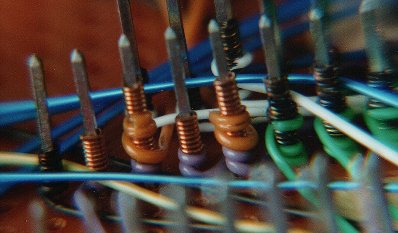
There are two different kinds of wire there, silver-plated and copper. The silver-plated tarnished on the outside and turned black, but that does not affect the connections where the corners of the post bite into the wire and make a gas-tight chemical weld.
There should be about a turn and a half of insulated wire wrapped on the post (although the exact amount is definitely not critical), mostly so if you have any motion on the wire before the project is completed, you don't get a lot of fatigue right where the wire exits the insulation, and break it. This picture from that page shows the idea:
There are two different kinds of wire there, silver-plated and copper. The silver-plated tarnished on the outside and turned black, but that does not affect the connections where the corners of the post bite into the wire and make a gas-tight chemical weld.
http://WilsonMinesCo.com/ lots of 6502 resources
The "second front page" is http://wilsonminesco.com/links.html .
What's an additional VIA among friends, anyhow?
The "second front page" is http://wilsonminesco.com/links.html .
What's an additional VIA among friends, anyhow?
Re: 65C02 computer with composite video generation
DPax92 wrote:
Regarding your suggestion to use verowire, I could not find it in local suppliers, where would you suggest to get it?
https://cpc.farnell.com/roadrunner/rrp- ... dp/CB01209
Re: 65C02 computer with composite video generation
Quote:
before going any further I would like to ask you a feedback about it.
Usually I solder the caps in place -- in this case wire wrap has no benefit, and would tend to result in longer connections. Sometimes a cap can be located *underneath* the IC it serves.

The reason I do this job first is because I have full access, with no wire-wrap wires in the way. Also, a hot soldering iron could damage the insulation on wire-wrap wires.
Usually I also solder the Ground connections between IC's. Ideally, each IC's Gnd pin should connect with the Gnd pins of all neighboring IC's to the North, South, East and West -- in other words, the Gnd connections will form a coarse grid. (The grid is a compromise solution, serving a role somewhat like that of a Ground Plane.)
Re: wiring pencils, I see Vero is another manufacturer. https://en.wikipedia.org/wiki/Wiring_pencil
-- Jeff
In 1988 my 65C02 got six new registers and 44 new full-speed instructions!
https://laughtonelectronics.com/Arcana/ ... mmary.html
https://laughtonelectronics.com/Arcana/ ... mmary.html
Re: 65C02 computer with composite video generation
Speaking of wire wrapping, isn't there a prototype board that has sort of a ground plane? I forget what it's called. But each hole has a small gap between a copper fill for the ground (and maybe even VCC on the top).
Cat; the other white meat.
-
GARTHWILSON
- Forum Moderator
- Posts: 8773
- Joined: 30 Aug 2002
- Location: Southern California
- Contact:
Re: 65C02 computer with composite video generation
cbmeeks wrote:
Speaking of wire wrapping, isn't there a prototype board that has sort of a ground plane? I forget what it's called. But each hole has a small gap between a copper fill for the ground (and maybe even VCC on the top).
http://WilsonMinesCo.com/ lots of 6502 resources
The "second front page" is http://wilsonminesco.com/links.html .
What's an additional VIA among friends, anyhow?
The "second front page" is http://wilsonminesco.com/links.html .
What's an additional VIA among friends, anyhow?