My Homebrew System: Retro-65

For discussing the 65xx hardware itself or electronics projects.
Post Reply
petrus
Posts: 10
Joined: 10 Feb 2018

My Homebrew System: Retro-65

Post by petrus »

I've been meaning to post here the details about the system I've been building, since I couldn't have done it without the resources I've found here. I'll warn you up front that there is nothing terribly exciting about the build starting with the name: Retro-65.

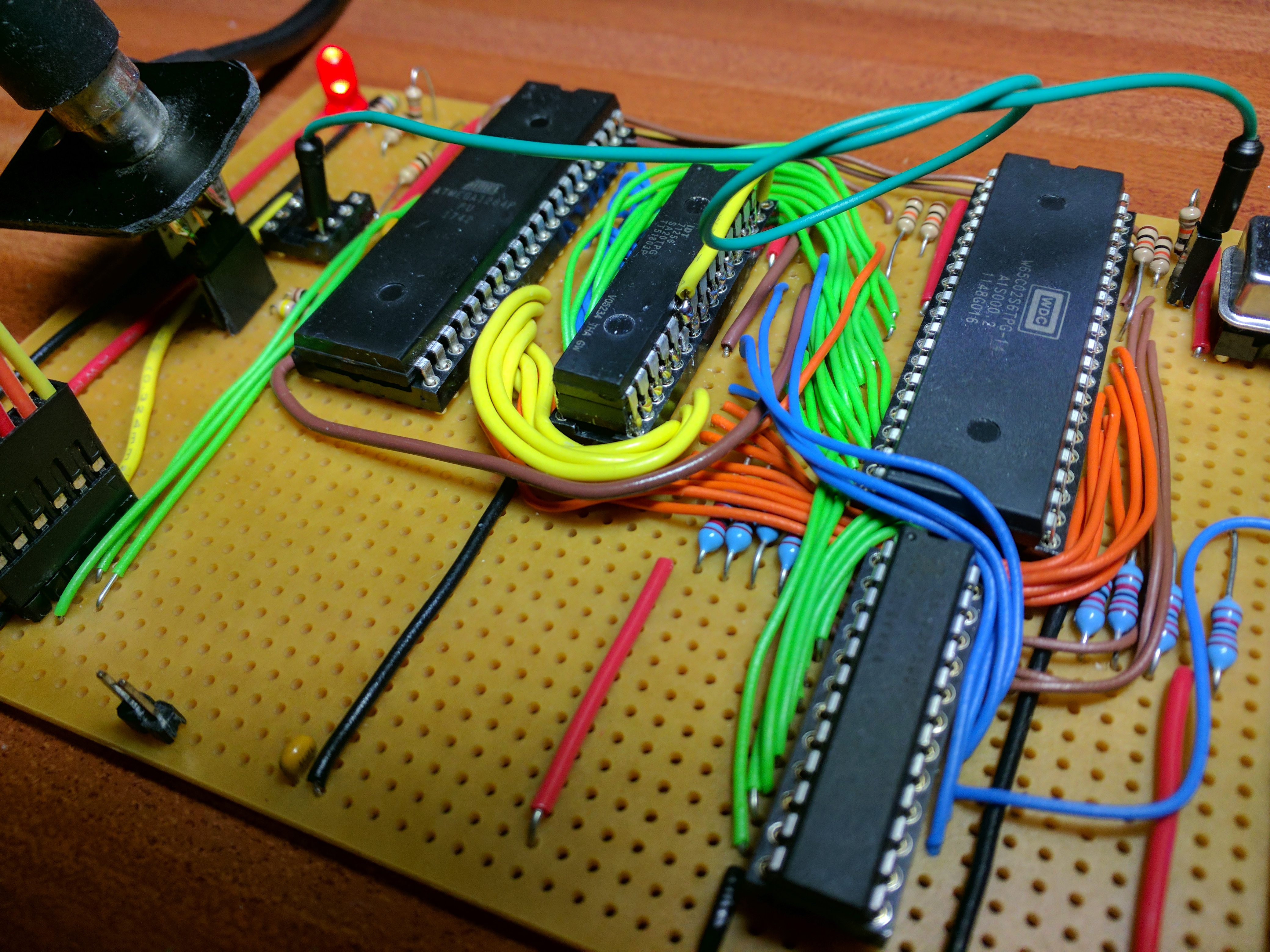
The core of the system is a 65C02. It has 32KB of RAM, 16KB of EEPROM, a 6551 ACIA, and a 6526 CIA. I use a ATF16v8 for address decode and some basic glue logic and a 555 for the reset timer. The whole thing is built using wire-wrap on an old prototyping board I've had lying around for ages, which conveniently has power planes on both sides.

The Retro-65 does not have its own video, sound, or keyboard. I'd really like to add those at some point, but it may be a while before I get there... so all the UI is handled through the serial port. Two things that might be a little unique are two breakout boards from Adafruit: a TTL serial to USB converter based on the CP1204, and a micro-SD breakout board with a voltage level shift chip built in. I'm currently working on core routines to try to access an SD card for storage, bit banging through the CIA.

In terms of software, I've gotten EhBASIC and FigForth working on the board.

The memory layout is designed to match the Symon emulator to make it easier to test out code for it:

$0000 - $7FFF : RAM
$8000 - $800F : CIA
$8800 - $8803 : ACIA
$C000 - $FFFF : ROM (I made a mistake in ordering the EEPROMs and got the 32KB version. For simplicity sake, I just tie its A14 line low and use it as a 16KB EEPROM. Oops.)

Here's a picture of the board:
Retro65_SDC.jpg
And here are the schematics. The schematics don't show the caps, which I've put near all the main chips with the exception of the 6526. The 6526 was a late addition, and wanted to see if I could get away without a cap for it (well, really I didn't want to fiddle with wire wrapping another discrete component). The schematics may also have some errors by the way, since I had to redo them after something went wrong with my Kicad install.
Retro65_SDC.pdf
(217.7 KiB) Downloaded 147 times
I'll be very interested in any comments or suggestions for improvement.
User avatar
BigEd
Posts: 11463
Joined: 11 Dec 2008
Location: England
Contact:

Re: My Homebrew System: Retro-65

Post by BigEd »

Good to hear about your project!
User avatar
floobydust
Posts: 1394
Joined: 05 Mar 2013

Re: My Homebrew System: Retro-65

Post by floobydust »

Well, congrats on getting an initial system up and running... it's always rewarding to build up your first SBC and have it working! I've also been using a USB-Serial interface module for many years now, albeit I use FTDI products and implement RTS/CTS handshaking for the console port, which I also use for Xmodem downloads to the SBC. I've not yet dabbled with a SD-Card interface but some other folks out here have, IIRC.

As far as making suggestions go, that really depends on what your plans are. Overall, I would likely be more inclined to use a newer 65C22 over the 6526. Granted, the CIA has some other features and was used in the C64, but availability of these is less and will limit the upper clock speed of the overall board. Other bits to consider... RTC chip, additional serial and/or parallel ports. Really depends on what you want to do with the board next.
User avatar
Dr Jefyll
Posts: 3526
Joined: 11 Dec 2009
Location: Ontario, Canada
Contact:

Re: My Homebrew System: Retro-65

Post by Dr Jefyll »

Nice work, petrus! And I'm always glad to hear about Forth being used. Just be aware FIG Forth has some bugs, such as those listed here and elsewhere. And if you want maximum speed for SPI bit-banging (for the SD card) then these routines may interest you.

-- Jeff
In 1988 my 65C02 got six new registers and 44 new full-speed instructions!
https://laughtonelectronics.com/Arcana/ ... mmary.html
User avatar
BigDumbDinosaur
Posts: 9425
Joined: 28 May 2009
Location: Midwestern USA (JB Pritzker’s dystopia)
Contact:

Re: My Homebrew System: Retro-65

Post by BigDumbDinosaur »

Glad to see you've got it working. Looks good.
petrus wrote:
I've been meaning to post here the details about the system I've been building...I use a ATF16v8 for address decode and some basic glue logic...
What did you use to program the GAL?
Quote:
...and a 555 for the reset timer.
In your next design consider using a Maxim DS1813 reset generator in place of the 555 timer. Only one part, which is in a TO-92 package, and it responds to a push button grounding the reset line.

Also, a half-can oscillator in place of that full-can unit will save you some board real estate.
x86?  We ain't got no x86.  We don't NEED no stinking x86!
User avatar
Dr Jefyll
Posts: 3526
Joined: 11 Dec 2009
Location: Ontario, Canada
Contact:

Re: My Homebrew System: Retro-65

Post by Dr Jefyll »

Petrus, in a post in another thread you mentioned modifying a 'C02 SBC to take an '816. Is it this board you're talking about?

Hacking for an '816 would be kinda extreme but doable. Adding a '245 transceiver and '573 address latch would be easy enough; I'd say the headache is adding RAM. IMO the best option (to save space and avoid lots of new wiring) is to use the third dimension and piggyback more than one memory IC in a single site.

Sticking with .3" wide DIP RAM's that'd be easy, despite being a little funny-looking if you use 3 chips stacked on top of the original RAM (for a total of 128K). Unfortunately, there are no high-capacity RAM's in .3" DIP packages; they're all .6" AFAIK. Even so, you could shuffle things slightly then arrange for the EEPROM and a .6" RAM to share a single site -- for example, solder a 512K by 8, 32-pin RAM chip (in a socket, perhaps) on top of the 28-pin EEPROM.

It's your call, of course, but if you opt to design a whole new board then these challenges would be avoided. And maybe you'd like to use a 6522 VIA instead of that CIA.

J :)
In 1988 my 65C02 got six new registers and 44 new full-speed instructions!
https://laughtonelectronics.com/Arcana/ ... mmary.html
petrus
Posts: 10
Joined: 10 Feb 2018

Re: My Homebrew System: Retro-65

Post by petrus »

Thanks for the comments and suggestions.
Quote:
What did you use to program the GAL?
The programmer I'm using is the TL866CS (same as I use for the EEPROMs). I generate the JED files using Opal. I'm not super-happy with this arrangement. The TL866CS can't seem to handle the 20v10s I have, and I have to run Opal in DOSBox.
Quote:
Petrus, in a post in another thread you mentioned modifying a 'C02 SBC to take an '816. Is it this board you're talking about?
Yes, this is the one. You're right about the real estate for memory being the big problem, so I'm vacillating on hacking this board further. It may be that my better path would be to finally branch out into another thing I'd like to learn, which is PCB layout. Although maybe a full-on motherboard with >1MB of RAM would be a tall order for a starting project.
User avatar
drogon
Posts: 1671
Joined: 14 Feb 2018
Location: Scotland
Contact:

Re: My Homebrew System: Retro-65

Post by drogon »

Looks like a nice little system there.

Just to add to the RAM thing - Garth Wilson of this parish has a nice large capacity RAM module which would work in an '816 system and is probably usable in a wire-wrap/perf board type of setup.

Also the stacking RAM thing - it's how I got 64K x 8 in my current 6502 system - I stacked 2 x 32Kx8 chips and separated out the CS line on the top one. It's probably what I'll do for my own '816 system - at least initially, anyway. There are many pages showing that too. e.g. from here: viewtopic.php?f=4&t=4142

Mine at: https://unicorn.drogon.net/IMG_20181115_164041.jpg

Cheers,

-Gordon
--
Gordon Henderson.
See my Ruby 6502 and 65816 SBC projects here: https://projects.drogon.net/ruby/
jmthompson
Posts: 127
Joined: 30 Dec 2017
Location: Detroit, Michigan, USA
Contact:

Re: My Homebrew System: Retro-65

Post by jmthompson »

petrus wrote:
The programmer I'm using is the TL866CS (same as I use for the EEPROMs). I generate the JED files using Opal. I'm not super-happy with this arrangement. The TL866CS can't seem to handle the 20v10s I have, and I have to run Opal in DOSBox.
I had a lot of similar issues with my TL866A; it would only program a small handful of the GALs I had. I finally decided to pick up the newer TL866II+ last week and I've had much better luck with it. Not only does it do well with Lattice parts but it explicitly claims to support the Atmel variants as well; I have not tried this personally but I do have some Atmel 22V10Cs coming from Ebay in a few days and I'll be trying those out once they arrive.
Post Reply