Commodore 64 Restoration

Topics related to older 6502-based hardware and systems including (but not limited to) the MOS Technology KIM-1, Synertek SYM-1, and Rockwell AIM-65.
petrus
Posts: 10
Joined: 10 Feb 2018

Commodore 64 Restoration

Post by petrus »

I hope this post is not inappropriate, but I figured you all might be interested to see it. I'd like to introduce you all to Commodore 64 #5575214:
C64Case.jpg
Poor little '214 has had a hard life, although I don't know all the details. I originally bought it sometime in the late '80s or early '90s for a few bucks from a bargain bin. It was just the console (no cables, manual, or power brick) and wasn't in working condition. I had dreams of fixing it and getting it working "one of these days." I made halfhearted attempts over the years to try to figure out what was wrong but never really sat down to really get into the problem. So the poor machine has just been in my storage, moving from place to place for ages now. Recently, I've been watching restoration videos from people like the 8 Bit Guy and others and realized I really had the stuff I needed to sort out what's wrong and fix the thing.

The first problem was getting power, since I had no power brick. That was just as well, really, because I don't think I would want to trust a vintage C64 power supply at this point. I decided to make my own supply, using a 9 volt transformer and a 2 amp USB power supply. The machine powered up but just displayed a black screen. I did a fair amount of probing about with a multimeter and oscilloscope. From what I could tell, the power to the chips looked correct and reasonably stable. Moreover, I could see sync signals on the VIC output, so at least the VIC seemed to be operable. I also did a continuity check on the data and address lines, and they seemed to be good all the way across the board. In fact, the board seemed to be in really good shape with no corrosion that I could see.
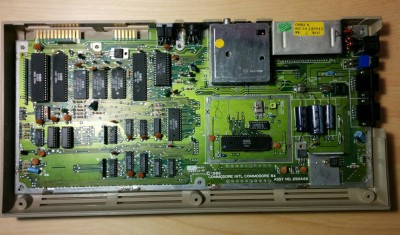
Top side of circuit board.
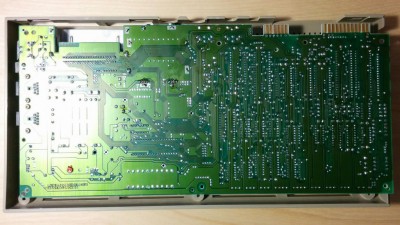
Bottom side of circuit board.
I was beginning to doubt I was going to be able to find the problem when I happened to check chip temperatures. The VIC chip was warm but not too bad... same for the 6510... then I touched one of the main DRAM chips, which was blisteringly hot. My immediate reaction was "oh my, that is rather hot. Perhaps this is the issue." (Roughly translated from the somewhat more colorful Anglo-Saxon expressions I used at the time.) I removed the old chip and soldered in a socket and popped in a new chip. I debated replacing both chips but decided to leave the other one in to make as few changes to the original board as possible (partly because this was my first attempt at desoldering something from an old two layer board and wanted to risk as little damage as possible). The next power up had the machine working a bit better (it displayed random text on the screen), but thereafter it just gave me a blank screen.

The next step was to order a dead test ROM, and I just got it this week. Using that showed that the other DRAM chip was indeed damaged, so I replaced that this morning. The end result was I got a boot screen and was able to type in and run a program. Also the dead test ROM shows no issues now. So, for the first time in nearly 30 years (yikes!), little '214 is able to power up and run a simple program!

At this point, there are some things I haven't tested yet (but will in time):
  • * Sound
    * Serial port
    * User port
    * Cassette port
    * Joysticks
I also have not recapped the board. The capacitors look ok, but I am thinking it may be worth replacing them so there are no surprises later. The board is in really good condition, and I'd just as soon keep it that way.

Anyway, I hope you find this interesting to see. Let me know if you have any questions or comments.
User avatar
cbmeeks
Posts: 1254
Joined: 17 Aug 2005
Location: Soddy-Daisy, TN USA
Contact:

Re: Commodore 64 Restoration

Post by cbmeeks »

Great job on bringing another C64 back to life.

I'm currently recapping my C64C. Debating if I want to retro-bright it or not. The keys are yellow and the case is yellow. However, the yellowing is mild and the whole thing has a uniform yellow. If I didn't know better, I'd say that was the original color. lol

The part I hate about recapping is buying the axial caps. I know I can use radial in a weird, "bent over" layout but I just don't like that. So I pay $3 per cap on those. Yuck. But they are nice Panasonic or Nichicon caps so I feel good about it.

Another guy you should watch is Jan Beta. He's very good at repairing C64's and has a good video on "future proofing" the C64.
Cat; the other white meat.
Jeff_Birt
Posts: 96
Joined: 18 Jul 2018

Re: Commodore 64 Restoration

Post by Jeff_Birt »

Be cautious using an typical USB phone charger type supply for other things, speaking of the ones terminated with a micro-USB connector. Most of the time if they are rated at say 2A by the time you get close to that and account for the voltage drop across the tiny leads used and the PSU itself you are lucky to get 4.5V out. Some of them are OK but a lot are junk so to be on the safe side measure it under load.

When getting a couple of RPi3s a year or so ago for work I popped for the $15 RasberryPi branded USB wall-warts. They have a nice thick twin lead cable and are much beefier than a similar rated 'generic' adapter I got for a Pi I bought for home use. (I won't go into the stupid idea of using that micro-USB connector for 2A+ use instead of a simple barrel connector...)
User avatar
GARTHWILSON
Forum Moderator
Posts: 8773
Joined: 30 Aug 2002
Location: Southern California
Contact:

Re: Commodore 64 Restoration

Post by GARTHWILSON »

I don't know, but you might want to check the USB current output. I think that if you go over half amp, the device has to negotiate with the USB host, meaning there's USB protocol and intelligence involved. The USB 2.0 spec is 650 pages, which is one reason I'd rather stay away from USB. Even just the part about supplying power and negotiating voltage and current levels is over a hundred pages IIRC.
http://WilsonMinesCo.com/ lots of 6502 resources
The "second front page" is http://wilsonminesco.com/links.html .
What's an additional VIA among friends, anyhow?
Jeff_Birt
Posts: 96
Joined: 18 Jul 2018

Re: Commodore 64 Restoration

Post by Jeff_Birt »

GARTHWILSON wrote:
I don't know, but you might want to check the USB current output. I think that if you go over half amp, the device has to negotiate with the USB host, meaning there's USB protocol and intelligence involved. The USB 2.0 spec is 650 pages, which is one reason I'd rather stay away from USB. Even just the part about supplying power and negotiating voltage and current levels is over a hundred pages IIRC.
AS I recall a smart USB device (phone etc) will look for a certain resistance across the data lines and if found knows that a 'dumb' charger is attached and no negotiation is required. Using a USB charger type power supply to power a project is only using the +5V (well and common) anyhow so none of that matters.
petrus
Posts: 10
Joined: 10 Feb 2018

Re: Commodore 64 Restoration

Post by petrus »

Thanks for the comments. I hadn't been thinking about the limitations on the USB supplies. The one I'm using at the moment seems to be working ok, but I'm sure I have some in the parts bin that are less than suitable. I do have a chunky, non-USB 5v supply from another project I could use instead, so maybe I'll rearrange things to use that.
User avatar
cbmeeks
Posts: 1254
Joined: 17 Aug 2005
Location: Soddy-Daisy, TN USA
Contact:

Re: Commodore 64 Restoration

Post by cbmeeks »

The important part to remember is to make sure whatever 5V supply you use has proper over-voltage protection.

Faulty 7805's have fried way too many C64's and VIC-20's in the past due to them letting in more than 5V. In fact, in one of the 8 Bit Guy's videos, he literally destroyed some chips on camera while using an unprotected, original C64 PSU.
Cat; the other white meat.
User avatar
GARTHWILSON
Forum Moderator
Posts: 8773
Joined: 30 Aug 2002
Location: Southern California
Contact:

Re: Commodore 64 Restoration

Post by GARTHWILSON »

There are a lot of inexpensive 5V wall-wart and table-top regulated supplies on the market. Here's one of many that Jameco sells:
https://www.jameco.com/z/ADS6818-1505-W ... 30361.html
It's 5V, 3A, and takes 100V to 240V input at 50 or 60Hz, has a common DC-10 plug on the end of a 4-foot cord, and costs $9. You can wire up your own DC-10 receptacle, unlike the situation with tiny USB connectors.
http://WilsonMinesCo.com/ lots of 6502 resources
The "second front page" is http://wilsonminesco.com/links.html .
What's an additional VIA among friends, anyhow?
User avatar
ttlworks
Posts: 1464
Joined: 09 Nov 2012
Contact:

Re: Commodore 64 Restoration

Post by ttlworks »

MEANWELL is building some nice power supplies.
Mouser currently has the RS-15-5 (5V/3A) for ca. 8€.

Edit: does your C64 need 9V AC for generating a +12V supply voltage for VIC-II and SID (and for incrementing that real time clock inside the 6526s) ?
Attachments
rs-15.gif
petrus
Posts: 10
Joined: 10 Feb 2018

Re: Commodore 64 Restoration

Post by petrus »

My board is a 250466, which I believe needs the 9v supply to generate the internal 12 volt supply. I was poking around last night and saw a supply like this, if not that very one. It did get me thinking I could use that and a hard-wired transformer to make a more permanent and neater supply box.

Side question for you all: do any of you have any insight on how NTE is as a brand for capacitors? My local shop has that brand, but I really know nothing about them. I'm sure they'll be fine at least in the short term, but if I'm going to recap this board, I don't want to put in something that going to start leaking in a couple of years. The original caps are still in reasonable apparent condition, even if I'm sure they aren't at their best anymore.
User avatar
GARTHWILSON
Forum Moderator
Posts: 8773
Joined: 30 Aug 2002
Location: Southern California
Contact:

Re: Commodore 64 Restoration

Post by GARTHWILSON »

petrus wrote:
do any of you have any insight on how NTE is as a brand for capacitors? My local shop has that brand, but I really know nothing about them. I'm sure they'll be fine at least in the short term, but if I'm going to recap this board, I don't want to put in something that going to start leaking in a couple of years.
There used to be a nearby shop that I went to often which had a huge stock of a lines like this, starting with GE, then went to TCG, then had NTE for the last 20 years or so before the shop closed. It was mostly semiconductors, but also had relays and maybe a few other things. I always kind of wondered about the story. It seemed like they wanted to gather a collection of replacement parts under one name and one catalog for the repair of TVs, stereos, etc.. (Remember when they used to fix them, rather than throw them out?) However, it also seemed to me like rather than bringing all those parts under one roof and simplifying things, they only added another confusing line, one whose numbers often did not show any resemblance to industry-standard numbers, and repairmen always had to look up the GE or TCG or NTE numbers in the thick cross-reference book. I never heard or experienced anything bad about their quality though.

There's a good video lecture about capacitors at https://www.youtube.com/watch?v=ZAbOHFYRFGg . The only capacitors you would probably need or want to replace are the electrolytics; and I think that as long as you derate them enough, they'll last nearly indefinitely. By "derating," I mean you don't use a 6.3V capacitor in a 5V application, but instead use a 16V or 25V capacitor. The capacitor engineer giving the talk in the video shows a diagram of what happens to electrolytics as they get old. You don't have to be a chemist to get the drift. 'Lytics can be reformed though (if they're not already internally shorted), by very slowly raising the voltage across them. It's easier to just replace the capacitor; but if there's no replacement available when you really need it, this might be a viable alternative.
http://WilsonMinesCo.com/ lots of 6502 resources
The "second front page" is http://wilsonminesco.com/links.html .
What's an additional VIA among friends, anyhow?
User avatar
BigEd
Posts: 11463
Joined: 11 Dec 2008
Location: England
Contact:

Re: Commodore 64 Restoration

Post by BigEd »

I've read before about reforming electrolytics, and I'm sure it can work, and yet I recently read a footnote in an article about restoring old IBM kit at the Living Computer Museum:
Quote:
There is a myth among hobbyists that such capacitors can be “re-formed”, that is, the effects of aging can be electronically reversed. This is not actually possible, because the aging process causes real physical damage to the internals of the device which no amount of magical treatment can repair. This fact is recognized by the US Department of Defense, which discards stockpiled capacitors after 6 years even if unused.
So that's a counterpoint.
User avatar
GARTHWILSON
Forum Moderator
Posts: 8773
Joined: 30 Aug 2002
Location: Southern California
Contact:

Re: Commodore 64 Restoration

Post by GARTHWILSON »

In the above-linked video, the capacitor engineer tells about reforming the 'lytics from 19 to 22 minutes into it.
http://WilsonMinesCo.com/ lots of 6502 resources
The "second front page" is http://wilsonminesco.com/links.html .
What's an additional VIA among friends, anyhow?
User avatar
GaBuZoMeu
Posts: 660
Joined: 01 Mar 2017
Location: North-Germany

Re: Commodore 64 Restoration

Post by GaBuZoMeu »

I wonder why anyone cares about a few cents when going to revive a valuable thing :shock: Use caps from Panasonic, they are not cheap nor expensive but reliable.

And to be safe from ill behaving series regulators - use a crowbar. See at the bottom of page 26 to have an example. I only suggest to avoid the trimmer in that circuit in the given position, as if the trimmer fails the circuit won't operate properly anymore. The trimmer (if any) should be placed where R2 sits. Adjusting should be done using a laboratory power supply.

my 1/2 cent ;)
User avatar
1024MAK
Posts: 155
Joined: 14 May 2015
Location: UK

Re: Commodore 64 Restoration

Post by 1024MAK »

As with various other things in life, electrolytic capacitors can suffer from various problems. If they have failed, for the most part, they will not be able to be "reformed".

Electrolytic capacitors in really old equipment (radios and such like, made before the 1960s), if not used for many years will need reforming before the equipment is powered up.

With electrolytic capacitors from the 1960s through to present, you are better off just fitting new good quantity replacements.

If you have unused spare 'new' electrolytic capacitors that have been in storage for more than three to five years, charging them slowly via a current limited supply to just below their rated voltage, and then waiting until the leakage current falls below the specified value, will reduce the likelihood of them being damaged when the equipment they are fitted in is powered up after being serviced. Of course, you may want to test them (capacitance, leakage current, ESR) before actually fitting them in something...

Mark
Post Reply