

Hi guys
This isn't specifically 6502 related (although it'll help when I reconstruct my project).
I was wondering how you guys manage to wirewrap, but still allow easy access to the socketed ICs in your project?
I.e. how do you deal with the bus and control lines for a chip which are on the far side of an IC from the other ICs? Do you somehow go around the ICs, don't use wire wrap for those, go under the DIL socket somehow?
Do you go to a central 'bus' area from each IC?
Also, is there a specific type of pin you use for wirewrap? I currently have some of these: http://uk.farnell.com/jsp/search/produc ... KU=1756962 (on which the pins are almost certainly too short if I use DIL sockets)
I did do a search of farnell and ebay' website for wirewrap pins but they didn't come up.
Lastly, are there any pitfalls that I should avoid?
Any advice would gratefully received.
Wire wrapping
Re: Wire wrapping
Use wirewrap IC sockets, and do all your wiring on the underside of the board.
See e.g.
http://www.jameco.com/webapp/wcs/stores ... 1_94503_-1
http://www.jameco.com/webapp/wcs/stores ... 1_37411_-1
Tip: for buses, don't daisy-chain your wiring. While searching online for an illustration of this, I found this page which you might find useful: http://wilsonminesco.com/6502primer/WireWrap.html
See e.g.
http://www.jameco.com/webapp/wcs/stores ... 1_94503_-1
http://www.jameco.com/webapp/wcs/stores ... 1_37411_-1
Tip: for buses, don't daisy-chain your wiring. While searching online for an illustration of this, I found this page which you might find useful:
http://wilsonminesco.com/6502primer/WireWrap.htmlBecause there are never enough Forth implementations: http://www.camelforth.com
Re: Wire wrapping
I had spotted the wirewrap ICs, but wondered how exactly they worked as I thought wirewrapping was done on the top side of the board  .
.
Many thanks
.Many thanks
-
GARTHWILSON

- Forum Moderator
- Posts: 8773
- Joined: 30 Aug 2002
- Location: Southern California
- Contact:
Re: Wire wrapping
Thanks for the link to my site, Brad.  Banedon, it should answer all your questions, although I can think of improvements to make there now. That's one of 22 pages of the 6502 primer. There are a couple more pictures on the previous page, http://wilsonminesco.com/6502primer/construction.html, showing complete boards. The first picture there shows the bottom of my primary workbench computer. In spite of the density, every pin is accessible, and I have indeed made changes and additions over the years. There are no wires at all on the top, except the ones that go to the LCD. Putting up an entire section of the website for this computer is one thing I have in the list of things to do. I'm in a bit of a hurry right now, but I might come back later in the day and post more pictures on this topic.
Banedon, it should answer all your questions, although I can think of improvements to make there now. That's one of 22 pages of the 6502 primer. There are a couple more pictures on the previous page, http://wilsonminesco.com/6502primer/construction.html, showing complete boards. The first picture there shows the bottom of my primary workbench computer. In spite of the density, every pin is accessible, and I have indeed made changes and additions over the years. There are no wires at all on the top, except the ones that go to the LCD. Putting up an entire section of the website for this computer is one thing I have in the list of things to do. I'm in a bit of a hurry right now, but I might come back later in the day and post more pictures on this topic.http://WilsonMinesCo.com/ lots of 6502 resources
The "second front page" is http://wilsonminesco.com/links.html .
What's an additional VIA among friends, anyhow?
The "second front page" is http://wilsonminesco.com/links.html .
What's an additional VIA among friends, anyhow?
Re: Wire wrapping
Garth, I did a Startpage search for "wirewrap daisy chain", and yours was the first listing (other than a Mouser data sheet) that wasn't about making jewelry. Congratulations on your high ranking.
The second such listing actually has a drawing of the proper daisy-chain technique. See "Figure A" and "Figure B." banedon, bear in mind that some of the advice on this page is for the use of motorized wirewrap tools:
http://www.tecratools.com/pages/tecaler ... guide.html
The second such listing actually has a drawing of the proper daisy-chain technique. See "Figure A" and "Figure B." banedon, bear in mind that some of the advice on this page is for the use of motorized wirewrap tools:
http://www.tecratools.com/pages/tecaler ... guide.html
Because there are never enough Forth implementations: http://www.camelforth.com
Re: Wire wrapping
Hi guys
I've had to take a break from this for a while, but am now able to give it anotehr go. I've started doing some wire wrapping, but have shortened the length of bare wire to about 0.5 inches due to the number of connections I need on a pin (I have 4 devices so need to connect 4 lots of wire to the the address/data bus pins). Also, I've noticed that when measuring resistance between each endpoint on a given wire-wrapped wire I get roughly 0.2 to 0.4 Ohms. Is this normal? I should be expecting absolute 0 Ohms?
Also, is it a major no-no to use 1/2 inch rather than 1 inch bare wire or is it ok?
Cheers!
I've had to take a break from this for a while, but am now able to give it anotehr go. I've started doing some wire wrapping, but have shortened the length of bare wire to about 0.5 inches due to the number of connections I need on a pin (I have 4 devices so need to connect 4 lots of wire to the the address/data bus pins). Also, I've noticed that when measuring resistance between each endpoint on a given wire-wrapped wire I get roughly 0.2 to 0.4 Ohms. Is this normal? I should be expecting absolute 0 Ohms?
Also, is it a major no-no to use 1/2 inch rather than 1 inch bare wire or is it ok?
Cheers!
-
GARTHWILSON
- Forum Moderator
- Posts: 8773
- Joined: 30 Aug 2002
- Location: Southern California
- Contact:
Re: Wire wrapping
banedon wrote:
I've started doing some wire wrapping, but have shortened the length of bare wire to about 0.5 inches due to the number of connections I need on a pin (I have 4 devices so need to connect 4 lots of wire to the the address/data bus pins).
Quote:
Also, I've noticed that when measuring resistance between each endpoint on a given wire-wrapped wire I get roughly 0.2 to 0.4 Ohms. Is this normal? I should be expecting absolute 0 Ohms?
Quote:
Also, is it a major no-no to use 1/2 inch rather than 1 inch bare wire or is it ok?
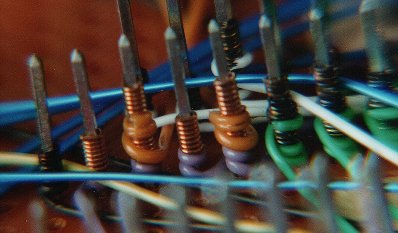
http://WilsonMinesCo.com/ lots of 6502 resources
The "second front page" is http://wilsonminesco.com/links.html .
What's an additional VIA among friends, anyhow?
The "second front page" is http://wilsonminesco.com/links.html .
What's an additional VIA among friends, anyhow?
-
ElEctric_EyE
- Posts: 3260
- Joined: 02 Mar 2009
- Location: OH, USA
Re: Wire wrapping
Wire wrapping is great. It's brings high performance to a hobbyist that has the ability to pay attention to detail. Nice to see this!
-
BigDumbDinosaur

- Posts: 9425
- Joined: 28 May 2009
- Location: Midwestern USA (JB Pritzker’s dystopia)
- Contact:
Re: Wire wrapping
banedon wrote:
Also, I've noticed that when measuring resistance between each endpoint on a given wire-wrapped wire I get roughly 0.2 to 0.4 Ohms. Is this normal?
As Garth noted, a good wire-wrap connection's resistance will be well down in the milliohm range. If your meter does go to dead zero with the probes shorted, verify that neither wires or posts were contaminated with anything. BTW, fingerprints are to be avoided, as skin oil is an insulator. All of this is well documented in Garth's article about wire-wrap.
Last edited by BigDumbDinosaur on Sun Sep 07, 2014 9:00 am, edited 1 time in total.
x86? We ain't got no x86. We don't NEED no stinking x86!
Re: Wire wrapping
BigDumbDinosaur wrote:
banedon wrote:
Also, I've noticed that when measuring resistance between each endpoint on a given wire-wrapped wire I get roughly 0.2 to 0.4 Ohms. Is this normal?
As Garth noted, a good wire-wrap connection's will be well down in the milliohm range. If your meter does go to dead zero with the probes shorted, verify that neither wires or posts were contaminated with anything. BTW, fingerprints are to be avoided, as skin oil is an insulator. All of this is well documented in Garth's article about wire-wrap.
. I did clean the posts as advised in Garth's wire-wrap guide and didn't touch the stripped wire.Here's my latest effort (see attached) - each image is at each end and I now get 000.0 Ohms
. It still doesn't look as perfect as yours, Garth, but I assume it'll get better.Technique-wise, do you slowly bring the ww-tool up as you twist?
- Attachments
-
-
-
-
GARTHWILSON
- Forum Moderator
- Posts: 8773
- Joined: 30 Aug 2002
- Location: Southern California
- Contact:
Re: Wire wrapping
banedon wrote:
Technique-wise, do you slowly bring the ww-tool up as you twist?
http://WilsonMinesCo.com/ lots of 6502 resources
The "second front page" is http://wilsonminesco.com/links.html .
What's an additional VIA among friends, anyhow?
The "second front page" is http://wilsonminesco.com/links.html .
What's an additional VIA among friends, anyhow?
Re: Wire wrapping
I did the ones last pictured by simply doing a you say: not pressing down, but not pulling up either. I've had a few poor ones, but they're easy to redo and pactice will no doubt make perfect . I have to say that this was really putting me off as I imagined it to be much harder than it actually is. Thanks for your advice/help guys.
. I have to say that this was really putting me off as I imagined it to be much harder than it actually is. Thanks for your advice/help guys.-
ElEctric_EyE
- Posts: 3260
- Joined: 02 Mar 2009
- Location: OH, USA
Re: Wire wrapping
banedon wrote:
... and pactice will no doubt make perfect . I have to say that this was really putting me off as I imagined it to be much harder than it actually is. Thanks for your advice/help guys.
. I have to say that this was really putting me off as I imagined it to be much harder than it actually is. Thanks for your advice/help guys.Most of us are human, we who have used wire wrap have all been through it. It being the 'learning curve'.
There's another learning curve for an electric WW gun and 30AWG insulator auto-stripper... Now you're talking progress there! A relatively simple board design completed in 1 day is humanly possible. Once your brain gets used to the mirrored pin numbers you're on your way. The bigger challenge, in my experience, is routing reliable power distribution especially in larger designs requiring more current distribution and adding in the bypass capacitors with some solder and heat shrink tubing.