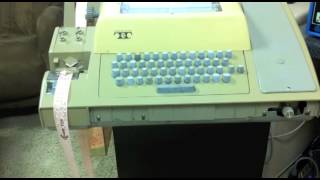
When I studied computer science (1989-1993), Teletypes were already very outdated...
I used to fix those contraptions—long before you started computer science classes.

We had four of them aboard ship when I was in the Navy, connected to their respective equipment via a 20 milliamp current loop interface (RS-232 barely existed back then). Three were in the radio room and one was in the pilot house. As it was possible to connect more than one TTY to the current loop, the TTY in the pilot house could be put on the same current loop as a TTY that was receiving a message, thus repeating what the radio room TTY was doing. There was a small patch board that looked like a miniature telephone operator's switchboard for setting up current loops.
When a message had to be transmitted, a TTY would drive a "digital-to-analog" converter that would change the mark and space signals of the current loop to a frequency shift keying (FSK) signal, which was then run through encryption hardware. The FSK signal was passed to the transmitter and used to modulate the carrier. Single sideband (SSB) transmission was used to increase the signal's range, reduce interference and minimize the RF footprint, making interception of the message more difficult. In a sort of spread-spectrum arrangement, the signal would periodically alternate between the upper and lower sidebands to further complicate interception. An elaborate procedure was involved to keep transmitter and receiver in sync. Every so often, the sideband switch would get out of sync and the receiver would get gibberish.
In some cases when traffic was heavy and messages had to be sent many thousands of miles, requiring that the most powerful of the three available transmitters be used, independent sideband (ISB) was used to send two different messages from the same transmitter. This was basically SSB times two.
Generally speaking, the message to be sent would be punched into paper tape and then a radioman would run the paper tape through a tape reader to actually send the message. Doing so allowed the message to proofed and edited before sending, and (usually) avoided having a typo get in there. Virtually all communications related to ship's movement, fuel and ammunition status were handled this way, since the fleet's status at any given time was something that we didn't want the Soviets to know.
For reception, the process was reversed. The incoming SSB or ISB signal was received, decrypted and sent to a current loop. Any time I was in the radio room and a message came in, the start-up of a TTY always startled me. Those things made quite a bit of racket when operating.
It all seems so archaic now, but was state-of-the-art 50 years ago.