6502 Design & concept questions.
- BigDumbDinosaur
- Posts: 9428
- Joined: 28 May 2009
- Location: Midwestern USA (JB Pritzker’s dystopia)
- Contact:
Re: 6502 Memory map considerations.
GARTHWILSON wrote:
The workbench computer has a 1-line, 16-character intelligent LCD, and a connector to externally connect a bigger one, say 4x40, which I don't normally do. It also has a 5-key keypad which is not suitable for typing but is suitable for chosing menu items. I have a PS/2 interface on it which I have never written the software for. My workbench doesn't look as bad as the picture recently posted, but even a laptop would take too much space, so I want the workbench computer to be rather small. The PC that hosts it is on another desk, linked by a serial cable. There's a tiny printer at the workbench, and the bigger one is on another desk.
x86? We ain't got no x86. We don't NEED no stinking x86!
Re: 6502 Memory map considerations.
GARTHWILSON wrote:
...and you can still have other stuff that's not on the board but it goes through I/O ICs.
Quote:
leave room / make it as flexible as you can
BigDumbDinosaur wrote:
One 65C51N. If you are going to provide the unit with two TIA-232 ports right out of the gate (no pun intended) use of a dual channel UART (e.g., an NXP 26C92) would be more efficient from a hardware decoding standpoint and would consume less board real estate. Also, the 6551 has had a long history of problems. I don't disguise the fact that I don't like the device.
http://images.ihscontent.net/vipimages/ ... 1566-1.pdf
If it’s not too hard to interface and not a pain... to program, I would consider this one.
I like your idea of having two uarts, one for the terminal and the other for software development from the PC.
Quote:
Quote:
One to three VIA’s W65C22S.
Quote:
Speaking of VIAs, the PLCC package takes up considerably less board space
Why using the S-type of the VIA’s and the N-type of the ACIA’s. Is it because of the ACIA’s are so scarce available? I’m confused about that. I do understand the IRQ issue.
Marco
- GARTHWILSON
- Forum Moderator
- Posts: 8774
- Joined: 30 Aug 2002
- Location: Southern California
- Contact:
Re: 6502 Memory map considerations.
lordbubsy wrote:
GARTHWILSON wrote:
...and you can still have other stuff that's not on the board but it goes through I/O ICs.
Quote:
Quote:
Speaking of VIAs, the PLCC package takes up considerably less board space
http://WilsonMinesCo.com/ lots of 6502 resources
The "second front page" is http://wilsonminesco.com/links.html .
What's an additional VIA among friends, anyhow?
The "second front page" is http://wilsonminesco.com/links.html .
What's an additional VIA among friends, anyhow?
- BigDumbDinosaur
- Posts: 9428
- Joined: 28 May 2009
- Location: Midwestern USA (JB Pritzker’s dystopia)
- Contact:
Re: 6502 Memory map considerations.
lordbubsy wrote:
The NXP 26C92 isn’t easy to get here but my local supplier has the “XR 68C681 CP40 IC D-UART FIFO Timer Dil-40”.
Quote:
Quote:
Speaking of VIAs, the PLCC package takes up considerably less board space
Quote:
Why using the S-type of the VIA’s and the N-type of the ACIA’s. Is it because of the ACIA’s are so scarce available? I’m confused about that. I do understand the IRQ issue.
x86? We ain't got no x86. We don't NEED no stinking x86!
Re: 6502 Memory map considerations.
lordbubsy wrote:
Quote:
Speaking of VIAs, the PLCC package takes up considerably less board space
Re: 6502 Memory map considerations.
Making your own symbols in Eagle is pretty easy with a bit of practice, and the advantage is that all your symbols will look consistent. With 3rd party symbols, they all look different (and often too bulky and poorly organized).
Re: 6502 Memory map considerations.
BigDumbDinosaur wrote:
The 2692 may be easier to obtain.
rwiker wrote:
I haven't even found EAGLE libraries for the DIL versions of the WDC chips
Arlet wrote:
Making your own symbols in Eagle is pretty easy with a bit of practice
Marco
Re: 6502 Memory map considerations.
lordbubsy wrote:
Yes, it really seem easy. I made an own new library and copied an existing part to it. Editing is straight forward. Creating from scratch takes somewhat more effort.
If you have a component with a bunch of odd measurements, it often easier to just open the properties and type in the coordinates by hand.
Re: 6502 Design & concept questions.
I changed the title to a more applying one.
Jameco has two versions of the 26C92
SC26C92A1A (856597) and SC26C92C1A (918647)
I don’t see a significant difference between those two.
I’m including the ‘245 bus drivers at this moment. Does a 65C02 or a 65C816 can do without them, even if one decided to go off the board?
I’m clearly uncertain.

Jameco has two versions of the 26C92
SC26C92A1A (856597) and SC26C92C1A (918647)
I don’t see a significant difference between those two.
GARTHWILSON wrote:
To clarify: Unless you're going to stick with really low frequencies like 1-2MHz, the stuff that's not on the board does not get connected to the processor's own buses.
I’m clearly uncertain.
Marco
- GARTHWILSON
- Forum Moderator
- Posts: 8774
- Joined: 30 Aug 2002
- Location: Southern California
- Contact:
Re: 6502 Design & concept questions.
lordbubsy wrote:
GARTHWILSON wrote:
To clarify: Unless you're going to stick with really low frequencies like 1-2MHz, the stuff that's not on the board does not get connected to the processor's own buses.
I’m clearly uncertain.
http://WilsonMinesCo.com/ lots of 6502 resources
The "second front page" is http://wilsonminesco.com/links.html .
What's an additional VIA among friends, anyhow?
The "second front page" is http://wilsonminesco.com/links.html .
What's an additional VIA among friends, anyhow?
Re: 6502 Design & concept questions.
Quote:
When connections get long compared to the wavelengths of the frequencies found in high operating speeds and fast edge rates, you'll get reflections and other unwanted effects that make a signal unintelligible unless special measures are taken
- BigDumbDinosaur
- Posts: 9428
- Joined: 28 May 2009
- Location: Midwestern USA (JB Pritzker’s dystopia)
- Contact:
Re: 6502 Design & concept questions.
lordbubsy wrote:
I changed the title to a more applying one.
Jameco has two versions of the 26C92
SC26C92A1A (856597) and SC26C92C1A (918647)
I don’t see a significant difference between those two.
Jameco has two versions of the 26C92
SC26C92A1A (856597) and SC26C92C1A (918647)
I don’t see a significant difference between those two.
Quote:
GARTHWILSON wrote:
To clarify: Unless you're going to stick with really low frequencies like 1-2MHz, the stuff that's not on the board does not get connected to the processor's own buses.
Bus drivers and transceivers (you'd use the latter on D0-D7) will help—their purpose in life is to strengthen bus signals to cope with increased loading. However, bus drivers may introduce problems with ringing. Also, as Garth noted, transmission line effects related to the effective "wave length" of the signal relative to the length of the bus can result in a variety of problems, e.g., signal reflections, that are not easily resolved by the average hobbyist. As the ideal waveform in a digital circuit is rectangular, very strong odd-order harmonic content is theoretically (and usually) present. Anything that delays or attenuates the higher order harmonics will have the effect of transforming the rectangular waveform into something more akin to a trapezoid, and may cause switching problems in the device that is at the receiving end of the signal.
Schottky diode suppression at the far ends of the bus can be applied to get ringing under control and possibly reduce reflection (see attachment). Higher order harmonic attenuation is more difficult to counteract, however—a good knowledge of transmission line theory is essential. Best practice is to develop an expansion bus that doesn't require direct connection to the MPU's buses and control lines. This is what is done in virtually all professionally-designed computer systems that accept plug-in cards. You can build such an arrangement with some 65C21s or 65C22s driving the expansion bus, along with some adroit glue logic design.
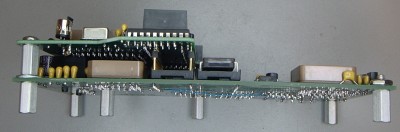
I was able to take the MPU's buses off-board to interface the SCSI host adapter to POC V1.1, suffering a small reduction in maximum stable Ø2 speed from 12.5 MHz to 10 MHz in the process (side-view of the interface between host adapter and mainboard attached). I was careful to keep the overall length of the connections to a minimum and it does work. POC V2 will have the 53C94 SCSI ASIC on the mainboard, which will eliminate the need for the separate host adapter.
x86? We ain't got no x86. We don't NEED no stinking x86!
- GARTHWILSON
- Forum Moderator
- Posts: 8774
- Joined: 30 Aug 2002
- Location: Southern California
- Contact:
Re: 6502 Design & concept questions.
Doing a very short-distance hop as shown in BDD's picture is low-risk. Doing long backplanes with big boards plugged in is another matter—although, like Arlet said, at 1-2MHz, you can get away with murder. [Edit: I must clarify that that refers to timings. If you have fast parts, you still have to keep your nose clean regarding build technique, as poor build technique can bite you even at very low clock rates.]
I wonder though if those diode arrays help much, since they basically duplicate the protection diodes at the inputs of CMOS ICs. If they're fast enough though, having a sudden change in the slope of the curve (where the diode starts conducting), and a sudden increase in current right there, can show up as a spike elsewhere on the transmission line.
Professionally designed high-speed backplanes and plug-in boards have controlled-impedance transmission lines with matching terminations to eliminate reflections; but if the termination doesn't match the characteristic impedance of the transmission line, you won't accomplish the purpose. And with several loads along the line (like you have with a backplane), mathematically it gets very complicated. The easiest way to stay out of trouble is to just keep the lines short for the speeds being used.
I wonder though if those diode arrays help much, since they basically duplicate the protection diodes at the inputs of CMOS ICs. If they're fast enough though, having a sudden change in the slope of the curve (where the diode starts conducting), and a sudden increase in current right there, can show up as a spike elsewhere on the transmission line.
Professionally designed high-speed backplanes and plug-in boards have controlled-impedance transmission lines with matching terminations to eliminate reflections; but if the termination doesn't match the characteristic impedance of the transmission line, you won't accomplish the purpose. And with several loads along the line (like you have with a backplane), mathematically it gets very complicated. The easiest way to stay out of trouble is to just keep the lines short for the speeds being used.
http://WilsonMinesCo.com/ lots of 6502 resources
The "second front page" is http://wilsonminesco.com/links.html .
What's an additional VIA among friends, anyhow?
The "second front page" is http://wilsonminesco.com/links.html .
What's an additional VIA among friends, anyhow?
Re: 6502 Design & concept questions.
GARTHWILSON wrote:
When connections get long compared to the wavelengths of the frequencies found in high operating speeds and fast edge rates, you'll get reflections and other unwanted effects that make a signal unintelligible unless special measures are taken.
[Update, 6:40PM EDT]: Actually, a further question comes to mind: Can we use this model (classical correspondance limit / wavelength vs. size of area in which the wave propagates) to predict the maximum stable speed for a system based on the length of the longest bus lines, and to what degree would variation in signal path length (for phi2, r/w, A and D lines) affect this speed?
- BigDumbDinosaur
- Posts: 9428
- Joined: 28 May 2009
- Location: Midwestern USA (JB Pritzker’s dystopia)
- Contact:
Re: 6502 Design & concept questions.
GARTHWILSON wrote:
Doing a very short-distance hop as shown in BDD's picture is low-risk. Doing long backplanes with big boards plugged in is another matter-- although, like Arlet said, at 1-2MHz, you can get away with murder.
I could see a 65xx system mimicking that arrangement, using 65C21s or 65C22s (or other devices that are similar in function), probably at a clock speed that is a subintegral of Ø2 to ease the problem of reflections and ringing. A scheme would also have to be worked out to deal with IRQs, card selects, etc.
Quote:
I wonder though if those diode arrays help much, since they basically duplicate the protection diodes at the inputs of CMOS ICs. If they're fast enough though, having a sudden change in the slope of the curve (where the diode starts conducting), and a sudden increase in current right there, can show up as a spike elsewhere on the transmission line.
The Schottky array that I earlier linked is designed to both limit over- and under-shoot, and has a typical recovery time of 8ns. I doubt that a device's internal protection diodes can do that.
x86? We ain't got no x86. We don't NEED no stinking x86!