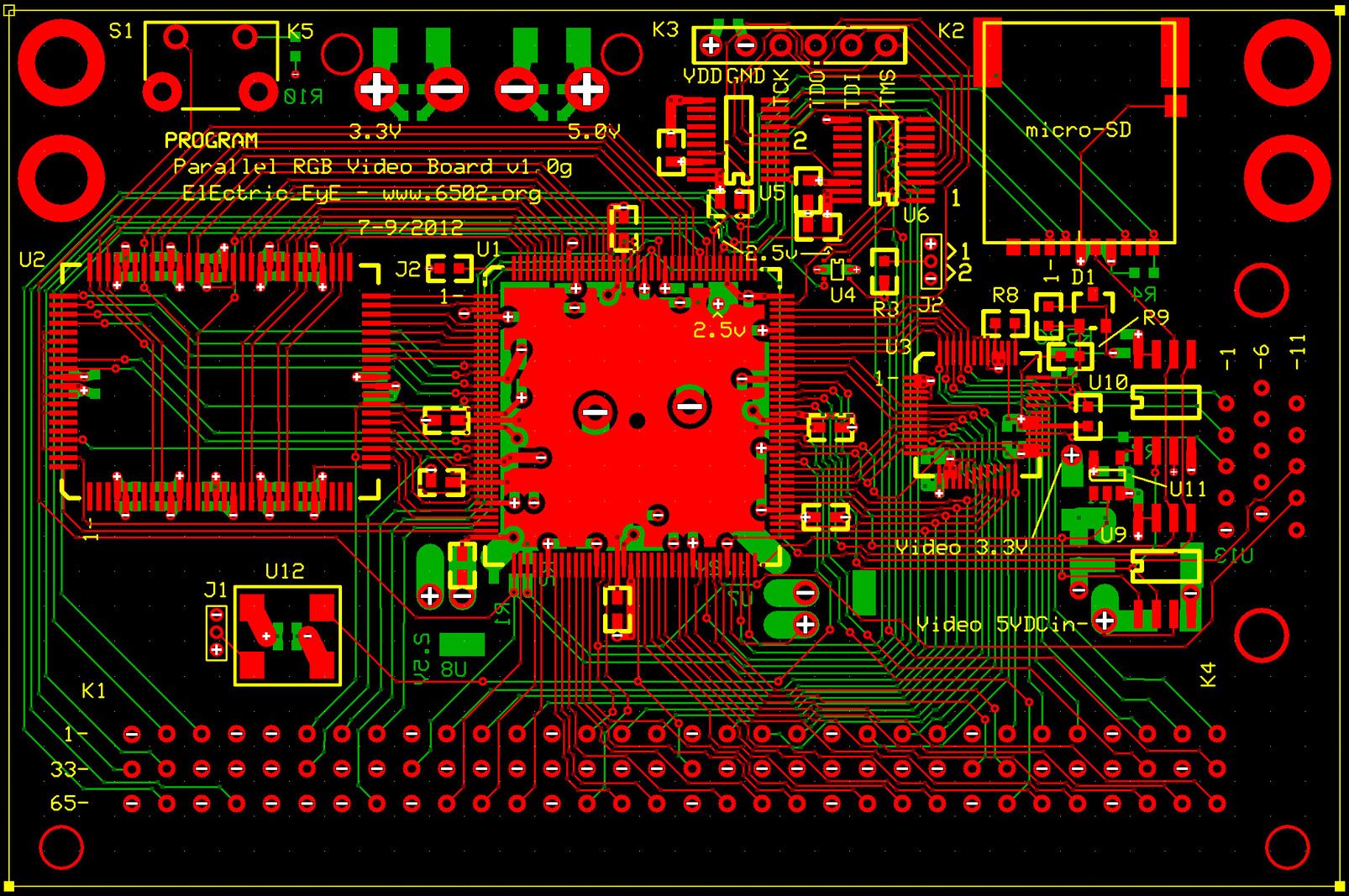
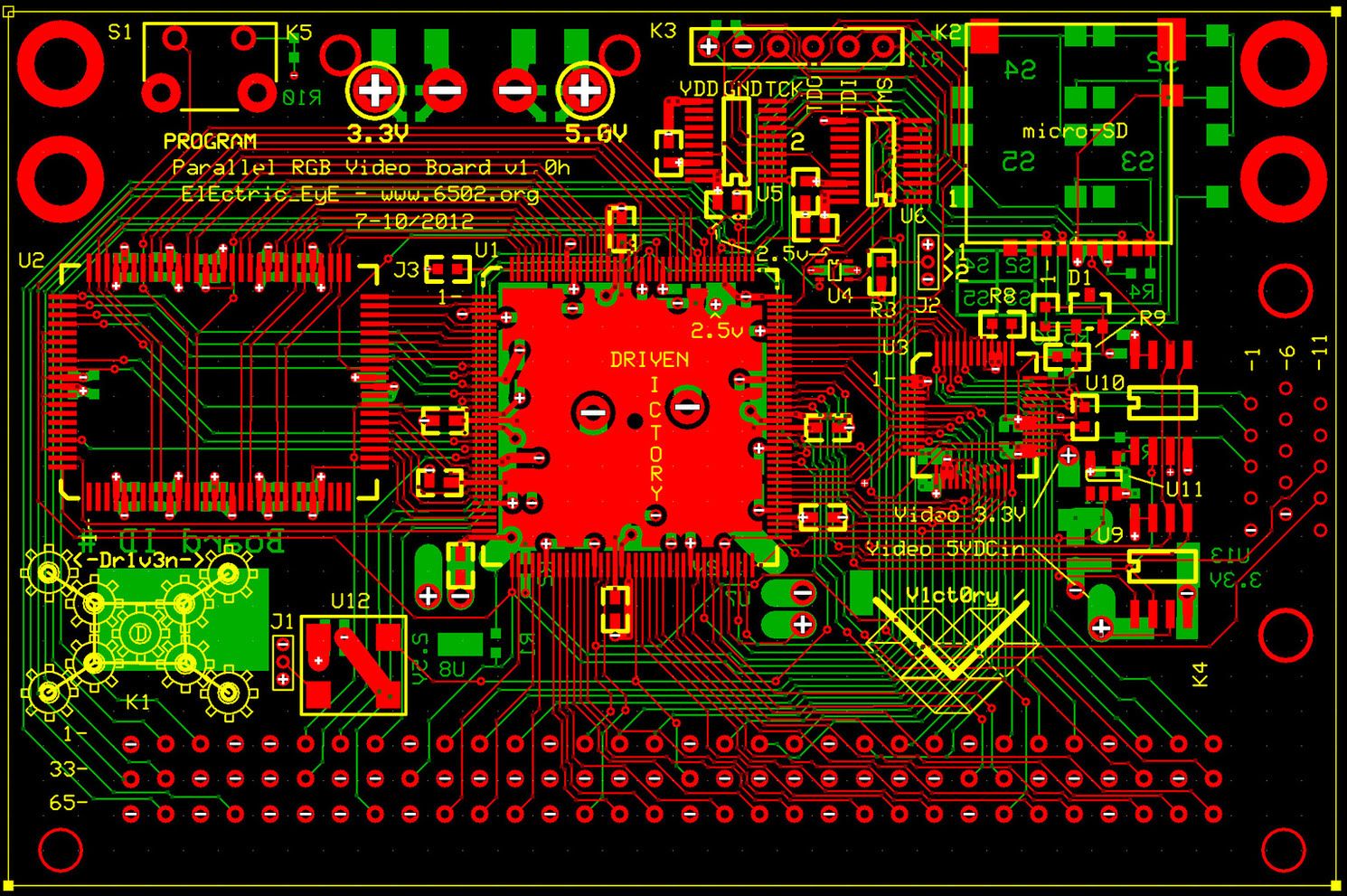
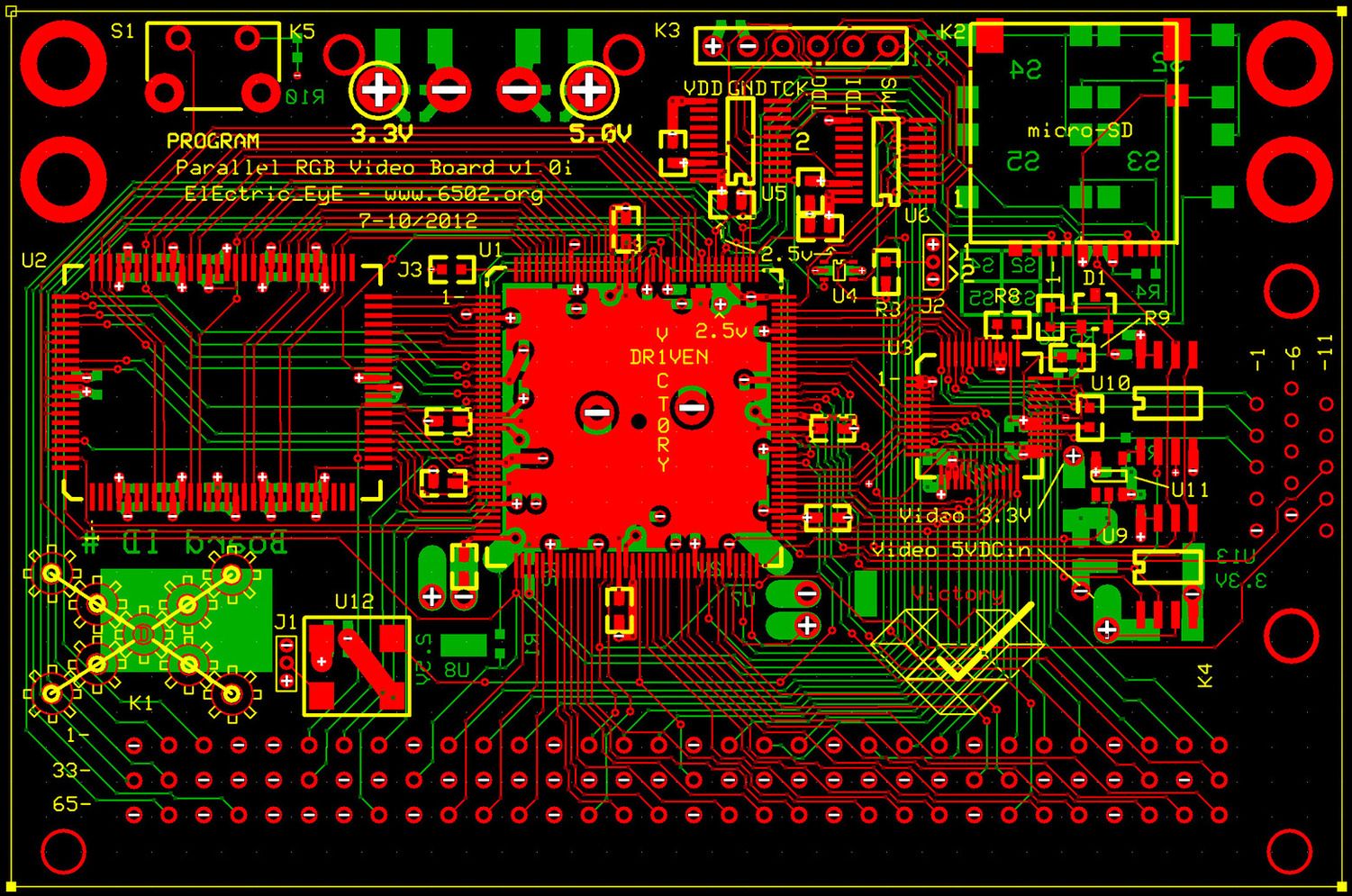
A CLOSEUP shows you the possibilities. v1.0h is virtually identical...
Concept & Design of 3.3V Parallel 16-bit VGA Boards
-
ElEctric_EyE
- Posts: 3260
- Joined: 02 Mar 2009
- Location: OH, USA
Re: Concept & Design of Parallel 16-bit VGA Boards
Arlet wrote:
ElEctric_EyE wrote:
Why would you want to do this? or maybe which signals would you want to look at in particular? I could surely put in some holes to accomodate the test points, however there are only 3 holes left in v1.0h design.
A CLOSEUP shows you the possibilities. v1.0h is virtually identical...
-
ElEctric_EyE
- Posts: 3260
- Joined: 02 Mar 2009
- Location: OH, USA
Re: Concept & Design of Parallel 16-bit VGA Boards
Got some neato graphic designs on there too, heh. Will put the order in tomorrow.
-
ElEctric_EyE
- Posts: 3260
- Joined: 02 Mar 2009
- Location: OH, USA
Re: Concept & Design of Parallel 16-bit VGA Boards
I hate that feeling right after I put in the order, and I realize I forgot to do 'such and such'. Well, I don't have that feeling this time around. I will order in 1 hr if I can't make another correction or add anything else. So what if it's potato soup for a week or 2! 
-
ElEctric_EyE
- Posts: 3260
- Joined: 02 Mar 2009
- Location: OH, USA
Re: Concept & Design of Parallel 16-bit VGA Boards
Order placed. ETA 3 days.
Used to be 3 days, now it's 5. Email says ETA is 10/18...
-
ElEctric_EyE
- Posts: 3260
- Joined: 02 Mar 2009
- Location: OH, USA
Re: Concept & Design of Parallel 16-bit VGA Boards
Received the v1.0h boards today, 1 day ahead of schedule from ExpressPCB!
Already I have a v1.0i in the works, although changes are purely cosmetic to the graphics at this point. Version 'i' should be the last, I think. I expect Arlet maybe will have some comments for possible improvements to add for the next PVB board run. We shall see his soldering skills!
Re: Concept & Design of Parallel 16-bit VGA Boards
ElEctric_EyE wrote:
Received the v1.0h boards today, 1 day ahead of schedule from ExpressPCB!
Already I have a v1.0i in the works, although changes are purely cosmetic to the graphics at this point. Version 'i' should be the last, I think. I expect Arlet maybe will have some comments for possible improvements to add for the next PVB board run. We shall see his soldering skills!
-
ElEctric_EyE
- Posts: 3260
- Joined: 02 Mar 2009
- Location: OH, USA
Re: Concept & Design of Parallel 16-bit VGA Boards
Arlet wrote:
...Do you have schematics, by the way ?
Re: Concept & Design of Parallel 16-bit VGA Boards
ElEctric_EyE wrote:
No schematics, I find them to be a hamper. I rely solely on the board layout from the beginning of the design.
-
ElEctric_EyE
- Posts: 3260
- Joined: 02 Mar 2009
- Location: OH, USA
Re: Concept & Design of Parallel 16-bit VGA Boards
Arlet wrote:
..Luckily, most of the important stuff is documented by the UCF file.
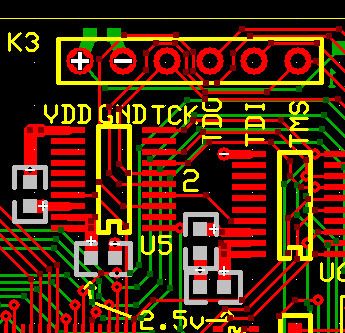
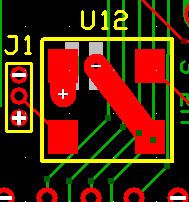
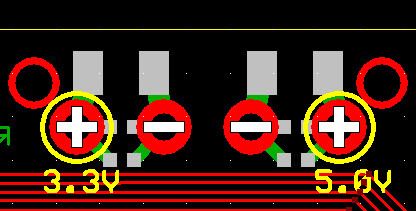
Some tips, in no particular order (parts are highlighted in white):
In regards to the:
(U2) SyncRAM: 2 0603 bypass cap's fit on each power pin on the bottom of the board.
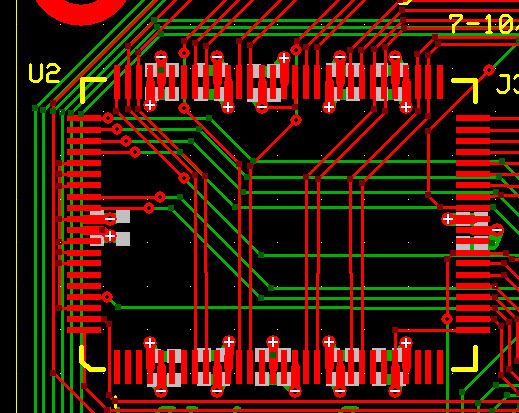
(U5 & U6) FPGA PROMs: 4 0603 bypass cap's on the top.
(U12) 100MHz Oscillator: 2 0603 cap's on the bottom.
(3.3V & 5.0V mains): 2 1210 cap's, 4 0603 cap's on the bottom.
(U1): 7 0603 bypass cap's on top.
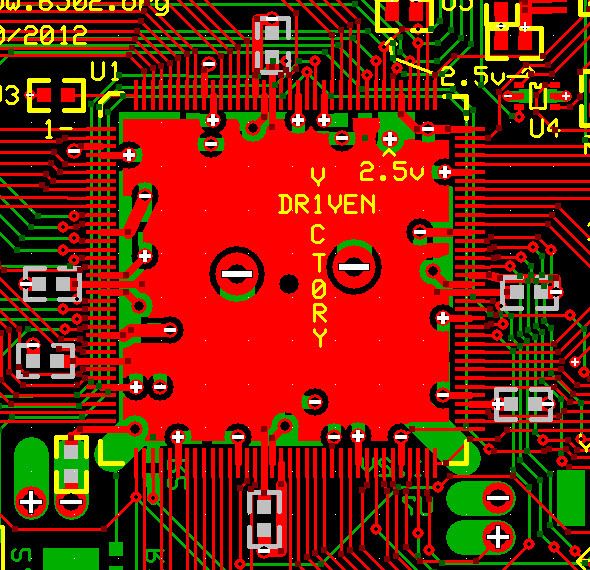
(U1): 14 0603 bypass cap's on bottom. 2 1210 bypass cap's on bottom center.
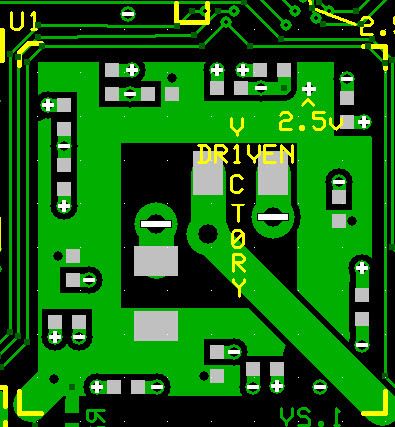
(U3): 1 0603 .1uF

(U3): 1 0603 1uF
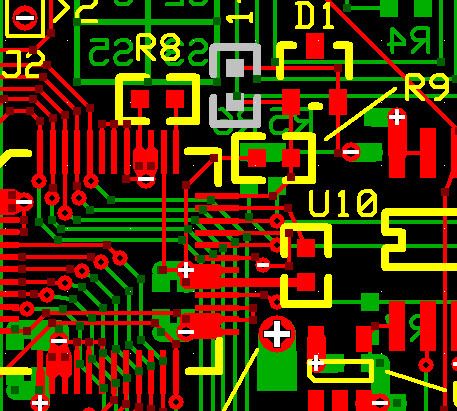
Now in retro, would've been easier for schematics, sorry.
Pics are from v.0i, but everything is the same here. My mistake.
- GARTHWILSON
- Forum Moderator
- Posts: 8775
- Joined: 30 Aug 2002
- Location: Southern California
- Contact:
Re: Concept & Design of Parallel 16-bit VGA Boards
I think a full schematic is a waste of time in many cases, but you can certainly have schematics of isolated portions, or sumarize certain portions with wiring lists (in text) that are quicker to generate and easier to read than a schematic might be. Laying out a large circuit's schematic in a way that's clear and easy to follow is no small task.
http://WilsonMinesCo.com/ lots of 6502 resources
The "second front page" is http://wilsonminesco.com/links.html .
What's an additional VIA among friends, anyhow?
The "second front page" is http://wilsonminesco.com/links.html .
What's an additional VIA among friends, anyhow?
Re: Concept & Design of Parallel 16-bit VGA Boards
GARTHWILSON wrote:
I think a full schematic is a waste of time in many cases, but you can certainly have schematics of isolated portions, or sumarize certain portions with wiring lists (in text) that are quicker to generate and easier to read than a schematic might be. Laying out a large circuit's schematic in a way that's clear and easy to follow is no small task.
-
ElEctric_EyE
- Posts: 3260
- Joined: 02 Mar 2009
- Location: OH, USA
Re: Concept & Design of 3.3V Parallel 16-bit VGA Boards
Today I was looking to order some 2MBx18 synchronous RAMs for the new supplier I found, GSI Technology. Earlier, I was looking at their 4MBx18 devices. As I was not quite ready to spend $160 for each IC, I looked at their 2MBx18 selection and I could not believe what I found! 4ns speed for Flow-Through mode. Also, these IC's have a pin to select Pipeline (2.5ns speed) or Flow-Through mode. Unfortunately, will have to wait 8 weeks for new stock.
Re: Concept & Design of 3.3V Parallel 16-bit VGA Boards
What clock frequency are you planning to use in your design, and how comfortable are you that it's actually going to work ?
-
ElEctric_EyE
- Posts: 3260
- Joined: 02 Mar 2009
- Location: OH, USA
Re: Concept & Design of 3.3V Parallel 16-bit VGA Boards
For the PVBs I would like a minimum resolution of 640x480, with a clock frequency of ~25MHz. With a 2MBx16 RAM that's enough for 6 frame buffers and the relatively low clock speed would allow for a possible cpu. I would also like a maximum resolution of 1920x1080, allowing 1 frame buffer. The speeds for this would be approaching 200MHz. I am unsure if anything designed in the FPGA would work at this speed. But since this higher speed part is only $10 more than the pin equivalent 2MB 6.5ns Cypress part, it is a wise decision to use it to expand the possibilities. Picture quality at 1280x1024 is very good running at 108MHz with my current modified 1.0g board and the 2MBx16 Cypress part.
EDIT: I think it's a good idea at this point to keep a record of PVB versions at the head post. I just realized the GSI 2MB part is not pin for pin compatible with the slower Cypress part. So v1.0i will be made to accommodate the faster part. That update still has to be made.
Re: Concept & Design of 3.3V Parallel 16-bit VGA Boards
I got the components (except for the SRAM), and I mounted some on the board. I now have FPGA + PROM installed, plus the regulators, and the oscillator. JTAG shows both PROMs, and the FPGA, and I made a simple test project to toggle some pins, which worked as expected. I have the DAC ready, but haven't installed it yet.
Now, I need to figure out how I'm going to test the VGA. I only have one monitor, and it's hooked up to my desktop PC. I don't feel like disconnecting the VGA connector from the PC every time I want to test the FPGA board.
By the way, I see R10 and R11 marked on the bottom, but the two pads are connected to each other. What's the purpose of these resistors ?
Now, I need to figure out how I'm going to test the VGA. I only have one monitor, and it's hooked up to my desktop PC. I don't feel like disconnecting the VGA connector from the PC every time I want to test the FPGA board.
By the way, I see R10 and R11 marked on the bottom, but the two pads are connected to each other. What's the purpose of these resistors ?