PCB design questions

Building your first 6502-based project? We'll help you get started here.
Post Reply
Niek6502
Posts: 35
Joined: 18 Jul 2025
Location: Alberta, Canada

PCB design questions

Post by Niek6502 »

I did my first PCB for my 6502 setup, and surprisingly it is all working as expected. Now I want to see if I can do it "properly". I have been reading a lot on the forum and checked out a lot of linked web sources. Just to be clear, my setup will initially run at 4MHz, but I might crank it up to 8MHz later on. My PCBs are 4-layer ones (stacked signal-ground-power-signal with most components on the top layer), and for now I use through-hole for the chips (I am not yet confident enough to use SMT versions of the chips), and all resistors and capacitors are surface-mount. I use KiCad and do all the trace routing by hand (no auto-routing).

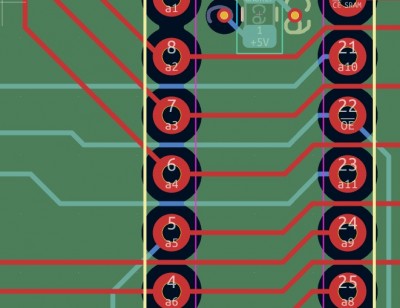
A lot of the info in designing PCBs give various pieces of advise, and pretty much all of them make sense. However, in some cases I run into conflicts. For instance, when laying out signal traces on the PCB, it is best to make sure it has a ground return that closely follows the signal trace. Also, connections should ideally be as short as possible. When using the defaults for KiCad, laying out a PCB ends up like this:
pcb001.jpg
In this picture, the green area shows the copper deposited for the ground layer. Here you can see that the clearance for the through-hole pins causes the ground layer to show a gap for each line of pins. When routing a signal line in between the pins, the ground return then has to go around the rows of pins. What would you do here? Adjust the clearances so the through-holes punch smaller holes in the ground layer (thus allowing the ground return to flow in between the pins), re-route connections to go around the pin rows (thus making them substantially longer and possibly causing a "traffic jam" of traces outside the pin rows), or leave the PCB as-is (so the ground return takes a detour around the pin rows)? To me, changing the parameters of the board so the holes in the ground layer would be smaller makes the most sense, but it might run afoul of the capabilities of the PCB manufacturer (I've used both pcbway and jlcpcb).

Another question is about which resistors and caps to use - not the values etc, but whether to use through-hole or SMT. For these "analog" components I used SMT because it is easier to lay out (I can easily put bypass caps in between the pin rows etc), but I don't really know if there are advantages or disadvantages to use either type.

I am fully aware that especially the routing questions are likely of little consequence for the speeds I am working with, but I would like to get into the habit of doing "proper" PCB layouts (if that makes sense).

-Niek.
User avatar
BigEd
Posts: 11463
Joined: 11 Dec 2008
Location: England
Contact:

Re: PCB design questions

Post by BigEd »

Hmm. As the red layer can route between pins 22 and 23 without danger of shorting against the rings, it seems to me that the green layer should be able to do the same. In other words, I'd expect the spacing rules to allow for a smaller gap around the pin surrounds. I'd be interested to hear otherwise.
User avatar
BigDumbDinosaur
Posts: 9425
Joined: 28 May 2009
Location: Midwestern USA (JB Pritzker’s dystopia)
Contact:

Re: PCB design questions

Post by BigDumbDinosaur »

I would reduce the diameter of the holes’ lands.  Almost any reasonable board house will be able to handle a land diameter that is only 0.45mm larger than the hole diameter.

Also, as Ed suggested, consider reducing the clearance around the hole.  A 0.3mm clearance is more that sufficient.
x86?  We ain't got no x86.  We don't NEED no stinking x86!
User avatar
GARTHWILSON
Forum Moderator
Posts: 8773
Joined: 30 Aug 2002
Location: Southern California
Contact:

Re: PCB design questions

Post by GARTHWILSON »

Yes, definitely run the ground plane between the pins.  AFAIK, all the board houses today, even the cheapest ones, can do .006" (0.15mm) trace and space with no problems, without charging extra.

As for bypass capacitors, if you are comfortable with SMT ones (as you imply), do use those, because they eliminate the lead inductance of thru-hole ones.

The speeds that can get you in trouble are the edge rates, not the clock speed.

I have a lot of good links for further reading and watching at the bottom of the 6502 primer's page "Construction: Avoiding AC-Performance Problems ," at http://wilsonminesco.com/6502primer/construction.html .
http://WilsonMinesCo.com/ lots of 6502 resources
The "second front page" is http://wilsonminesco.com/links.html .
What's an additional VIA among friends, anyhow?
User avatar
gilhad
Posts: 85
Joined: 26 Jan 2024
Location: Prague; Czech Republic; Europe; Earth
Contact:

Re: PCB design questions

Post by gilhad »

Niek6502 wrote:
... it has a ground return that closely follows the signal trace. ...
IMHO the ground return goes via GND pin of such chip (which is usually on one end), so avoiding the trap around pins line.
Niek6502
Posts: 35
Joined: 18 Jul 2025
Location: Alberta, Canada

Re: PCB design questions

Post by Niek6502 »

Thanks all. I haven't had time to poke at the PCB layout some more (struggling with after-surgery complications), will chime back in this week hopefully.

-Niek.
User avatar
GARTHWILSON
Forum Moderator
Posts: 8773
Joined: 30 Aug 2002
Location: Southern California
Contact:

Re: PCB design questions

Post by GARTHWILSON »

gilhad wrote:
Niek6502 wrote:
... it has a ground return that closely follows the signal trace. ...
IMHO the ground return goes via GND pin of such chip (which is usually on one end), so avoiding the trap around pins line.
I'm not sure what you mean here; but if there's a signal line that runs through the middle of an IC, between pins, you want its return current to be able to run directly under it, not having to go down around the "southern tip of Africa" so to speak.  When the return current in the ground plane can't take the path of the signal line, you open up a gap, a space, that must be charged up with this electromagnetic field, increasing inductance, and trying to collapse on other traces that are closer, causing unwanted coupling between signal lines.  If edge rates are slow (like 74HC or slower), it probably won't hurt anything; but as you get into faster stuff (like 74AC and above), it may sometimes cause trouble.
http://WilsonMinesCo.com/ lots of 6502 resources
The "second front page" is http://wilsonminesco.com/links.html .
What's an additional VIA among friends, anyhow?
Post Reply