Looking for recommended 65C02/65C816 SBC for learning
Re: Looking for recommended 65C02/65C816 SBC for learning
drogon wrote:
... Many years ago I made my own W65C02 SBC(s) (and '816 versions). It might fit your needs without a display, but they do use a GAL (could probably use a current in-production Atmel/Microchip version if I ever had a programmer for them). ...
Re: Looking for recommended 65C02/65C816 SBC for learning
I reached out to Putnam Electronics a bit ago about the PE6502, but haven't heard back yet, so I'm looking at other options.
One option I've started looking more closely at is Ben Eater's 6502 kit. Or, if I don't buy the kit, at least watching through his series and building out my own based on what I learn there. I started watching his "Hello World from scratch on a 6502" video series while looking into something to start with. So far that's the one I'm leaning towards, though I'm split between ordering the kit with plans to migrate it to a custom PCB later or buy the parts myself.
My goal is to make things like electronic toys (digital pet kind of thing, maybe add a cartridge slot for read-only minigames) and cartridge based game consoles (the reason I'm even exploring this path to begin with was wanting to make a 16-bit handheld game system), so I'd like to start with as simple hardware as possible and build up from there. It's easier for me to understand from the basics and build up than it is to take apart an existing system and figure out what I don't need to get to where I want to go.
My plan was to use SPI for the LCD unless a better option is available in the system I go with for a display. At least while working in the realm of monochrome displays.
I did start mocking up a 65C02 computer in EAGLE in hopes of making something like a prototyping board with a 5V power supply and sockets for a 65C02, 65C22, RAM, EEPROM and a large prototyping board area with a few different connectors that could be wired up to the prototyping board space for anything I need and wire up everything by hand over time, but I ran into the board size restriction in the free version that killed that idea. I can barely fit the bare minimum for a 65C02 computer on what EAGLE is letting me use (if I want to stick to the easier to solder DIP packaging, at least.) A friend suggested that instead of having a large prototyping board on there, I should some expansion slots using card edge connectors.
One option I've started looking more closely at is Ben Eater's 6502 kit. Or, if I don't buy the kit, at least watching through his series and building out my own based on what I learn there. I started watching his "Hello World from scratch on a 6502" video series while looking into something to start with. So far that's the one I'm leaning towards, though I'm split between ordering the kit with plans to migrate it to a custom PCB later or buy the parts myself.
My goal is to make things like electronic toys (digital pet kind of thing, maybe add a cartridge slot for read-only minigames) and cartridge based game consoles (the reason I'm even exploring this path to begin with was wanting to make a 16-bit handheld game system), so I'd like to start with as simple hardware as possible and build up from there. It's easier for me to understand from the basics and build up than it is to take apart an existing system and figure out what I don't need to get to where I want to go.
My plan was to use SPI for the LCD unless a better option is available in the system I go with for a display. At least while working in the realm of monochrome displays.
I did start mocking up a 65C02 computer in EAGLE in hopes of making something like a prototyping board with a 5V power supply and sockets for a 65C02, 65C22, RAM, EEPROM and a large prototyping board area with a few different connectors that could be wired up to the prototyping board space for anything I need and wire up everything by hand over time, but I ran into the board size restriction in the free version that killed that idea. I can barely fit the bare minimum for a 65C02 computer on what EAGLE is letting me use (if I want to stick to the easier to solder DIP packaging, at least.) A friend suggested that instead of having a large prototyping board on there, I should some expansion slots using card edge connectors.
- GARTHWILSON
- Forum Moderator
- Posts: 8773
- Joined: 30 Aug 2002
- Location: Southern California
- Contact:
Re: Looking for recommended 65C02/65C816 SBC for learning
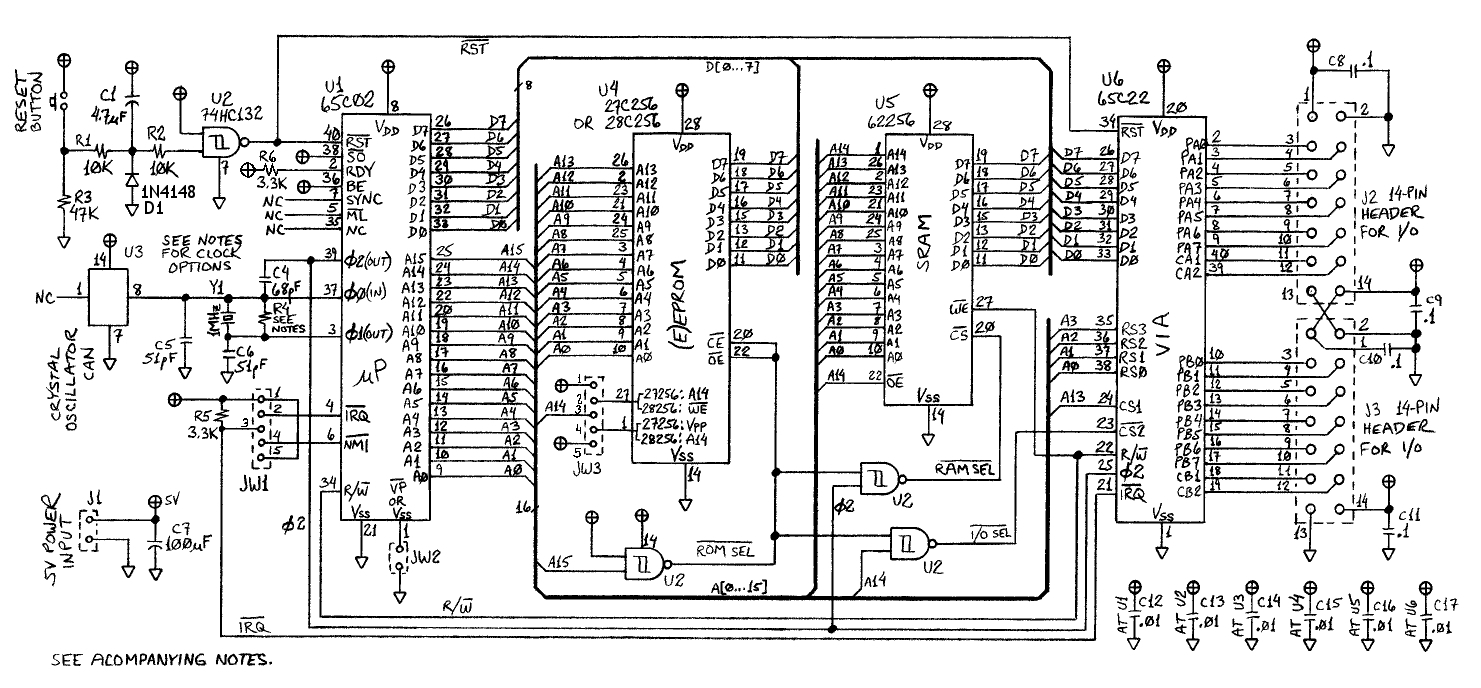
Ardis, you allude to a lot of aspects that are addressed in the 6502 primer. Be sure to go through it. It was written in approximately 2002 to answer questions and problems that kept coming up on the forum, but not cleaned up and posted until I had my own site in 2012, and then keeps getting improved as the need arises. The major techniques given there are ones I've been using for about 35 years, starting long before Ben Eater came on the scene. It's organized in 22 logically ordered pages; so it'd be good to go more or less in order rather than skipping around.
http://WilsonMinesCo.com/ lots of 6502 resources
The "second front page" is http://wilsonminesco.com/links.html .
What's an additional VIA among friends, anyhow?
The "second front page" is http://wilsonminesco.com/links.html .
What's an additional VIA among friends, anyhow?
Re: Looking for recommended 65C02/65C816 SBC for learning
> I'm looking at other options.
> I'm split between ordering the kit with plans to migrate it to a custom PCB later or buy the parts myself
It sounds to me a bit like you're having trouble getting started. Just get started! So long as you can afford it, just buy the kit - it's the least-effort option and it won't have you delaying yourself for longer while you select parts. Once you've made the kit and all is well, then do the other thing.
It's all about overcoming barriers, all the things you think you need to figure out before you can start. You have to start! You will make mistakes and you will learn from them.
Also, your first system will not be your only system. You do not have to do the best possible project: there's a series of projects. Think of it like running, or something similar. You're not best-advised to start by entering a marathon.
> I'm split between ordering the kit with plans to migrate it to a custom PCB later or buy the parts myself
It sounds to me a bit like you're having trouble getting started. Just get started! So long as you can afford it, just buy the kit - it's the least-effort option and it won't have you delaying yourself for longer while you select parts. Once you've made the kit and all is well, then do the other thing.
It's all about overcoming barriers, all the things you think you need to figure out before you can start. You have to start! You will make mistakes and you will learn from them.
Also, your first system will not be your only system. You do not have to do the best possible project: there's a series of projects. Think of it like running, or something similar. You're not best-advised to start by entering a marathon.
- BigDumbDinosaur
- Posts: 9425
- Joined: 28 May 2009
- Location: Midwestern USA (JB Pritzker’s dystopia)
- Contact:
Re: Looking for recommended 65C02/65C816 SBC for learning
Ardis wrote:
I did start mocking up a 65C02 computer in EAGLE...but I ran into the board size restriction in the free version that killed that idea.
You might want to take a look at Kicad, which is Open Source and doesn’t have board size limitations. Kicad has been around for some time now and, in my opinion, has matured to the level of Eagle...without the cost.
As Ed is suggesting, you don’t want your project stalling due to design paralysis. Start simple, such as the design that Garth has posted on his site, and experiment with it. With a serial link to a PC or Mac, you can write code and send it over to your 65C02 contraption to give it a spin and see what happens. As you get comfortable with your unit and with writing assembly language programs, you can plan for a more ambitious design. By doing it in stages, you will minimize difficulty in making a functional unit, and will have an easier time seeing where you want to go and how to get there.
x86? We ain't got no x86. We don't NEED no stinking x86!
Re: Looking for recommended 65C02/65C816 SBC for learning
Kicad exceeds the level at which Eagle was when they finally pushed me away. I still have lifetime commercial licenses for Eagle in various sizes, but Autocad's purchase and transfer to subscription model (they're obviously unfamiliar with the concept of 'perpetual') was the step too far.
Kicad is my preferred schematic/pcb program (I used Altium at work and never got on with it) _but_ it does not work the same way as Eagle does; there may be a rapid initial learning curve. But the price is certainly right!
If you want a simple single board computer, this one is derived from Grant Searle's but using a WDC65C02, and expects serial communication using an STDI USB-3v3 serial adaptor cable to a terminal. It has 32k RAM, and 16k EEPROM. It fits easily on an 80x100mm PDB (half Eurocard) (and the bus connector can be ignored).
If you want the Gerbers, you're welcome, just let me know.
Neil
Kicad is my preferred schematic/pcb program (I used Altium at work and never got on with it) _but_ it does not work the same way as Eagle does; there may be a rapid initial learning curve. But the price is certainly right!
If you want a simple single board computer, this one is derived from Grant Searle's but using a WDC65C02, and expects serial communication using an STDI USB-3v3 serial adaptor cable to a terminal. It has 32k RAM, and 16k EEPROM. It fits easily on an 80x100mm PDB (half Eurocard) (and the bus connector can be ignored).
If you want the Gerbers, you're welcome, just let me know.
Neil
- BigDumbDinosaur
- Posts: 9425
- Joined: 28 May 2009
- Location: Midwestern USA (JB Pritzker’s dystopia)
- Contact:
Re: Looking for recommended 65C02/65C816 SBC for learning
barnacle wrote:
If you want a simple single board computer, this one is derived from Grant Searle's but using a WDC65C02, and expects serial communication using an STDI USB-3v3 serial adaptor cable to a terminal. It has 32k RAM, and 16k EEPROM. It fits easily on an 80x100mm PDB (half Eurocard) (and the bus connector can be ignored).
I’m not totally onboard (no pun intended) with that design.
- The Ø2 clock generation circuit is needlessly complicated and may be unreliable with parasitic capacitance, voltage and/or temperature fluctuations.
- The circuit uses the PHI1 and PHI2 outputs of the 65C02, which is contrary to WDC’s recommendations (Garth’s circuit also uses those signals).
- The 68B50 is a dubious choice for a UART, as it lacks a bit rate generator and a hardware reset.
- The reset circuit likely won’t correctly work with a WDC 65C02. Also, with the push button directly shorting out C3, contact sticking may eventually occur.
x86? We ain't got no x86. We don't NEED no stinking x86!
- GARTHWILSON
- Forum Moderator
- Posts: 8773
- Joined: 30 Aug 2002
- Location: Southern California
- Contact:
Re: Looking for recommended 65C02/65C816 SBC for learning
BigDumbDinosaur wrote:
2. The circuit uses the PHI1 and PHI2 outputs of the 65C02, which is contrary to WDC’s recommendations (Garth’s circuit also uses those signals).
http://WilsonMinesCo.com/ lots of 6502 resources
The "second front page" is http://wilsonminesco.com/links.html .
What's an additional VIA among friends, anyhow?
The "second front page" is http://wilsonminesco.com/links.html .
What's an additional VIA among friends, anyhow?
- BigDumbDinosaur
- Posts: 9425
- Joined: 28 May 2009
- Location: Midwestern USA (JB Pritzker’s dystopia)
- Contact:
Re: Looking for recommended 65C02/65C816 SBC for learning
GARTHWILSON wrote:
BigDumbDinosaur wrote:
2. The circuit uses the PHI1 and PHI2 outputs of the 65C02, which is contrary to WDC’s recommendations (Garth’s circuit also uses those signals).
Speaking of Sanyo, it was they who worked with WDC to make the static core conversion. The static version was the one in which the Rockwell instructions appeared in the WDC-supplied parts. The WDC data sheet from 2000 indicates that the C02 was available with or without a static core. By 2002, only the static core C02 was listed in the data sheet, available in 0.8µ geometry, with a 14 MHz rating at five volts and DC specs like current production. The 2002 data sheet also recommended that PHI1OUT and PHI2OUT not be used in new designs.
x86? We ain't got no x86. We don't NEED no stinking x86!
Re: Looking for recommended 65C02/65C816 SBC for learning
BDD's criticisms are all valid; it was my first design of that nature in forty-odd years. Parts are not to commercial best practice, but on the whole it works. The reset circuit rarely power-on-resets but the button works (at the moment); ph1 and ph2 are used because the design was originally for an NMOS circuit and will accommodate either part; the clock oscillator has been found to be reliable in use (it's from a Motorola CMOS design note) though it won't work with an HCT part, I suspect; and the 68B50 is using the system clock so no issues there (though there are other potential issues, none of which have arisen in practice).
The circuit was not presented as a professional example but rather something simple, quick, easy, and inexpensive which the OP might use to get his head around the basics of 6502 programming. My more recent designs use clock generators, power supervisors/reset generators, and phase0...
Neil
The circuit was not presented as a professional example but rather something simple, quick, easy, and inexpensive which the OP might use to get his head around the basics of 6502 programming. My more recent designs use clock generators, power supervisors/reset generators, and phase0...
Neil
- BigDumbDinosaur
- Posts: 9425
- Joined: 28 May 2009
- Location: Midwestern USA (JB Pritzker’s dystopia)
- Contact:
Re: Looking for recommended 65C02/65C816 SBC for learning
barnacle wrote:
...The reset circuit rarely power-on-resets but the button works (at the moment)...
WDC says Ø2 has to complete at least two cycles after VCC stabilizes before reset can go high, something I determined is definitely the case with the 65C816. In your circuit, reset likely goes high well before the oscillator starts, which would explain why a power-on reset fails.
x86? We ain't got no x86. We don't NEED no stinking x86!
Re: Looking for recommended 65C02/65C816 SBC for learning
True, dat!
Are there any cheap and cheerful supervisor chips out there that monitor both incoming Vcc _and_ a system clock before releasing ~reset? It's possible that using a time-based supervisor may beat the clock to the reset.
Neil
Are there any cheap and cheerful supervisor chips out there that monitor both incoming Vcc _and_ a system clock before releasing ~reset? It's possible that using a time-based supervisor may beat the clock to the reset.
Neil
Re: Looking for recommended 65C02/65C816 SBC for learning
(Some explanation: that circuit was largely not designed by me; mostly it was lifted from Grant's page. Exactly as the OP needs, I needed something cheap and quickly, ideally already known to work; this was that. I also had to design and build an eeprom programmer, including the software to talk to it, before I could use it.)
Neil
Neil
Re: Looking for recommended 65C02/65C816 SBC for learning
barnacle wrote:
True, dat!
Are there any cheap and cheerful supervisor chips out there that monitor both incoming Vcc _and_ a system clock before releasing ~reset? It's possible that using a time-based supervisor may beat the clock to the reset.
Neil
Are there any cheap and cheerful supervisor chips out there that monitor both incoming Vcc _and_ a system clock before releasing ~reset? It's possible that using a time-based supervisor may beat the clock to the reset.
Neil
Re: Looking for recommended 65C02/65C816 SBC for learning
MCP130 is a cheap supervisor in TO92 package.