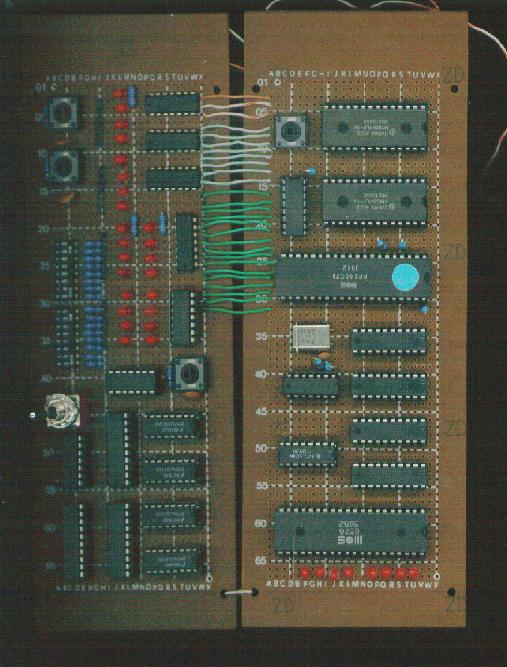
One approach is to use a single-stepping circuit and toggle the bootstrap into RAM. This is historically authentic but error-prone and tedious!
If the SBC uses an EEPROM, it could be made to be programmable in-place(*), once you've got a way to get your code into the SBC.
Or, combining the two approaches, it would be possible to toggle the bootstrap into EEPROM, so you only need to get it right once.
But in any case the bootstrap should be short. I found myself wondering how short, and this is what I came up with - 27 bytes of utterly untested machine code!
Code: Select all
        ;; sketch of a minimal bootstrap
        ;; suitable to be toggled into an eeprom
        ;; loads up to 256 bytes, to be placed in zero page
        ;; this is minimal! no error checking!
        ;;
        ;; this bootstrap will load a bigger second-stage bootstrap from serial port
        ;; a typical second stage might load a monitor in srecord format
        ;;

        .ORG $FFE5 ; (manually) place the bootstrap up against the reset vector (Edit: Nope! 2 bytes out!)

        ;; for info on 6850 see http://www.electronics.dit.ie/staff/tscarff/6800/6850acia/6850.htm
        .DEFINE         SERIAL_STATUS_REG  $FE08
        .DEFINE         SERIAL_DATA_REG    $FE09

        .DEFINE         EOF                $EA   ; NOP opcode to indicate end of program
                                                 ; (must avoid this value even as a data byte)

bootstrap:
        ; master-reset the UART
        LDA #$03
        STA SERIAL_STATUS_REG

        LDX #0
readbyte:
        LDA SERIAL_STATUS_REG   ; bit 0 tells us if there is a byte to read
        ROR
        BCC readbyte
        LDA SERIAL_DATA_REG
        CMP #EOF    ; check for end of second stage
        BEQ 65536   ; jump to second stage at bottom of zero page
        STA 0,X
        INX
        BNE readbyte

.word bootstrap ; the 6502 reset vectorCode: Select all
FFE5   A9 03
FFE7   8D 08 FE
FFEA   A2 00
FFEC   AD 08 FE
FFEF   6A
FFF0   90 FA
FFF2   AD 09 FE
FFF5   C9 EA
FFF7   F0 07
FFF9   95 00
FFFB   E8
FFFC   D0 EE
FFFE   E5 FF
(*) Edit: I think some EEPROMs are particularly easy to program, but I might be mistaken.