Thanks to everyone who helped me in this thread. I have finally written my first Vectrex Program now. It bounces 20 squares and 20 dots around the screen. Since I am new to all this it took me a while to actually understand what I was doing, and i had to overcome quite a lot of problems, but I got there in the end
I tried to record the best quality video i could but my video-recording software didn't really like the line graphics (it looks like the screen shot normally - not all shimmery like it does in the video) or the flashing text at the start . Also normally it runs totally smoothly but having the video-recording software running slowed it down a bit.
I havent optimised or looked for duplication in the program yet (I'm sure there is some appalling programming in here, also Xman,Yman,Xv,Yv are no longer used) I was more concerned with actually getting it to run but here is the source code in case anyone else wants an easy way in to making Vectrex programs. The print routine was used for debugging, but not in the actual program
(this program is laid-out fine in notepad and here, but some lines move out of aligment when i actually publish the post. sorry)
Code: Select all
;***************************************************************************
; DEFINE SECTION
;***************************************************************************
                INCLUDE "VectBiosAdd.asm"		; vectrex function includes (BIOS Functions)
		INCLUDE	"RichMacros.asm"		;Macro File (not used in this program now)
;
; start of vectrex memory with cartridge name...

;**************** ROUTINES

m_3 macro max,digit    ;Ville Krumlinde's routine to convert a binary number into decimal, must be less than 100
  cmpb #max-1
  bls tpd\1
  subb #max
  addb #'0'
  lda #'digit'
  std ,U
  bra tlsExit2
tpd\1:
  endm

;NOTE BIOS routines : Print_str_d trashes X REg, Wait_recal does too, intensity trashes D only


               ORG     0
;***************************************************************************
; HEADER SECTION
;***************************************************************************
                DB      "g GCE 2013", $80       ; 'g' is copyright sign
                DW      music1                  ; music from the rom
                DB      $F8, $50, $20, -$56     ; height, width, rel y, rel x
                                                ; (from 0,0)
                DB      "SQUARE ATTACK!!",$80        ; some game information,
                                                ; ending with $80
                DB      0                       ; end of game header

;***************************************************************************
; CODE SECTION
;***************************************************************************
; here the cartridge program starts off

main:
		LDA 	#0
		STA 	XMan
		STA	YMan
		STA	Yv
		LDA	#1
		STA	Xv

		LDA	#1
		STA	dl1
		LDA	#40
		STA	dl2

;move dot list to RAM (can't be chanaged while in ROM)


		LDB	#79
		LDX 	#Objects
		LDY	#ObjectList

memloop	LDA	B,Y
		STA	B,X
		DECB
		BPL	memloop


loop:
		JSR     Wait_Recal              ; Vectrex BIOS recalibration

		LDX	#Objects		;Base address of dotlist in RAM, each entry is a byte
		LDY 	,X++			;Number of Objects into Y, Base address of Object list in RAM into X also increment X by a word so on next item

		STX	tempX			;Store X in temporary variable because a lot of BIOS routines use X register

ListLoop:
;----------  MOVE OBJECTS
;---------- X Limits
		LDX 	tempX
		LDA	,X			;xposition of object to A
		ADDA	2,X			;add x-vector to A

		CMPA	#XLIM		;check if hits right side of screen
		BLE	chk2
		LDA	#XLIM
		BRA	SetX
chk2:
		CMPA	#-XLIM              ;check if hits left side of screen
		BGE	fin
		LDA	#-XLIM

SetX:
		NEG	2,X			;two's complement X-vector (negate it)
fin:
		STA	,X			;store new X position

;---- Y limits
		LDA	1,X			;y position of object in A
		ADDA	3,X			;add yv to y position

		CMPA	#YLIM		;check if hits top of screen
		BLE	chk2y
		LDA	#YLIM
		BRA	SetY
chk2y:
		CMPA	#-YLIM              ;check if hits bottom of screen
		BGE	finy
		LDA	#-YLIM

SetY:
		NEG	3,X			;two's complement XV
finy:
		STA	1,X

		LDX tempX


		LDA     #$7F            ;Set scale factor to $7F
                STA     <VIA_t1_cnt_lo

;---------------DRAW DOTS

		JSR	Intensity_7F		;brightest intensity for dots
		;LDA     #$F4                   ;Init dot dwell (brightness)
                ;STA     <Vec_Dot_Dwell
		LDX 	tempX


		JSR	Reset0Ref		;Reset pen to origin
		LDA     1,X	                ; relative Y position
                LDB     ,X                   	; relative X position
                                               ; register D = 256*A+B
		NEGA				;Dot positions are positioned at the inverted positions of the squares
		NEGB
                JSR     Moveto_d  		;move to position specified in
						; d register
                JSR     Dot_here                ; Plot a dot at this position

;---------------DRAW SQUARES

		;LDA     #$05            ;Init dot dwell (brightness)
                ;STA     <Vec_Dot_Dwell

		JSR	Reset0Ref
		LDX	tempX

                LDA     1,X                      ; set y
                LDB     ,X                      ; set x

                JSR     Moveto_d                ; move the vector beam the
                                                ; relative position
		LDA     #$10                    ; scaling factor of $10 to A
                STA     VIA_t1_cnt_lo           ; move to time 1 lo, this
                                                ; means scaling
                JSR     Intensity_5F            ; Sets the intensity of the
                                                ; vector beam to $5f
                LDX     #square_line_list       ; load the address of the to be
                                                ; drawn vector list to X
                JSR     Draw_VLc                ; draw the shape

;------------
		LDX	tempX			;Retrieve X
		LEAX	4,X			;move to next item in list
		STX	tempX


		LEAY 	-1,Y			;Dec Y (number of items)
		BNE	ListLoop


;		LDY	#1			;Delay routine, uncomment to slow program down
;delay2:
;		LDX	#25
;delay:		LEAX	-1,X
;		BNE	delay
;		LEAY	-1,Y
;		BNE	delay2

                BRA     loop			; and repeat forever

Print_Text:					;Print text A=Text position relative Y  B=Text position relative X
		JSR     Text_ConvertX2		;Convert binary number to decimal
		JSR	Reset0Ref
                JSR     Print_Str_d             ; Vectrex BIOS print routine
		RTS

Text_ConvertX2:           ;x holds value to be converted (max 99), u = destination buffer-2 (2 bytes needed)

tlsBelow100:

  m_3 90,9
  m_3 80,8
  m_3 70,7
  m_3 60,6
  m_3 50,5
  m_3 40,4
  m_3 30,3
  m_3 20,2
  m_3 10,1

  LDA#'0'
  ADDB #'0'
  STD ,U

tlsExit2:

	LDB	#$80             ;add end byte
	STB	2,U

  RTS


;***************************************************************************
; DATA SECTION
;***************************************************************************

XLIM		EQU	80
YLIM		EQU	122
XMan		EQU	$C880
YMan		EQU	$C881
Xv		EQU	$C882
Yv		EQU	$C883
dl1		EQU	$C884
dl2		EQU	$C885
temp_string	EQU	$C886
tempX		EQU	$C887 			;(allow 2 bytes to store X)
Objects		EQU	$C899			; store dotlist in RAM here so it can be altered
						         ; ROM cannot be written to!
User		EQU	$CAB9			;User Stack
ObjectList:

		DB 0,20                           ; number of objects (word, 2 bytes)
                DB  20,-20,-2,2
		DB  -20,-10,1,-2
		DB 10,10,-1,1
		DB -20,20,2,-1
		DB -40,30,3,1
		DB 40,-30,-2,-3
		DB 30,40,2,2
		DB 60,-20,1,3
		DB 35,-15,4,2
		DB -35,15,2,3
		DB 10,70,-1,-1
		DB -10,-70,2,1
		DB -5,16,1,3
		DB 5,19,4,1
		DB 12,-12,-3,-2
		DB 35,-14,-1,1
		DB 12,20,2,3
		DB -10,-10,2,-2
		DB 30,30,-3,-1
		DB -28,-26,-2,-2

SPRITE_BLOW_UP EQU 35
square_line_list:
                DB 3                           ; number of vectors - 1
                DB  2*SPRITE_BLOW_UP,  0*SPRITE_BLOW_UP
		DB  0*SPRITE_BLOW_UP,  2*SPRITE_BLOW_UP
		DB  -2*SPRITE_BLOW_UP,  0*SPRITE_BLOW_UP
		DB  0*SPRITE_BLOW_UP,  -2*SPRITE_BLOW_UP
;***************************************************************************
                END  main
;***************************************************************************


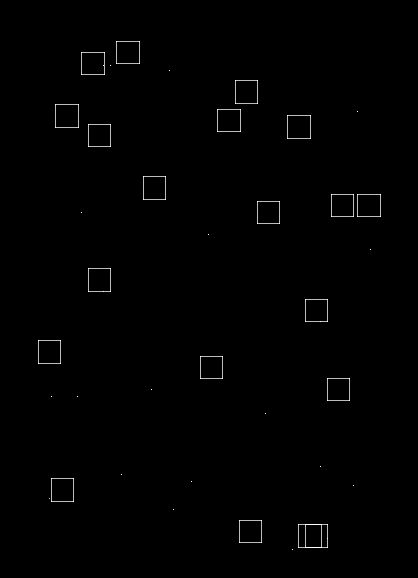
 Don't forget the dots, those boxes get all the attention...