Page 1 of 1
New SBC Project looking for feedback
Posted: Wed Jul 02, 2025 7:17 pm
by willeye
I have created a Ben Eater based sbc with expansion cards. This is my first and welcome any feedback
https://github.com/Willeye-uk/RetroLogic
Re: New SBC Project looking for feedback
Posted: Wed Jul 02, 2025 7:55 pm
by BigEd
Welcome! Thanks for sharing your project. And thanks for the renders - LEDs, VGA boards, looking good.
(Sorry I can't give a technical view at present)
Re: New SBC Project looking for feedback
Posted: Thu Jul 03, 2025 2:51 am
by BigDumbDinosaur
Welcome to 6502 land!
Any chance of posting your project here? Some of us seem to have intractable trouble with Github.
The 6502.org forum allows you to attach images, source code, etc., to your posts, allowing you to create a running log of your project. For an example, here is my “running log” on my POC V1 project. As I come up with new stuff, or redo existing stuff, I add to the topic. You can do the same thing, knowing that it is always accessible to you and to other 6502.org members who are interested in what you are doing.
As your unit is your first project, you might find Garth Wilson’s extensive 6502-oriented website to be of interest, especially his 6502 primer. As you debug and test your unit, you may discover solutions to any problems that arise by reading his site’s content, especially the primer. If not, just post a question here and someone will offer some help.
Re: New SBC Project looking for feedback
Posted: Thu Jul 03, 2025 8:26 am
by willeye
These are where i am at so far, I have also designed a soundcard for expansion port
Re: New SBC Project looking for feedback
Posted: Thu Jul 03, 2025 8:28 am
by willeye
I know the main board schematic needs work, can you guess which came first and which last lol
Re: New SBC Project looking for feedback
Posted: Thu Jul 03, 2025 10:03 am
by hoglet
One recommendation: don't leave unused inputs of 74HC series (or any CMOS logic device) floating. Connect them to ground directly, or if you think there is a chance you might want to use the gate (e.g. as a patch) then connect them to ground or VCC via a pullup resistor.
Are the two different reset circuits there as alternatives?
I also see you have the flow control signals connected directly to the DB9. Don't take my word as gospel, but don't these are need to pass through the MAX232 to be translated to/from RS232 levels?
Re: New SBC Project looking for feedback
Posted: Thu Jul 03, 2025 12:50 pm
by barnacle
Yes. All signals in RS-232 are unbalanced, -3v to -12v 'high' and +3v to +12v 'low'.
Everything needs to go through an RS-232 to logic converter (and back the other way).
However... if you're going to be communicating with something like a terminal program on a computer, and _not_ an actual piece of hardware that can only use RS-232, you might do better with something like a usb-ttl serial adaptor. I favour the FTDI cables: TTL-232R-5V or TTL-232R-3V3.
https://lcsc.com/datasheet/lcsc_datashe ... 890393.pdf
Neil
Re: New SBC Project looking for feedback
Posted: Thu Jul 03, 2025 1:58 pm
by BigDumbDinosaur
Some notes...
- Referring to the fourth schematic (the one with the 65C02 on it), as Dave (Hoglet) observed, you seem to have two reset circuits. Which one are you planning to use? I can tell you that the one with just series resistance, the push button and a 0.01µF capacitor will be unreliable and may not cleanly reset the 65C02 (MPU). The DS1813 circuit, on the other hand, is a good choice—it’s what I use in my builds, and will also properly cycle the reset line at power-on. Although the DS1813 has an internal pullup resistor, it is relatively high in value and should be supplemented with an external resistor—4.7K is a good choice.
Incidentally, it is not good design practice to put a capacitor directly across a switch, push button or relay contact. When a fully-charged capacitor is shorted, there is a brief but intense current surge that can cause contacts to eventually stick. Always put resistance in the discharge path to limit peak current flow to something no greater than the contact’s maximum DC rating.
- RDY on the MPU must not be directly connected to VCC. On the WDC version of the 65C02, RDY is a bi-directional pin. In the event the MPU executes a WAI instruction, intentionally or due to a bug in your software, it will attempt to drive RDY low, which in your circuit would cause the MPU to try to short VCC to ground. RDY should be pulled up to VCC with a resistor, typically 3.3K.
- The SOB (SO) input on the MPU must be either grounded or pulled up to VCC—I recommend pulling it up through a 3.3K resistor. As Dave noted, CMOS inputs must not be left floating, except under very narrow circumstances (which don’t apply here). A floating CMOS input will be vulnerable to noise pickup, which may cause the affected device to behave in an unpredictable manner.
- In your application, your IRQ circuit is wired-OR, which means the IRQB (IRQ) input on the MPU must be pulled up to VCC—I recommend a resistor value between 2.2K and 3.3K. When you do your board layout, strive to keep the total length of all IRQ circuit connections to a minimum to avoid spurious interrupts due to parasitic capacitance.
- You may find it useful to connect NMIB on the MPU to another DS1813 so you can trigger a non-maskable interrupt with a push button. With suitable code in your firmware, you can use this function to regain control in the event a software bug puts the MPU into an endless loop.
- The W65C22N and 65C51 have open-collector IRQ outputs. Hence the diodes attached to those devices’ IRQ pins are unnecessary and should be removed. Your IRQ circuit may not work at all with those diodes in place.
- Use of the Ø2 clock to qualify chip selects, as you are doing with U3, is not the best design technique. While it will perform okay at single-digit Ø2 rates, it may not scale with higher speeds. I mention this because you indicated you eventually want to go up to 14 MHz. Use of Ø2 to qualify chip selects at that speed may run into timing issues that will result in unreliable operation.
The MPU generates an effective address during Ø2 low, which is when your chip-select logic should assert /CS on the device that is to be read or written. The /OE and /WE inputs on the selected device are what should be qualified with Ø2. That is easily accomplished with a circuit such as the following:
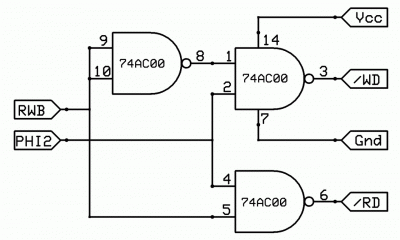
- Read/Write Qualified by Ø2
/RD would drive /OE and /WD would drive /WE. The above shows 74AC logic, but you can use 74AHC or 74HC in your design.
Note that chip selects and read/write inputs on 65xx devices that are clocked by Ø2 must never be qualified by the clock.
- The CTS and RTS flow-control connections on the 65C51 operate at CMOS logic levels. As Neil (barnacle) points out, they must be translated to/from TIA-232 levels (which are nominally ±12 volts) in order to work with TIA-232 devices. I recommend you use a MAX238 instead of the MAX232, which will give you extra channels to make your flow control connections. The MAX238 is two MAX232s in a single package, and uses the same number of charge pump capacitors.
- Speaking of the MAX232 (or 238), Maxim requires that a 1.0 µF capacitor be connected to VCC and ground as close as possible to the device. Additionally, the charge pump capacitors (C3, C4, C5 and C6) should be as physically close to their respective pins as possible. I recommend that you also bypass the MAX with a 100 µF, low-ESR electrolytic to help dampen the current pulses the device pulls off VCC. Try to place the electrolytic as close as possible to the device.
- I see you are powering your unit from a USB source. A lot of el cheapo USB power sources are notorious for poor regulation. You might want to check the output voltage of the source under load...you may be in for an unpleasant surprise. If VCC sags too much, you may not be able to maintain stable operation.
- The value of R3 is too low. I would go with 470 ohms. Assuming a forward drop of 2.1 volts (typical for a lot of LEDs), that will drive the LED with a more modest 6 mA, instead of the 13 mA with the 220 ohm value you specified. It will still be plenty bright.
- In the circuit that drives all the LEDs, you are using 74LS devices. Those should be CMOS devices and probably should be 74AC to assure adequate drive. Mixing TTL (74LS) silicon with CMOS parts may result in unreliable or no operation due to differing logic levels—a CMOS device’s notion of what constitutes a logic 0 or logic 1 is significantly different than that of a TTL device.
Also, the output of a TTL device is only guaranteed to reach 2.4 volts when driving the load high and the current sourcing capability is poorer than the sinking capability. Your circuit has relatively little margin and may struggle to adequately drive the LEDs.
BTW, it appears you have all the LEDs backwards.
Re: New SBC Project looking for feedback
Posted: Mon Jul 07, 2025 2:16 am
by enso1
Welcome!
A quick note on attribution, in case you haven't realized it: the so-called 'Ben Eater' computer is a shameless, direct copy of Garth Wilson's design.
Garth Willson has been making 6502 machines for decades, and has
shared everything with our community, without peddling merch or asking to subscribe to get better sponsorships and ad revenue.
https://wilsonmines.com/
It always irks me when people don't realize the difference between self-promiting influencers and true heroes of our community.
Re: New SBC Project looking for feedback
Posted: Mon Jul 07, 2025 3:33 am
by GARTHWILSON
Garth Willson has been making 6502 machines for decades, and has shared everything with our community, without peddling merch
Anyway, again, the site's main purpose is information dissemination. There are many, many places where I give others credit for ideas or solutions. In the case of the structure macros article, I added a note saying "1/12/18: I just found out Dave Keenan did the same kind of thing for the IAR assembler and the MSP430 processor. We were unaware of each other's work until now." IOW, even though I didn't get any ideas from him, I'm giving credit and an example that I'm not the only one who's come up with this. I don't need to hoard any glory. I just want to promote our interest.
Re: New SBC Project looking for feedback
Posted: Mon Jul 07, 2025 6:49 pm
by enso1
I think there is a big difference between making hard-to-find modules available at or near cost vs. marketing a kit of few Chinese breadboards and parts for $299. There is nothing wrong with getting paid for your work, but if you are copying a schematic that someone else had shared with the community, it is just common decency to mention that.
I get flak for hating on Mr. Eater, but I feel it is my duty to remind people not familiar with the situation about the origins of the 'Ben Eater' computer.
Re: New SBC Project looking for feedback
Posted: Tue Jul 08, 2025 10:29 pm
by willeye
I am sorry did i copy your work, I thought it came from Ben Eater
Re: New SBC Project looking for feedback
Posted: Tue Jul 08, 2025 10:35 pm
by willeye
Thank you all for the tips, I have gotten my boards back from pcb way and they are working great so far. I have stuck to ftdi usb rather than rs232 port for now. I fixed the LED's too
Re: New SBC Project looking for feedback
Posted: Wed Jul 09, 2025 6:14 pm
by enso1
willeye, I don't think you did anything wrong! Garth's site is full of circuits and tips, for all of us to use and enjoy!
I am just venting frustration at Mr. Eater for not giving credit where it's due.