Page 1 of 1
Statement of intent
Posted: Wed Jun 04, 2025 7:40 am
by Charlielamus
Hello lovely people!
I am embarking on a project which some of you might be interested in, so I thought I would introduce myself and let you comment...
Basically, I have literally no background in computer science at all, and no knowledge of electronics beyond a few Velleman 555 timer kits assembled as a teenager. My programming experience amounts to 10 PRINT "HELLO" / 20 GOTO 10 (as a child) and a bit of Python code theft for the Pi Pico and so on.
I am planning to build an Apple-1-esque computer, leaning heavily on Ben Eater and others, without asking for other people to do the thinking for me, and document all my progress, mistakes and so on. The main thing is to have a record of my progress from total ignorance to a working breadboard computer.
I plan to call it the JECS-1 (Just Enough Computer Science).
One thing before I start - assuming I run the processor at 1Mhz, will I get away with using 12 breadboard power rails as a sort of backplane for the address and data busses, like Ben Eater did with his 8 bit breadboard computer? I know at higher speeds I am likely to run into latency problems, but I am hoping this means I can lay out the computer with plenty of space and label all the bits and so on so it can be mounted in a picture frame as a work of art.
Any thoughts?
Thank you!
Re: Statement of intent
Posted: Wed Jun 04, 2025 8:22 am
by drogon
Don't over-think it. And don't pay too much attention to the nay-sayers either - many of us here (including me) have breadboarded 6502 systems and 1Mhz is just the starting point. I got to 16Mhz on stripboard after starting on breadboards and it worked just fine.
Get something going and take it from there.
And don't forget to enjoy!
-Gordon
Re: Statement of intent
Posted: Wed Jun 04, 2025 8:55 am
by BigDumbDinosaur
I plan to call it the JECS-1 (Just Enough Computer Science).
One thing before I start - assuming I run the processor at 1Mhz, will I get away with using 12 breadboard power rails as a sort of backplane for the address and data busses, like Ben Eater did with his 8 bit breadboard computer?
The main problem encountered with breadboards is they can introduce intermittent/flaky connections that will drive you nuts. Your chances of building a working unit will to some extent be dependent on the quality of the breadboard and the way in which you dress your wiring. Go for the best breadboard you can afford to purchase and do a little layout planning before you start wiring.
As Gordon said, don’t over-think it. Plenty of people have built functioning machines on breadboard and have also gone well over 1 MHz. Start with something basic and once that’s running, add features. Trying to shoot for the moon with the first design almost always results in failure.
One other thing...don’t be stingy with bypass capacitors. 
Re: Statement of intent
Posted: Wed Jun 04, 2025 12:33 pm
by Charlielamus
Fortunately I have seen enough to order breadboards from BPS (via Mouser), I have a plan which starts very much in the same vein and the same speed as Ben Eater, and I have a large party pack of ceramic capacitors!
If you are interested, it's basically going to start out as a BE6502 minus the LCD screen, linked to Geoff Graham's VT100 terminal project, and aiming to install Wozmon as per the BE6502.
Re: Statement of intent
Posted: Wed Jun 04, 2025 1:57 pm
by gilhad
I was making breadbord comp at 4MHz and it worked on 3 breadboards, but failed to work on 5 breadboards, because of the power lost on chaining breadboards like this (power dropped from 5V somewhere to 3V traveling over the all breadboards and some ICs did not like that. When power was connected in middle of the chain, it sometimes worked, sometimes not. If it was on one side, it did not works at all.) :
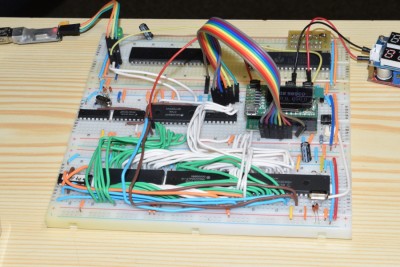
- Power useable
So I made solid power source lines like this, and everything worked again
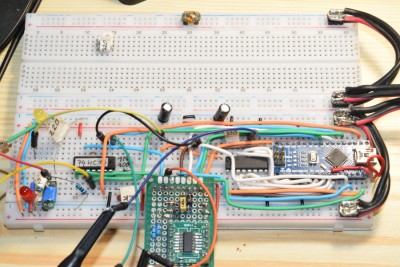
- Betterr power
The difference is all power routed by wide cables (on the right side, I think it is like 2 or 4 mm^2 of copper, it is rated for something like 10A / 240V ~ which is simply overkill, but cheap) and connected by 2x3 pins to the breadboard rails, so there is solid 5V on one side of each breadbord.
So make your power lines reliable
Re: Statement of intent
Posted: Wed Jun 04, 2025 2:44 pm
by Paganini
One of the secrets to success at building breadboard computers is to make your power distribution as much like a grid as possible. Don't just connect all the rails at one end (like in gilhad's first photo); do that at both ends, and, ideally, have a full set of connections running the width of the rails *between every pair if ICs.*
There are some really good tips about breadboarding in this thread:
viewtopic.php?f=4&t=3329
They used to be all collected together in a page on Radical Brad's website, but I think that website became defunct. They're still present in that thread though, and, in spite of its vastness, that thread is a great source of inspiration.

Re: Statement of intent
Posted: Wed Jun 04, 2025 4:09 pm
by Dr Jefyll
Don't just connect all the rails at one end (like in gilhad's first photo); do that at both ends
Yes, this. For subtle reasons having to do with loop area, it matters
where the connections are. Connecting at both ends as suggested reduces inductance. (This would not be the case If you were to double the connections, but with all the connections at one end only.)
breadboards from BPS (via Mouser)
I hope BPS is a reliable product, because (as noted upthread) the flaky connections of a low-quality breadboard will drive you nuts.
gilhad managed to get some
relief, but only by using "2x3 pins to the breadboard rails." IOW,
three pins each 
for power & ground. It wasn't the extra-thick conductors that helped. It was the triple redundancy (to help make up for the flaky connections).
-- Jeff
ps- Welcome!
Re: Statement of intent
Posted: Wed Jun 04, 2025 5:15 pm
by jgharston
Just one point. What you're doing is engineering, not science.
Re: Statement of intent
Posted: Wed Jun 04, 2025 6:07 pm
by BigDumbDinosaur
If you are interested, it's basically going to start out as a BE6502 minus the LCD screen, linked to Geoff Graham's VT100 terminal project, and aiming to install Wozmon as per the BE6502.
Mention of Ben Eater prompts me to recommend you read the 6502 primer at Garth Wilson’s website. More than a little of the content in Mr. Eater’s videos appears to have been derived from Garth’s 6502 primer. A good read of the primer will help to fill in some of the details not present in the Eater videos.
Re: Statement of intent
Posted: Wed Jun 04, 2025 7:10 pm
by Agumander
Yes good I think more people should be unafraid to bumble their way through from nothing and learn what's needed as they go. I was even able to transfer to an embedded systems team at work off the results of my 6502 bumbling. Highly underrated type of project, in my opinion.
Re: Statement of intent
Posted: Wed Jun 04, 2025 10:16 pm
by okwatts
I commend your enthusiasm. I was inspired by Ben Eater's video to resurrect my SYM-1 (from 1980). I too started on a breadboard but the finicky connections had me purchase a PCB to continue with less frustration. One way of tackling this has been given by Nick Gammon
https://www.gammon.com.au/G-Pascal/ where he also provides a nice local environment for assembly and his GPascal. I built Geoff Graham's video terminal and some of the variants he mentions on his website also. Another approach to this was a board derived from Ben Eater's with video on board (Grant Searle) is given here
https://github.com/The-Invent0r/6502-Computer-PCB. Lots of places to go to explore retro style computing. Good Luck!
Re: Statement of intent
Posted: Thu Jun 05, 2025 10:54 am
by J64C
I look forward to seeing your progress. You’ll learn tons along the way and make many improvements as you go. The fun is often more so in the journey than the destination. Good luck!
Re: Statement of intent
Posted: Sat Jun 07, 2025 9:01 am
by gilhad
gilhad managed to get some
relief, but only by using "2x3 pins to the breadboard rails." IOW,
three pins each for power & ground. It wasn't the extra-thick conductors that helped. It was the triple redundancy (to help make up for the flaky connections).
I think, that also the fact, that there was only one connection to rail from source and one to chip from rail helped. The more connections in series, the more problematic places along the way... and the 2x3 pins add also mechanical integrity = it cannot just fall half away and still stay hidden