Best approach for large, slow computer
Posted: Wed Feb 14, 2018 10:15 am
Hello again everyone!
I have been building a computer on breadboard and have been having very good luck with it up until now. I recently attempted to increase the size of my project from 4 breadboard panels, to 8. At the same time, I attempted to simplify my mess of wiring by extending the entire data bus vertically across two sets of rails (doing the same for the clock line, r/w line, IO active-low line, etc.)
Well, much to my chagrin even my +5v VCC line (30W power supply) dropped down to +2v on the far side of the two breadboard rails. I can run power lines directly to each breadboard panel, but there was no hope for my data bus! And oh the poor clock line!
I am trying to run at 2MHz, but I don't think I can even get 500kHz out of such a big breadboard arrangement. Perhaps I am ready to graduate to the next level.
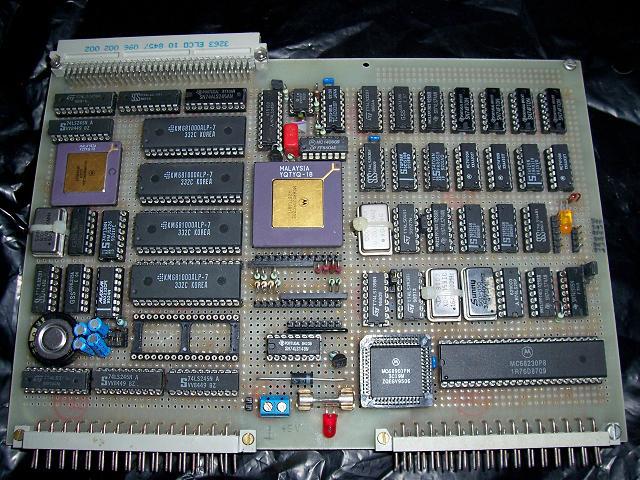
How do you guys recommend I proceed? I am thinking I should move to protoboard and solder? And can I also ask, what about the I/O expandability? I am using the address decoding style from Garth's primer, so I have 10 I/O lines available to me. I am already using 4 of them and will most likely want to use all 10 I/O lines. Can I connect that many chips directly to the data pins of the CPU? 12 wires total coming off of each CPU data pin....?
Since that sounds kind of ridiculous to me, I thought maybe for so many chips I should be using expansion boards? But then I will have to buffer the bus, or stick a VIA in-between is that correct? I'm still trying to keep things simple where I can.
What do you recommend as the best approach for a "large" computer, if top speed is not crucial? (Keeping in mind I am still a beginner?)
Thanks as always for your time!
I have been building a computer on breadboard and have been having very good luck with it up until now. I recently attempted to increase the size of my project from 4 breadboard panels, to 8. At the same time, I attempted to simplify my mess of wiring by extending the entire data bus vertically across two sets of rails (doing the same for the clock line, r/w line, IO active-low line, etc.)
Well, much to my chagrin even my +5v VCC line (30W power supply) dropped down to +2v on the far side of the two breadboard rails. I can run power lines directly to each breadboard panel, but there was no hope for my data bus! And oh the poor clock line!
I am trying to run at 2MHz, but I don't think I can even get 500kHz out of such a big breadboard arrangement. Perhaps I am ready to graduate to the next level.
How do you guys recommend I proceed? I am thinking I should move to protoboard and solder? And can I also ask, what about the I/O expandability? I am using the address decoding style from Garth's primer, so I have 10 I/O lines available to me. I am already using 4 of them and will most likely want to use all 10 I/O lines. Can I connect that many chips directly to the data pins of the CPU? 12 wires total coming off of each CPU data pin....?
Since that sounds kind of ridiculous to me, I thought maybe for so many chips I should be using expansion boards? But then I will have to buffer the bus, or stick a VIA in-between is that correct? I'm still trying to keep things simple where I can.
What do you recommend as the best approach for a "large" computer, if top speed is not crucial? (Keeping in mind I am still a beginner?)
Thanks as always for your time!
 Very good quality breadboards