Page 1 of 2
Prototyping Bits
Posted: Tue Aug 22, 2017 7:07 pm
by floobydust
I went shopping on Digi-Key a while back for some goodies. They had decent stock of the Proto-Advantage adapter boards. I bought a small collection which makes prototyping with some PLCC chips a lot easier, pic attached. Pricing seems fair enough, albeit the PLCC-44 was $20, but it sure beats me spending the time to build one up

.
PLCC-44, PLCC-32, DB9-M/DB9-F, RJ45, Mini-USB and 5.5mm power connector.
Re: Prototyping Bits
Posted: Tue Aug 22, 2017 7:51 pm
by GaBuZoMeu
I hope you have something like this
to extend the lifespan of your plcc sockets.

Re: Prototyping Bits
Posted: Tue Aug 22, 2017 7:55 pm
by GARTHWILSON
It's good news to see those other adapters, since those connectors (DC-10, DB-9, ...) have always been a problem with common perfboard with .100" hole spacing.
Re: Prototyping Bits
Posted: Tue Aug 22, 2017 11:45 pm
by BigDumbDinosaur
PLCC-44, PLCC-32, DB9-M/DB9-F, RJ45, Mini-USB and 5.5mm power connector.
RJ45 is a TELCO standard, not a connector type.

It just so happens that RJ45 specifies an
8P8C modular connector, which is what you have.
Re: Prototyping Bits
Posted: Wed Aug 23, 2017 12:14 am
by Alarm Siren
PLCC-44, PLCC-32, DB9-M/DB9-F, RJ45, Mini-USB and 5.5mm power connector.
RJ45 is a TELCO standard, not a connector type.
It just so happens that RJ45 specifies an
8P8C modular connector, which is what you have.
If we're being pedantic, then they're D
E-9 connectors, not D
B-9, too.
Nevertheless good finds. Breadboarding is such a PITA nowadays because so many parts simply don't fit...
Re: Prototyping Bits
Posted: Wed Aug 23, 2017 2:10 am
by floobydust
Yes, if you want to be technically accurate, 8P8C is it, but using common terms that everyone identifies with seems easier. Per the description at Digi-Key, they mention both:
https://www.digikey.com/products/en?keywords=CN0035
I'm pretty sure everyone figured it out as RJ-45 however

I also have the PLCC removal tool, have had one for decades (mine is black), and yes, attempting to remove a PLCC chip without one isn't fun. In the early days, I would use a small spring-hook and needle-nose pliers to pop them out.
Re: Prototyping Bits
Posted: Wed Aug 23, 2017 6:24 am
by BigDumbDinosaur
I also have the PLCC removal tool, have had one for decades (mine is black), and yes, attempting to remove a PLCC chip without one isn't fun. In the early days, I would use a small spring-hook and needle-nose pliers to pop them out.
This is a PLCC extractor I purchased c. 1990, which I still use.
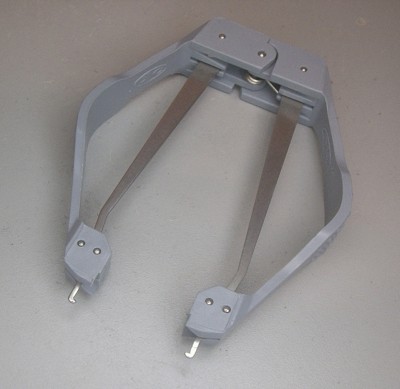
- PLCC Extractor
Before that, I would use a jeweler's screwdriver and a lot of patience.
Re: Prototyping Bits
Posted: Wed Aug 23, 2017 6:35 am
by BigDumbDinosaur
If we're being pedantic, then they're DE-9 connectors, not DB-9, too.
It should be noted the
E refers to the shell size, not the number of pins. The "DB-15" used as a VGA connectors is properly a D
E-15.
Re: Prototyping Bits
Posted: Thu Aug 24, 2017 8:01 am
by BigEd
I like this:
'When I use a word,' Humpty Dumpty said, in rather a scornful tone, 'it means just what I choose it to mean — neither more nor less.' 'The question is,' said Alice, 'whether you can make words mean so many different things.' 'The question is,' said Humpty Dumpty, 'which is to be master — that's all.'
even if it's perhaps the opposite of my reaction. If we write RJ45 or DB9, everyone will know what we mean - even the pedants. If we used the pedants' "corrections" first, barely anyone would understand us.
So: what's the aim: successful communication, or being "correct"?
Re: Prototyping Bits
Posted: Thu Aug 24, 2017 2:31 pm
by Alarm Siren
As far as I'm concerned, being correct, every time. I consider encountering someone who misunderstands something as an opportunity to spread knowledge. Just because a misunderstanding is common doesn't make it not a misunderstanding, and there are circumstances where such misconceptions can cause problems. In these cases perhaps not, since true RJ45 connectors are obsolete and DB-9 connectors don't exist (to my knowledge), but as a counter-example imagine a confused elderly relative in the 80s or 90s who walks into a game shop and buys a "nintendo" for little Timmy, not understanding that Nintendo is a brand name and not a generic term for a video game console - turns out Timmy actually wanted a Sega machine, and bam, ruined Christmas.
If you really want to be certain that you're understood first time whilst still being "correct", you could use a construction like "8P8C connector (aka RJ45)", or you could specify the function of the term which would in most cases clarify what you mean - e.g. 8P8C Ethernet connector, or DE-9 Serial connector.
The Humpty Dumpty character in Lewis Caroll's Through the Looking Glass is a parody and critique of people who use technical terminolgy or jargon without defining it or clarifying meaning where appropriate, implying that the onus of successful communication rests entirely with the speaker. Whilst I agree that a speaker should tailor their speech to their audience, including explanations (or not) as appropriate for the perceived understanding of the listener, it is impossible for the speaker to know in advance exactly what their listener may or may not know, and therefore the listener should enquire or research where they did not comprehend some part of the communication. To that end, I believe that perpetuating misunderstandings does not ultimately serve the interests of the listener: in the immediate here and now, they may more easily understand what you have said, but in the long term they have not learnt the correct terminolgy and will, inevitably, encounter it later in some other form and then be confused. Why delay that enlightenment to a later time when you can help them now?
Nevertheless, I do not normally correct other people (in this case BDD had already started so I thought I'd finish the job) as I know that it annoys people, even though my intent is only to help them learn rather than to somehow demonstrate "superiority" as many seem to believe, but I refuse to use terminolgy that I know to be incorrect, and if someone else corrects me - provided I am satisfied that their correction is valid - then I will happily modify my own terminolgy. BDD earlier corrected my incorrect use of the term "RS-232 Serial" to refer to the specific implementation of serial on IBM compatibles: Firstly, that the standard is now called TIA-232 and not RS-232; secondly that the DE-9 connector is not part of the TIA-232 standard but instead just industry convention, and he is 100% correct, so I now try to say "PC-Style Serial" or something to that effect (though I admit remembering to do so is a struggle).
Re: Prototyping Bits
Posted: Thu Aug 24, 2017 3:04 pm
by BigDumbDinosaur
So: what's the aim: successful communication, or being "correct"?
Both.
Alarm Siren summed it up well. Why should the above goals be mutually exclusive? Why should someone who knows better intentionally promulgate incorrect information? If Humpty-Dumpty believes words can mean whatever he wants them to mean then in his world "wrong" must mean "right". It's patent such thinking is wrong, right?
Re: Prototyping Bits
Posted: Thu Aug 24, 2017 3:59 pm
by BigEd
I think pedantry is usually more about showing off than about helping. Consider that many of your audience may already be quite aware: they had the same extra knowledge you had, and chose not to go down that rabbit hole. The negative effect is on the newcomer: instead of just getting the information they need, they get extra information which they don't need and which won't help them, usually without the caveat that it's information useful only for scoring pedantry points.
I think pedantry is best reserved for private conversations where your audience knows you, and you have a chance to hear their groaning.
Of course, I'm all for accurate communication. It would be a mistake to think that pedantry is the same thing. The question is only whether or not your audience will understand you.
Re: Prototyping Bits
Posted: Thu Aug 24, 2017 7:51 pm
by EugeneNine
Something like this is handy instead of the .5mm connector
https://smile.amazon.com/gp/product/B00 ... UTF8&psc=1
it has a 5v and 3.3v regulator.
Re: Prototyping Bits
Posted: Thu Aug 24, 2017 8:09 pm
by Alarm Siren
Yea, but that's $5. A 7805 and a couple of caps'll set you back ~$0.50.
Re: Prototyping Bits
Posted: Thu Aug 24, 2017 9:42 pm
by GARTHWILSON
Something I learned in this topic is the D-subs' shell sizes. "DB-9" is a very common term even with the suppliers, for example
this one at Jameco; but according the
Wikipedia article, the
A shell size is what the normal (not high-density) 15-pin connector uses, the
B is for the 25,
C is for the 37,
D is for the 50, and
E is for the 9. So a high-density 15 is a DE-15 whereas the normal one is DA-15.