Page 1 of 1
Prototypes and long wires...
Posted: Tue May 09, 2017 8:02 pm
by cbmeeks
I know this has been covered ad nauseam...but I'm curious about something.
First, I have some of the Adafruit permaboards which are really high quality, if you ask me.
https://www.adafruit.com/product/590
For fun I'm going to wire up a very simple 650C2 computer. I have the CPU/RAM/ROM wired on ONE of those boards but there isn't enough room for the glue logic and I/O.
I've kept the wires as short as I can. The wires also seem to be very well insulated (insulation appears to be much thicker than my other wires).
I'm going to put another one of those boards off to the side and jumper over the data/address bus along with a few control signals.
I know people have done this many times (as have I) on solder-less breadboards. I know to keep the wires short. Also, I know this is NOT preferred.
 But this is just for fun
.
So, I started thinking...what if I wrapped a ground wire around each wire that goes off board? Kind of like a bunch of Twizzlers (lol) running over to the other board.
Ribbon cable would be better for this...as I could alternate each data/addr line with a ground line. However, I don't have any ribbon cable I could use for this.
Would there be any benefit to that? Or, is it just a waste of time?
Oh, I forgot to mention, this computer will run at
1 MHz tops.
Thanks!
Re: Prototypes and long wires...
Posted: Tue May 09, 2017 8:45 pm
by whartung
I was curious about this too.
Garth has mentioned, among others, that the big problem with breadboards has something to do with "capacitance", though I'm not sure quite what that means.
I was wondering if the soldered breadboards, like what you're talking about, innately suffer the same problem.
As to jumping from one board to another, why is that an issue? I appreciate the "keep the wires" show mantra, but are the lines going to necessarily be that much longer than what can be done on a custom board? For sure you can make a much more dense custom board, but we're not talking about 12" leads arcing through the air year.
Consider the W65C265SXB board. You have the CPU in the middle(ish), with wires heading to the pins on the side of the board. Were you to plug in a daughter card, you'd then have those leads running up through the connector, and then back to whatever it is you're wiring to. That can easily be 2-3" of wire run in that case. Now, those traces are finer than hookup wire. And, no doubt, taken to an extreme, there are limits. But is that 2-3" within those limits? and why would those same limits not apply to two breadboards being hooked together. And this is for a ~4MHz device, or potentially an 8MHz if you get the other, pure '816 board (which is even larger than the W65C265SXB).
Is it partly the nature that the wire is not bonded to the board, or is a wire an antenna whether bounded to the board, or simply soldered in to the top of it?
What about using a normal proto board for the extra board? Also, part of the issue is simply the added space from the (ostensibly) unused rows of connections. Perhaps you can cut the boards thinner, so as to make them closer together.
Speaking of proto boards, how are they used? I can see how you solder the component to the individual pads, but how are the pads linked together? They're all discrete.
Re: Prototypes and long wires...
Posted: Tue May 09, 2017 8:52 pm
by cbmeeks
For sure you can make a much more dense custom board, but we're not talking about 12" leads arcing through the air year.
I'm actually making some boards. This topic isn't anything about that. The reason I'm wiring this prototype on the Adafruit boards is (other than just for fun) because that's what I have on-hand.
This is just a little weekend (or two) project I'm doing.
Re: Prototypes and long wires...
Posted: Tue May 09, 2017 9:28 pm
by GARTHWILSON
The wires also seem to be very well insulated (insulation appears to be much thicker than my other wires).
I started thinking...what if I wrapped a ground wire around each wire that goes off board?
Twisted pairs are great, as long as both ends of the ground wires are connected to ground near the pins of the ICs that use those signals. It's most important on the clock signal. Twisted pairs (signal line twisted with a ground line) is partly how Cat-5 cable can handle such high data rates over long connections. The Cray-1 computer which ran at 80MHz had an incredible quantity of long wires but they were twisted pairs. Mutual inductance between the two wires of the pair causes the return current to flow through the ground wire right there, not other ground wires or the signal wires that are twisted with them, and it cuts the inductive and antenna effects of each wire. Ribbon cable with every second wire grounded does basically the same thing.
this computer will run at 1 MHz tops.
If you're using 1MHz parts, you can get away with murder. If you're using 16MHz parts, it may not be so easy. This is because of the rise times, not the frequency. The clock line is the most important to keep clean however. There's more explanation, with a video showing the effect of frequency, at viewtopic.php?p=51516#p51516 .
Garth has mentioned, among others, that the big problem with breadboards has something to do with "capacitance", though I'm not sure quite what that means
There is more capacitance between the contact rows on the solderless type of breadboards; but the bigger enemy is inductance.
If the parts are not particularly fast, and you keep your wires to the next board short, I'm sure you'll do fine. I would still do a twisted pair at least for the clock line.
Re: Prototypes and long wires...
Posted: Wed May 10, 2017 1:14 pm
by cbmeeks
Thanks for the tips Garth.
That's a good call on the clock signals. I will certainly twist them with ground wires.
Re: Prototypes and long wires...
Posted: Fri May 12, 2017 11:55 am
by EugeneNine
Twisted pairs are great, as long as both ends of the ground wires are connected to ground near the pins of the ICs that use those signals. It's most important on the clock signal. Twisted pairs (signal line twisted with a ground line) is partly how Cat-5 cable can handle such high data rates over long connections.
Cat5 when used for networks is not a signal and ground, it is a differential signal running through each pair, much different than signal and ground.
Re: Prototypes and long wires...
Posted: Fri May 12, 2017 7:40 pm
by GARTHWILSON
Twisted pairs are great, as long as both ends of the ground wires are connected to ground near the pins of the ICs that use those signals. It's most important on the clock signal. Twisted pairs (signal line twisted with a ground line) is partly how Cat-5 cable can handle such high data rates over long connections.
Cat5 when used for networks is not a signal and ground, it is a differential signal running through each pair, much different than signal and ground.
Re: Prototypes and long wires...
Posted: Sun May 14, 2017 12:02 am
by EugeneNine
it doesn't matter what the signal looks like on the wires unless you have a differential amp and transmitter, thats what makes it work, you have to have two ac signals, one on each wire and 180 degrees out of phase.
Re: Prototypes and long wires...
Posted: Sun May 14, 2017 3:27 am
by GARTHWILSON
it doesn't matter what the signal looks like on the wires unless you have a differential amp and transmitter, thats what makes it work, you have to have two ac signals, one on each wire and 180 degrees out of phase.
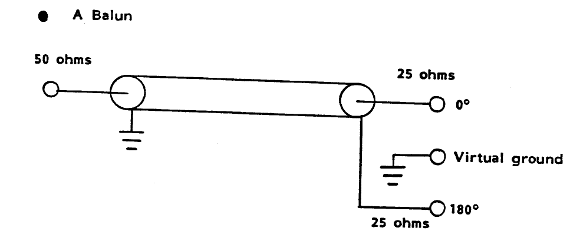
You can do some really cool stuff, like this:
- XmissionLineBalun.gif (8.02 KiB) Viewed 3618 times
(This is from a seminar from when I was working in RF, as is the next diagram.)
Any conductor has inductance. In the transmission line, current going through one conductor faces an inductive impedance from having to build up a magnetic field around it. The impedance, by definition, pushes back; but if the other conductor is right there, it pushes back in that one just as hard, because of mutual inductance. If it can make the make the same current flow in the second conductor but in opposite direction, the net current at that point is zero, so there's no "pushback" fighting the signal. For really short transmission lines, putting a ferrite bead over the pair of conductors, or putting the pair through a toroid, improves this effect.
When I worked in applications engineering at the VHF/UHF power transistor manufacturer, we sometimes made 4:1 or 9:1 transformers with coax. Here's how a 4:1 is connected:
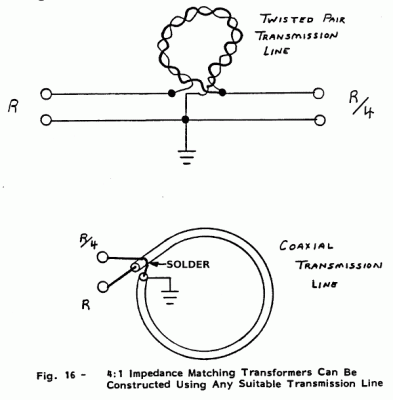
Again note that although one conductor is grounded at one end, it's the signal at the other end.
Re: Prototypes and long wires...
Posted: Sun May 14, 2017 6:29 am
by BigDumbDinosaur
When I worked in applications engineering at the VHF/UHF power transistor manufacturer, we sometimes made 4:1 or 9:1 transformers with coax. Here's how a 4:1 is connected:
4to1X4mr.gif
Again note that although one conductor is grounded at one end, it's the signal at the other end.
It was commonplace aboard ship for fixed length whip antennae (usually 35 feet) to be attached to radio transmitters with very wide frequency ranges, usually from 50 meters to 10 meters. As best energy transfer occurs between transmitter and a whip antenna when the whip is a quarter-wavelength, means had to be provided to achieve such a condition. The fact that the whip was bolted to a grounded steel ship effectively made the antenna system look a lot like a dipole, although it didn't operate in that fashion
The solution took the form of a sophisticated antenna adapter made by Collins which essentially did what you were doing with your coax "transformers." The adapter wound and unwound a silver plated strip onto a drum (an adjustable inductor) in such a way that the whip appeared to be "longer" or "shorter" according to the frequency on which the transmitter was operating. It was easy to see when a good match was achieved during CW transmission, as the final plate current would sharply dip and the field strength meter we used to assess transmitter performance would sharply peak up.
The Collins box also included an adjustable capacitor, which was used to aid in matching the 50 ohm characteristic impedance of the transmitter output and the coax cable as closely as possible. An impedance mismatch would also cause a rise in final plate current, but also bring on significant harmonic distortion, which a trained operator could readily hear in the received signal. Therefore, coordinated use of drum and capacitor was required to correctly load the transmitter.
Both voice and data were transmitted with SSB suppressed carrier, sometimes with voice on the lower sideband and encrypted data on the upper (I no longer recall the reason, but the upper sideband was considered better for data flow). A 2KW transmitter could operate around the world with this setup, even during daylight hours.