Page 1 of 1
OT: Wireless World's 1967 transistor-based computer project
Posted: Fri Nov 16, 2012 11:30 am
by BigEd
Back in 1967 Wireless World published a series of articles by Brian Crank on the design, construction and programming of a bit-serial digital computer, built for a project cost of approx £50, mostly using reject germanium transistors.
The articles were re-published as a short book, and Dave Wade has put
a scan on his website.
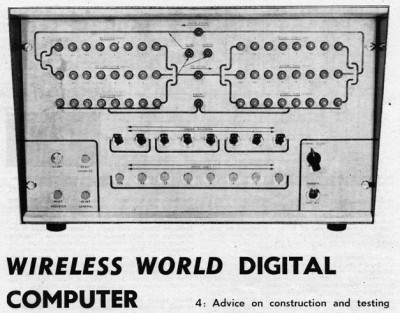
- Front panel photo
Here are some images from the original articles, as scanned by Dave Caroline and
announced on the
cctalk mailing list.
The explanation proceeds bottom-up, starting from logic gates:
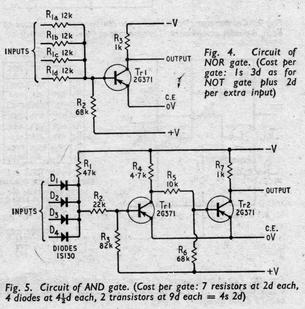
- From the bottom up: logic gate circuits
- logic-gates-p369.jpg (23.38 KiB) Viewed 9452 times
and storage elements:
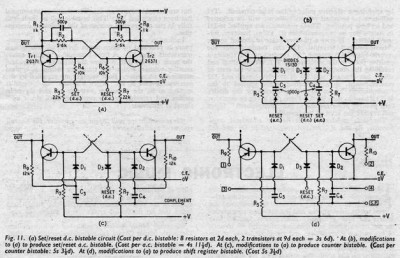
- Sequential circuits including a toggle flop
Then we can leave circuit design and proceed to logic design, for example a subtractor:
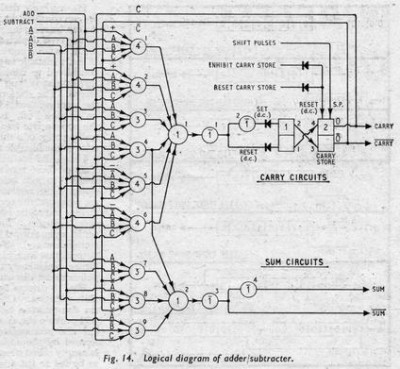
- Moving up from circuit to logic diagrams
And up a level to block design:
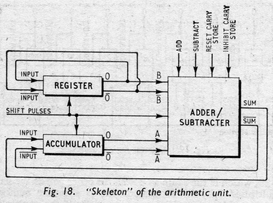
- Block diagram of the ALU
- alu-block-p419.png (66.23 KiB) Viewed 9452 times
Continued in next post...
Re: OT: Wireless World's 1967 transistor-based computer proj
Posted: Fri Nov 16, 2012 11:31 am
by BigEd
Follow-on because there's a limit on attachments...
Here's the overall block design of the computer:
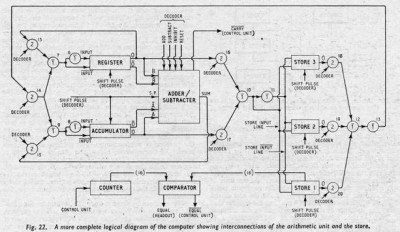
- Block diagram of the computer
We need to define the instruction set (or control orders, as they were then called):
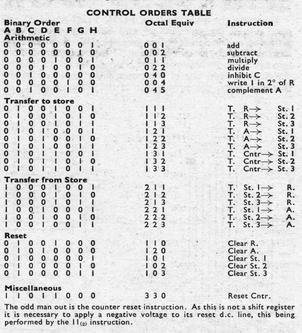
- Control Orders (Instruction set table)
- control-orders-p489.jpg (28.78 KiB) Viewed 9450 times
and then design the decoder at logic level:
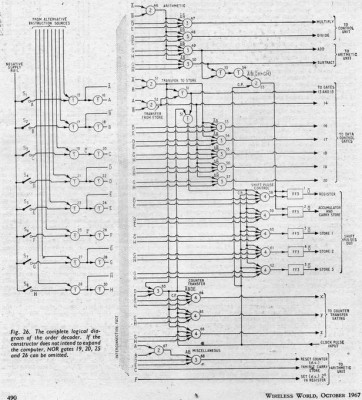
- Order decoder (instruction decode)
Now we can design the control logic:
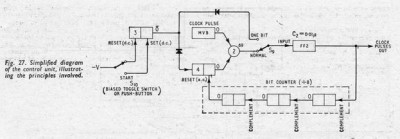
- Control Unit
and
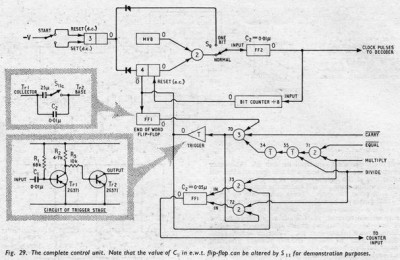
- Complete Control Unit
Final part in next post...
Re: OT: Wireless World's 1967 transistor-based computer proj
Posted: Fri Nov 16, 2012 11:38 am
by BigEd
Follow-on because there's a limit on attachments...
There's just one picture in the article showing the control sequencing:
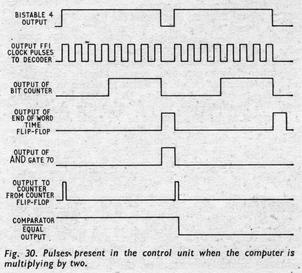
- waveforms-p492.jpg (18.56 KiB) Viewed 9449 times
There are a few short example programs:
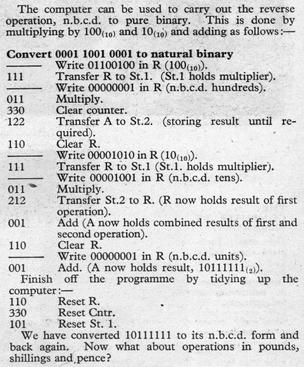
- BCD conversion program
- convert-binary-program-p601.jpg (34.48 KiB) Viewed 9449 times
The implementation is on large circuit boards:
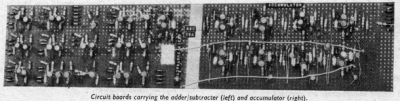
- Two (of several) circuit boards
This computer design was used in education, here at Sandhurst (a military school)
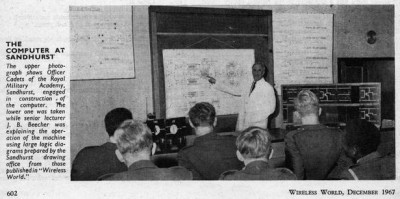
- In a teaching context at Sandhurst
See also
http://www.fano.co.uk/history/WWcomp.html and
http://www.6502.org/users/dieter/mt15/mt15.htm
(On a personal note, I'm really pleased to have these articles, as it was a formative experience for me to find a book on computer design in the school library in the late 70s, which as far as I can remember was based on exactly this project.)
Cheers
Ed
Re: OT: Wireless World's 1967 transistor-based computer proj
Posted: Fri Nov 16, 2012 12:24 pm
by MichaelM
Thanks for posting this.
These two postings (Wireless World computer and the earlier post about the Elliot) go along with my recent efforts at a serial processor implementation. There are a couple of operations that are a bit more difficult, or tedious, to perform serially.
It is interesting to note that this computer is microprogrammed.
Re: OT: Wireless World's 1967 transistor-based computer proj
Posted: Fri Nov 16, 2012 12:52 pm
by BigEd
Re: OT: Wireless World's 1967 transistor-based computer proj
Posted: Sun Nov 18, 2012 8:25 pm
by BigEd
(On a personal note, I'm really pleased to have these articles, as it was a formative experience for me to find a book on computer design in the school library in the late 70s, which as far as I can remember was based on exactly this project.)
With more assistance, I've found that the book is:
Alan Wilkinson's Computer Models (1968, Edward Arnold, SBN 7131 1515 X)
and I now have a copy on order.
It's referenced at
http://en.wikipedia.org/wiki/Transistor ... te_note-15 and there's a related page by Malcolm Schute here:
http://malcolm.shute.free.fr/ioc200.htm
It seems that Alan was at Spennymoor Grammar School and built his machine with his class, and another teacher by the name of Hector Parr at the nearby Darlington Grammar School had some of the pupils there build a related, but novel, design called DENICE.
Cheers
Ed
Re: OT: Wireless World's 1967 transistor-based computer proj
Posted: Sun Nov 18, 2012 9:03 pm
by MichaelM
BigEd:
That was a fun read. Some of the idioms are transliterated, and the result provides great entertainment value. (The translation has the feel of having been performed by machine, but that may unfairly impugn the author listed.)
Can't claim I would do any better in translating Spanish (native/first tongue) into English, and any translation of a non-trivial work is always a good vocabulary workout. What I find particularly enlightening is the idiomatic basis that is revealed in the literal translation of one language to another. It may be nothing more than synthetically derived idioms for technical concepts that can't be described in the language, or it may actually provide a window into the thought processes of another culture.
I found the following passage emblematic: "Mario Tchou assigned a different task to every member of the technical staff. In 1957 at Olivetti Laboratory, five different groups were at work for developing respectively a) machine instructions, b) government system for magnetic tapes, c) the central government unit, d) the mainframe memory, e) the arithmetic unit. ... ".
Now that "central government unit" and "government system for magnetic tapes" should be right down BDD's alley.

Re: OT: Wireless World's 1967 transistor-based computer proj
Posted: Sun Nov 18, 2012 9:13 pm
by BigEd
Ah, I think you've picked up citation 12, about
http://en.wikipedia.org/wiki/Olivetti_Elea
Rather than citation 15!
However, sounds like it's worth a look!
Cheers
Ed
Re: OT: Wireless World's 1967 transistor-based computer proj
Posted: Sat Nov 24, 2012 12:32 pm
by BigEd
I now have both Alan Wilkinson's 1968 book, and Hector Parr's memoir. I
posted some low-res photos on G+ which can now be seen
here.
Note that Alan recommends using silicon rather than leaky germanium transistors, and using an input diode in the latter case. (Whereas Brian uses a positive base bias.) Note also that Alan is not building a computer, but something more like an ALU - as he says, he's calling it a Computer Model. All the combinatorial logic is made of 3-input NOR gates, although he uses what we'd now recognise as a NAND logic symbol. Unused inputs can simply be left unconnected.
So, I have a new story now: Alan was first, publishing in 1965 a design for his Small Computer Model in the magazine of the Association of Teachers of Mathematics. Brian would have picked up from that and written his articles in 1967. Hector also picked up from the book, and built first his DENICE and then his BRENDA computers - the first at Darlington Grammar and the second at Barnard Castle School.
I found some postings about BRENDA on usenet/google groups, by John Gilliver:
But the first computer, as
opposed to programmable calculator or similar, I used was BRENDA, the
Barnardian Electronic Numerical Demonstration Apparatus; it was a
computer by Mr. Parr's definition, which was that the sequence in which
it obeyed instructions could be varied - i. e. it had a conditional
jump instruction. It had a memory of 16 - not K, 16; 7 bits, too - very
odd, Mr. Parr's own design. Shape and size of the boot of a Hillman Imp
- for the simple reason that that's where he built it. (Quite a
character: as well as mathsmatering and computerbuilding, he built -
professionally, one was even exported to Canada! - electronic organs for
churches.)
Programming in 16 memory locations makes you write very compact code!
LEDs? BRENDA had filament bulbs! And 16 toggle switches? BRENDA was a
serial processor (quite weird - ones complement rather than the more
common twos complement), so you entered things one bit at a time.
(The BaRnardian Electronic Demonstration Apparatus was a computer that
looked like everybody's idea of a computer then: a bank of glowing
bulbs. It was the shape and size of the boot [trunk] of a Hillman Imp
[small car of the time], because that's where Mr. Parr my maths master
built it. In discrete components, not an IC in sight. Despite that, it
was a true computer, and I started learning coding on it: I can still
remember the instruction set. I wish I had a picture of it.)
Edit: fix link rot
Re: OT: Wireless World's 1967 transistor-based computer proj
Posted: Tue Dec 04, 2012 10:22 am
by BigEd
(continuing to self-reply on this off-topic thread...)
Hector wrote a simulator for Brenda, and I'm pleased to attach it here with his permission. It's written for Windows but runs happily in WINE on linux.
There are only 16 memory locations, and minimal operations, but Hector has supplied a demonstration program to multiply two numbers.
Re: OT: Wireless World's 1967 transistor-based computer proj
Posted: Mon Dec 10, 2012 2:41 am
by djmips
Code: Select all
;;;;;;;;;;;;;;;;;;;;;
; ROL
      inp  m1
one   clr  1
      add  m1
loop  bpl  nob7
      add  one
nob7  sta  m1
      jmp  loop

m1    ds  1
- rol.zip
- (194 Bytes) Downloaded 304 times
Re: OT: Wireless World's 1967 transistor-based computer proj
Posted: Mon Dec 10, 2012 3:13 am
by BigEd
Nice!
Re: OT: Wireless World's 1967 transistor-based computer proj
Posted: Wed Oct 18, 2017 6:04 pm
by BigEd
Back to Brian Crank's 1967 computer as published in Wireless World (and as seen at the top of the thread), he's recently made available
an 8mm movie of the machine before it was cased up - with blinking lights!
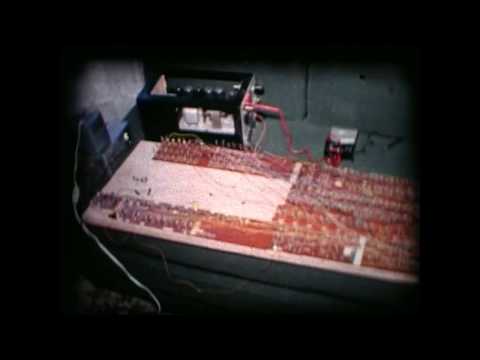
Thanks Brian for sharing!