Page 1 of 3
Beginner needs help
Posted: Fri Sep 21, 2012 8:53 am
by alkopop79
Dear all,
I'm planning to build a 6502 microcomputer. I'd like to keep
the project cheap and simple. I work part time for very
little money - an eprom burner for +100 dollars is definitely
not an option. However I have TTL logic chips, breadboards,
oscilloscope and a 6502. I want something simple as a Cosmac
Elf and programmable with switches or hex keypad. Also, I
would preferably build it on breadboard first or WW. I wonder
if my requirements are realistic? Where can I find circuit
diagrams for a similar project?
Re: Beginner needs help
Posted: Fri Sep 21, 2012 9:13 am
by GARTHWILSON
Early computers required pre-loading their reset routines into RAM with switches. You could do a similar thing, but be aware that it's very tedious and error-prone, and getting enough switches won't be cheap either unless you already have them or use something like DIP switches which are not made to last very many cycles. You power-up the computer but hold the processor in reset with its bus drivers disabled, then set each address and its data with the switches, and press the button to store the data into that address, one at a time, then when you're done with that, release the processor from reset so it can start. The little program is called a bootstrap loader, and contains just enough to tell the computer how to load more by a less-tedious method.
My first EPROM programmer worked similarly. I built it up on a 4.5" square board with a socket for the EPROM, 3 octal DIP switches, and a pushbutton. It worked, but again the slowness and the propensity for human error made it nearly worthless. To erase the EPROMs, I left them in the sun for a week which wasn't too big a deal since it took so long to re-write my program and assemble by hand. Soon however I went to a friend who made his own EPROM programmer controlled by his hand-held Hewlett-Packard HP-71 computer, which made the programming much faster. I would dictate the machine-language hex numbers as he typed them into his text editor. The editor meant that a single error did not mean having to start over, since he didn't actually program the EPROM until we were convinced we had transferred everything correctly. Today a PC just takes a second to assemble many thousands of bytes of program, and my cheap EPROM programmer (from the now-defunct Needham's Electronics) programs an 8Kx8 EPROM about as fast as you can put it in the socket and get it back out. Almost no delay.
Edit: An EEPROM programmer would be easier to make than an EPROM programmer, since it would not need the high voltage and the critical pulse timing.
Re: Beginner needs help
Posted: Fri Sep 21, 2012 9:17 am
by BigEd
Hi alkopop79, and welcome.
It's not exactly what you want, but a good starting point would be Grant Searle's UK101 which can be built on veroboard. Even breadboard would be OK for 1MHz, most likely, but unlike solder or wirewrap it won't be robust against the hazards of everyday life.
http://searle.hostei.com/grant/uk101/uk101.html
I recommend you read Quinn Dunki's tales of her 6502-based system "Veronica" - not to copy it, but to learn from a well-told story. Perhaps start here:
http://quinndunki.com/blondihacks/?p=680
or here:
http://hackaday.com/2011/12/07/programm ... at-a-time/
It's worth a quick look around the other homebuilt pages indexed here on this site too:
http://6502.org/homebuilt/ (The "Projects" link in the banner)
For ROMless bootstrapping, there are a couple of links in this post:
viewtopic.php?t=1526 (and this post has a circuit idea:
viewtopic.php?p=10059#p10059)
Check this thread too:
viewtopic.php?f=1&t=1471&start=29 which recommends taking a look at the KIM-1 circuit. (
http://www.zimmers.net/anonftp/pub/cbm/ ... index.html)
And do use Garth's 6502 primer!
http://wilsonminesco.com/6502primer/index.html
Cheers
Ed
Re: Beginner needs help
Posted: Fri Sep 21, 2012 9:37 am
by BigEd
(You might want to read the adventures of a UK101 build in this thread:
viewtopic.php?f=4&t=1795)
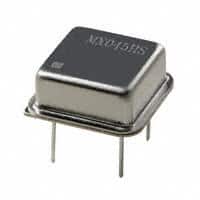
One takeaway from that is to use a canned crystal oscillator, not a crystal oscillator circuit. Something like
this:
Re: Beginner needs help
Posted: Fri Sep 21, 2012 4:43 pm
by BigEd
There's another minimal design, by Halldor Karl Hognason but his site seems to be mostly offline. Some of it can be seen here:
http://webcache.googleusercontent.com/s ... ns&strip=1
or in the cached previews here
https://www.google.co.uk/search?q=site% ... url%3A6502
(you may need to click "text only" because the images won't load)
If anyone has a mirror which includes the schematics, please let me know!
Cheers
Ed
Re: Beginner needs help
Posted: Fri Sep 21, 2012 11:05 pm
by ChuckT
Dear all,
I'm planning to build a 6502 microcomputer. I'd like to keep
the project cheap and simple. I work part time for very
little money - an eprom burner for +100 dollars is definitely
not an option. However I have TTL logic chips, breadboards,
oscilloscope and a 6502. I want something simple as a Cosmac
Elf and programmable with switches or hex keypad. Also, I
would preferably build it on breadboard first or WW. I wonder
if my requirements are realistic? Where can I find circuit
diagrams for a similar project?
You can save up and buy a kit from Apatco. They have two different versions.
http://www.apatco.com/shop/
You could also switch to ARM. I believe the markers of ARM started out with the 6502. I'm trying to remember but the makers of ARM tried to make a chip faster than the 6502 and there are support chips around the 6502. ARM is basically a design without those external chips and I have to spend time reading and looking it up but they may have included what is on those support chips inside of ARM. ARM has a real CPU and you could probably get one working that is 180 MHZ with a large FLASH memory and RAM whereas you aren't going to get a faster 65XX family chip than 20 MHZ. ARM is in mobile phones and many devices and I think the price is lower than 6502 prices.
You can get an STM32 Cortex chip for about $16 plus shipping or you can get a $5 Stellaris chip from Texas Instruments during their promotion and then it will probably go up to $10 or more. There are also development boards on Ebay and I just ordered a free chip from Coridium (I got one of the last ones) which runs BASIC on an ARM chip.
ARM is also fast enough to connect to TFT screens and screens from the iPhone if you can get a connector for the latter or if you can build one from Eagle.
Re: Beginner needs help
Posted: Sun Sep 23, 2012 10:20 am
by alkopop79
I kinda like the Apatco one. It's just it's not cheap and I want to build it myself.
Re: Beginner needs help
Posted: Sun Sep 23, 2012 1:02 pm
by ChuckT
I kinda like the Apatco one. It's just it's not cheap and I want to build it myself.
I want to build a computer myself. I think you could build one with an arm chip. For $1.21 to $1.51 a chip (depending where you get it), you can breadboard an ARM chip, you would need a $20 FTDI cable or a USB dongle, a zener diode or a 78L33 Linear regulator and you can program it in BASIC or C:
http://www.coridium.us/ARMhelp/index.ht ... inout.html
You would need to provide a breadboard and a few wires but it is easy and you can have more memory and speed than a 6502.
The alternative would to get a $16 development board and either a Jtag connector or ST link.
The other alternative is to invest in Arduino or some other microcontroller.
Re: Beginner needs help
Posted: Sun Sep 23, 2012 1:27 pm
by BigEd
Nothing wrong with an ARM homebuild, but as the memory and peripherals are integrated it's a higher level challenge than an 8-bit homebuild, where you get to make the busses and the decode, and architect the memory map and bootstrap.
I'm supportive of both types of project, but they are different things. The 8bit might be a bit more challenging, but you'll learn more. The 32-bit will of course deliver a faster machine.
Cheers
Ed
Re: Beginner needs help
Posted: Sun Sep 23, 2012 1:36 pm
by alkopop79
Thanks guys! I teach Arduino and love it. Still, I want to build something from the scratch and understand every single bit (pun not intended) of it.
Re: Beginner needs help
Posted: Sun Sep 23, 2012 1:37 pm
by alkopop79
BigEd, where do you source your components from in the UK?
Re: Beginner needs help
Posted: Sun Sep 23, 2012 1:52 pm
by BigEd
Umm, I don't do a huge amount of electronics, but Digikey and Farnell both appear on my radar - and Maplins for small-scale urgent supplies. (I have a note-to-self that CPC is often much cheaper than Farnell even when their things arrive in Farnell packaging)
Then there's RS. Whatever works out cheaper, postage included!
I bought a few bits and bobs recently from hobbytronics.co.uk, which worked out well even though they seem small-scale players.
Not sure how much that helps!
Cheers
Ed
Edit: as BDD points out below, also Mouser operate in the UK
Re: Beginner needs help
Posted: Sun Sep 23, 2012 6:33 pm
by BigDumbDinosaur
Thanks guys! I teach Arduino and love it. Still, I want to build something from the scratch and understand every single bit (pun not intended) of it.
Then grab your 65C02 or 65C816 and start soldering! By the time you have it working you indeed will have a detailed understanding of every single bit, byte...and mistake. 
Seriously, building around an ARM, 65C134 or other microcontroller is too much like building a PC, where, as another member put it, you are assembling (not building) macroscopic components. That's screwdriver work, which isn't at all the same as taking some chips, capacitors, RAM, etc., scratch-designing a circuit, and then soldering the mess together and seeing if it goes or blows.
Re: Beginner needs help
Posted: Sun Sep 23, 2012 6:59 pm
by BigDumbDinosaur
Umm, I don't do a huge amount of electronics, but Digikey and Farnell both appear on my radar - and Maplins for small-scale urgent supplies. (I have a note-to-self that CPC is often much cheaper than Farnell even when their things arrive in Farnell packaging)
Then there's RS. Whatever works out cheaper, postage included!
I bought a few bits and bobs recently from hobbytronics.co.uk, which worked out well even though they seem small-scale players.
Not sure how much that helps!
Cheers
Ed
Digi-Key has a very extensive selection, especially in glue logic and such. However, they have discontinued the WDC product line and have been removed from WDC's distributor page. Both Mouser Electronics and Jameco Electronics stock the WDC lineup. Mouser also has an extensive glue logic selection equal to that of Digi-Key and is my preference over Digi-Key for most component purchases (we have open accounts with all three companies).
Re: Beginner needs help
Posted: Sun Sep 23, 2012 9:37 pm
by whartung
Seriously, building around an ARM, 65C134 or other microcontroller is too much like building a PC, where, as another member put it, you are assembling (not building) macroscopic components. That's screwdriver work, which isn't at all the same as taking some chips, capacitors, RAM, etc., scratch-designing a circuit, and then soldering the mess together and seeing if it goes or blows.
I haven't done it myself, but I have to agree with this. The modern micro controllers are so self contained, they literally need little more than power to get something up and running. It's an exciting development for folks that just want to get stuff done that need a micro processor, but pretty far from the concept of "building a computer".
Now, we can get all grognardy, and "get off my lawn", and "if you're not grinding gears, you don't know what computer design is", and "if you're not weaving, you're not coding", so it's a matter of how far you want to take it. The beauty is that you can take it all the way from off the shelf boards (heck I think even Radio Shack is selling Arduino kits now), through build SBCs with CPU down to hand crafting CPUs out of TTL gates to burn on to a PGA, or simply wrap together. You can do whatever you want any where along that spectrum, at home, with data from the internet. It pretty much stops cold at making transistors at home from beach sand. Home foundries aren't quite common place.
That's why it boils down to what you're really interested in learning and accomplishing, from design, to interfacing, to code, etc.
That's one reason I went the simulator route. I started out thinking of building a board, but ended up creating a simulator. That helped scratch itch I had. I still think a simple SBC similar to POCv1 would be interesting.