Page 1 of 1
Clock sources
Posted: Tue Oct 25, 2011 1:26 am
by Dajgoro
Could you post your clock sources schematics, i only know how to rig a 4060 as a crystal oscillator, so i would like something that can actually run faster than 4MHz...
Posted: Tue Oct 25, 2011 2:02 am
by GARTHWILSON
A couple of old but good ap. notes from Fairchild:
HCMOS crystal oscillators:
http://www.fairchildsemi.com/an/AN/AN-340.pdf
CMOS oscillators:
http://www.fairchildsemi.com/an/AN/AN-118.pdf
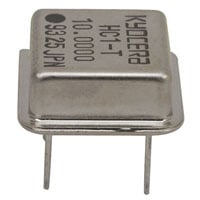
It's often most productive however to just use one of the off-the-shelf oscillator cans that take the space of an 8- or 14-pin DIP. This will make sure the oscillator will always work correctly for the whole voltage and temperature range, and it's easy to change.
Posted: Tue Oct 25, 2011 11:25 am
by ElEctric_EyE
I made
this last year. It works well, except the 74S124 uses some current.
Might be a little more money, but it's better then buying multiple crystals/cans.
Posted: Tue Oct 25, 2011 2:29 pm
by Dajgoro
It's often most productive however to just use one of the off-the-shelf oscillator cans that take the space of an 8- or 14-pin DIP. This will make sure the oscillator will always work correctly for the whole voltage and temperature range, and it's easy to change.
I would love to do that, if just there were any to buy... They don't really sell them in electronic stores here where am I, and also are kinda rare on ebay...
So i am left whit crystals self made oscillators...
And thanks for the schematics...
One more question, will it work if i use a 74LS01 or other 74LS as an inverter?
Posted: Tue Oct 25, 2011 4:13 pm
by PaulF
TTL Chips (74LS, etc) need a different circuit to CMOS gates.
The one I use is as follows
Code: Select all
    470 ohm            470 ohm
    ----               ----
 --|    |--         --|    |--
|   ----   |       |   ----   |
|          |       |          |
|  |\      |  10n  |  |\      |     |\
|--| >O--------||-----| >O----------| >O---
|  |/                 |/    |       |/
|                           |
 -------------|X|-----------
This has worked reliabally with crystals from 1MHz to 18MHz using a 74LS04 or 74S04 device.
Posted: Tue Oct 25, 2011 4:26 pm
by Dajgoro
Thanks!

Re: Clock sources
Posted: Wed Jan 02, 2013 8:06 am
by GARTHWILSON
In trying to figure out what some obviously erroneous oscillator data in a PIC microcontroller data sheet should have been (yes, there are other companies besides WDC that have errors in their data sheets), I came across this page that links some more ap. notes on crystal oscillator design near the top:
http://www.microchip.com/forums/m49934.aspx
Clock Sources
Posted: Sat Jan 12, 2013 6:54 pm
by BigDumbDinosaur
Here's the clock generator circuit I used in POC V1. It produce an output frequency that is one-half that of the can oscillator that drives it.
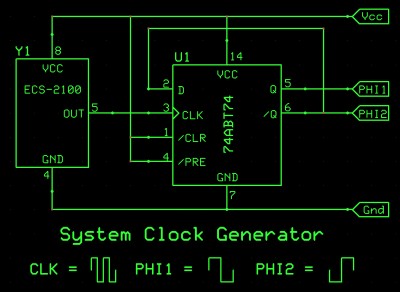
- Two phase clock generator.
Re: Clock sources
Posted: Sun Jan 13, 2013 12:14 am
by Dajgoro
Phi1 and Phi2 shown on the schematic are not the same as the one generated by the 6502, since the 6502 splits the clock on his own.
In my new cpu board I use a 74HC393 counter to get multiple clocks(I have rotary switch for selecting clocks).
Re: Clock sources
Posted: Sun Jan 13, 2013 6:11 am
by BigDumbDinosaur
Phi1 and Phi2 shown on the schematic are not the same as the one generated by the 6502, since the 6502 splits the clock on his own.
That's correct. However, this clock generator is on my W65C816S-powered POC. For other applications just ignore the phase you don't need. Also note that the two phase clock is not required with the W65C02S. That was an NMOS "feature." All timing on WDC microprocessors is based on the Ø2 clock only.
In my new cpu board I use a 74HC393 counter to get multiple clocks (I have rotary switch for selecting clocks).
Tick-tock.
Re: Clock sources
Posted: Sun Jan 13, 2013 11:41 pm
by Dajgoro
What about making a more advanced clock source with a custom clock divider, so it can divide by 2,3,4,5, etc... Maybe a fast oscillator with a ring counter could be used.
Also software clock settings would be nice.
Re: Clock sources
Posted: Mon Jan 14, 2013 3:29 am
by GARTHWILSON
What about making a more advanced clock source with a custom clock divider, so it can divide by 2,3,4,5, etc... Maybe a fast oscillator with a ring counter could be used.
Also software clock settings would be nice.
That sounds more or less like the Maxim/Dallas
DS1077 and the
DS1085, both of which work at 5V and need no external components. They don't have crystal accuracy, but about 1% error which is good enough for RS-232, and the frequency can be programmed via I²C, from 8.1
kHz to 133
MHz.
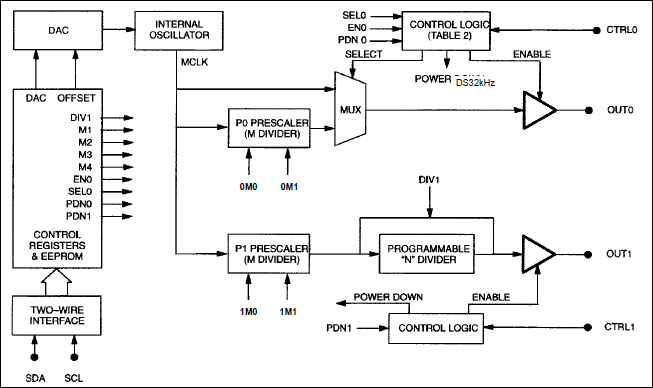
If accuracy is not important at all and you just want to see how fast you can run it up before the computer starts having problems, you can make a relaxation oscillator whose frequency varies with a pot, like so:
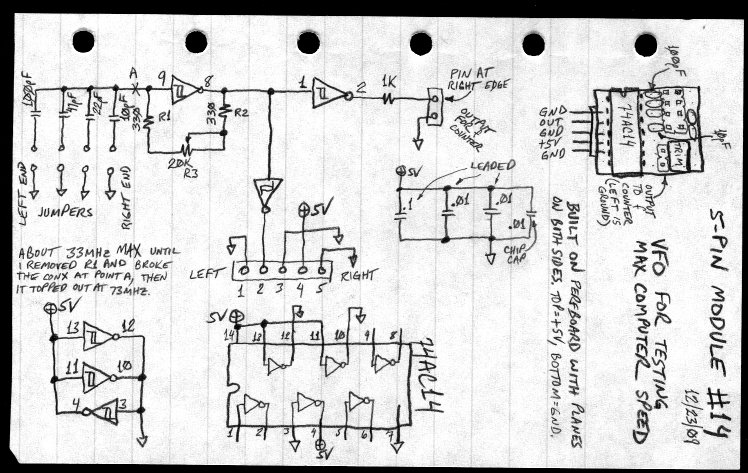
That one goes to 73MHz. Below is an earlier one I did which is slower:
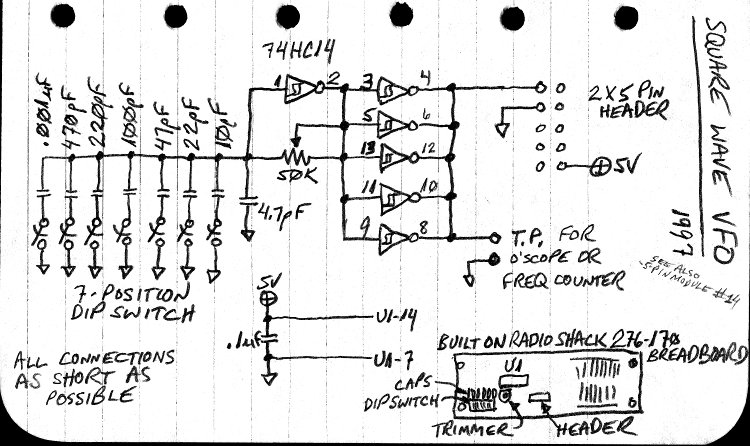
Re:
Posted: Wed Aug 14, 2013 12:45 am
by Dajgoro
TTL Chips (74LS, etc) need a different circuit to CMOS gates.
The one I use is as follows
Code: Select all
    470 ohm            470 ohm
    ----               ----
 --|    |--         --|    |--
|   ----   |       |   ----   |
|          |       |          |
|  |\      |  10n  |  |\      |     |\
|--| >O--------||-----| >O----------| >O---
|  |/                 |/    |       |/
|                           |
 -------------|X|-----------
This has worked reliabally with crystals from 1MHz to 18MHz using a 74LS04 or 74S04 device.
It also works fine with a 7404, I tested it at 10MHz.