Page 1 of 1
AppleCrate - parallel computing on 17 apple IIe boards
Posted: Sun May 01, 2011 11:50 am
by BigEd
See
here (and the
earlier 8-board system)
It's networked up (and network booted) using
NadaNet, and can be used for multi-voice sound synthesis.
(By Michael J. Mahon – July 26, 2008, Revised – May 7, 2010)
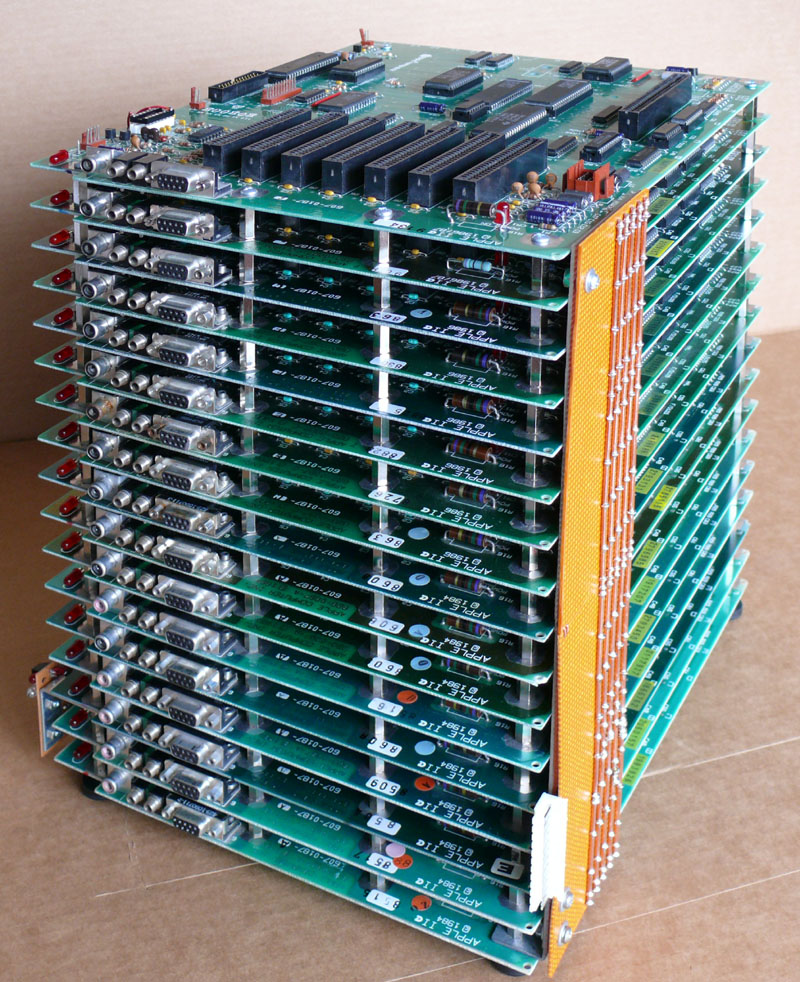
(seen
here)
Posted: Sun May 01, 2011 1:09 pm
by Arlet
I wonder how hot it gets

Posted: Sun May 01, 2011 1:17 pm
by BigEd
He'll be fine - there's no power supply!
But seriously, the
earlier system was better arranged for convective cooling. I'm a big fan of fanless computing. (No pun intended.)
Posted: Sun May 01, 2011 3:37 pm
by Nightmaretony
got a bunch of 2+ and 2E motherboards if anyone wants to duplicate...
Posted: Sun May 01, 2011 3:50 pm
by Nightmaretony
scratch, I should consider for my own music studio, already got ESQ-1s, a theremin and an 1891 pump organ....
Posted: Tue May 03, 2011 7:32 pm
by micro_brain
Wowser.
Didn't know there were so many Apple IIe boards lying around. Thought they'd all been ebayed..
Posted: Wed May 04, 2011 2:14 am
by dclxvi
Only 17?
The last paragraph of this article briefly mentions a "supercomputer" with 256 6502s. (I don't know if Bob and his colleagues actually built it, though.)
http://bob-bishop.awardspace.com/Mandelbrot/index.html
Posted: Wed May 04, 2011 12:03 pm
by ElEctric_EyE
That is an awesome find! Talk about a stress test. That's it. May take hours in machine code @2MHz... and there's code too!
Posted: Wed May 04, 2011 12:49 pm
by 8BIT
The CC65 package has a Mandelbrot Generator in the sample code. I adopted that for the SBC-3. The code took 7 minutes and 46.4 seconds to run (65816 clocked at 7.1MHz generating a 320x200 color display).
Here a picture of the results:
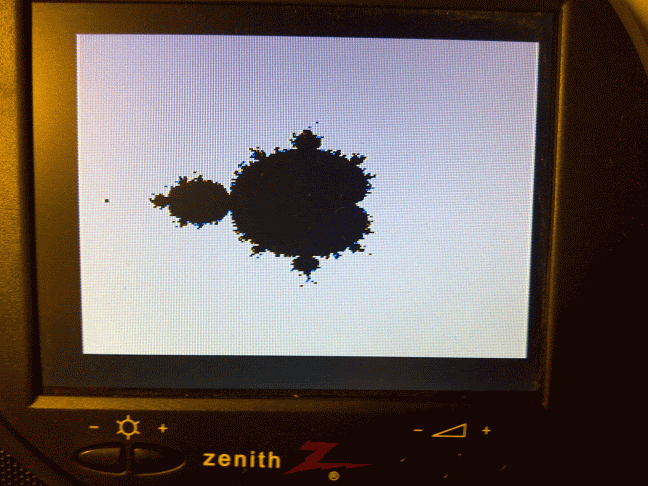
The article was very impressive. I would like to use some of that code in the future, when I can get the time.
Daryl
Posted: Wed May 04, 2011 2:34 pm
by Nightmaretony
backscratch, boards still offered for anyone who wants them, just pay shipping. will inventory. Mostly 2+, some 2Es in there. doing variation based on my Thinking Dolphin based on Darryl's SBC-1 on paper...
Giant Bed Bugs
Posted: Wed May 04, 2011 5:13 pm
by BigDumbDinosaur
I recall seeing some of those in a hotel room in Saudi Arabia.
Posted: Thu May 05, 2011 2:18 am
by dclxvi
The code took 7 minutes and 46.4 seconds to run (65816 clocked at 7.1MHz generating a 320x200 color display).
The code in the article can be sped up in a number of ways, such as using a smaller timeout value than 256 (e.g. 32 as in CC65). 7.1 MHz compared to 1 Mhz Apple II (or 2.5 MHz Apple IIgs) helps too, of course, as would using 16-bit native mode on the 65C816. (I thought about replacing the multiply routine with a faster table-driven technique, like 4AB = (A+B)^2 - (A-B)^2, but I never got around to doing much about that.) The BASIC loop in lines 300-550 would be much faster in assembly, since the all the necessary values already pre-computed; the FP math would be replaced with fixed point math (and the FP to one's complement fixed point conversion wouldn't happen inside the loop any more, nor would saving/restoring the ZP each time), and so on.
One modification I made was to separate the calculation from rendering. I just stored the data in RAM, then I could apply coarse value coloring or fine value coloring to the same data without having to recalculate the data (which was the slow part). (The built-in BASIC graphics routines were ROM-space-optimzed, and thus slow; redisplaying the image was fairly quick using speed-optimized routines.)
The next month's article (Bob doesn't have a scan of it on his website for whatever reason) has a modified BASIC program that uses (if memory serves) the neighboring value technique described in the article. I still have both issues somewhere in the bat cave. It was an interesting, but slow, program. I'd let it run overnight, and I can remember my father making me get out of bed at some ungodly hour of the morning one day because "the computer is beeping". Of course, back then I considered anything before 11:45 A.M. to be some ungodly hour of the morning.
Posted: Sun Jun 19, 2011 6:44 pm
by ElEctric_EyE
I came across
this post at the FPGA4FUN forums.
It's someone's mandlebrot project on a Spartan 3E based Nexys 2 Digilent board, started in April 2011. Check out his Wiki, it's pretty cool, although VHDL coding... I think it's the owner of the forum.
Re: AppleCrate - parallel computing on 17 apple IIe boards
Posted: Sun Aug 21, 2011 6:13 pm
by dog_meat_phantom
See
here (and the
earlier 8-board system)
It's networked up (and network booted) using
NadaNet, and can be used for multi-voice sound synthesis.
(By Michael J. Mahon – July 26, 2008, Revised – May 7, 2010)
(seen
here)
It sure looks cool....I like it.