Page 1 of 4
Working SBC-3
Posted: Tue Nov 18, 2008 4:49 pm
by 8BIT
I've completed assembly of the first SBC-3.
Here's the link:
http://sbc.rictor.org/sbc31/info.html
Picture here:
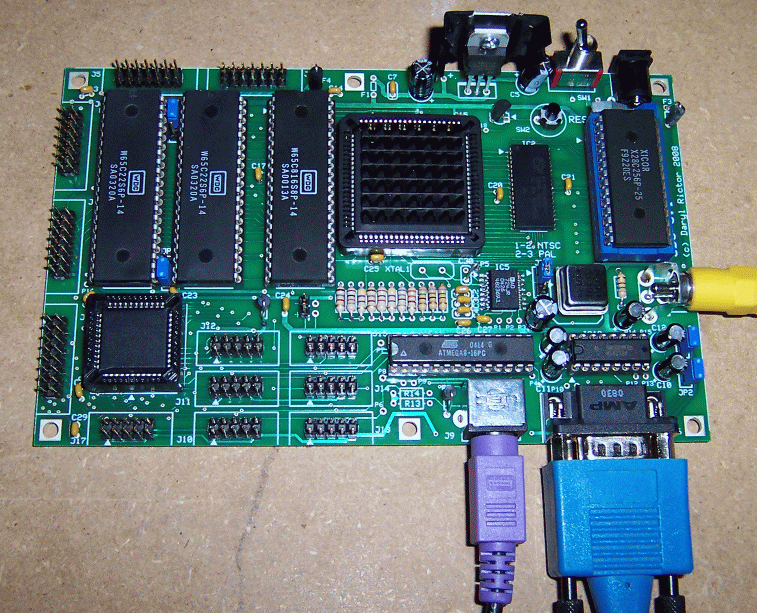
Works done - time to play!

Daryl
Posted: Tue Nov 18, 2008 7:29 pm
by kc5tja
Very nice job! Congrats.
Posted: Wed Nov 19, 2008 12:02 am
by 8BIT
Thanks! It took a lot of time to complete. I hope the other users can come up with some cool things to do with it!!!
I still want to work on SD or CF storage and ethernet access.
Daryl
Posted: Wed Nov 19, 2008 6:18 am
by kc5tja
I still would like to finish my Kestrel.
Although, all things considered, given that I have experience playing with these SEAforth chips, I'm probably going to abandon the Kestrel for a home computer that is built around those instead. I like the 65816 a lot, but considering these chips are engineered expressly for Forth, and a whole lot faster, are a whole lot simpler to program for, and draw a whole lot less power, I think the fate of my Kestrel is looking like it's sealed up pretty well.
Posted: Wed Nov 19, 2008 1:37 pm
by 8BIT
When I started palying with the Atmel microcontrollers, I had the same thoughts. Here's this 16 MIPS part with the peripherals already built-in. Why not build a computer around one of these? Their assembly language is very much like the 6502. Someday, I may give that a try.
I was driven to finish a 6502-based system with a color graphics capability and SBC-3 was the answer.
I still need to read up on Forth and purhaps give it a try. The neat thing about SBC-3 is that you can overwrite the built-in System Monitor with anything you want since it runs from RAM.
Good luck with the SeaForth project. Hope to see some more on it.
Daryl
Posted: Sat Nov 22, 2008 5:28 am
by Nightmaretony
Posted: Mon Nov 24, 2008 8:15 pm
by wirehead
The problem with using an Atmel is that it's not really designed for use as a "general purpose" computer. Program memory is separate from storage memory. So there are a lot of harder limits as to what you can do.
The 816 has the advantage of a fairly large address space.
OTOH, I think there's a LOT more to be done than folks have done so far with using AVRs as intelligent peripherals for a 6502/65816 computer...
Posted: Tue Nov 25, 2008 3:31 am
by 8BIT
OTOH, I think there's a LOT more to be done than folks have done so far with using AVRs as intelligent peripherals for a 6502/65816 computer...
What are your ideas?
I have not played with hanging an AVR directly off of the 6502/816 bus, but a few others have.
I am planning to continue work with my CF FAT16 driver on an AVR and use my 65SPI as the bridge. I may do the same with an ethernet function as well.
Daryl
Posted: Tue Nov 25, 2008 6:56 pm
by Nightmaretony
The problem with using an Atmel is that it's not really designed for use as a "general purpose" computer. Program memory is separate from storage memory. So there are a lot of harder limits as to what you can do.
The 816 has the advantage of a fairly large address space.
OTOH, I think there's a LOT more to be done than folks have done so far with using AVRs as intelligent peripherals for a 6502/65816 computer...
Agreed. I developed an exciting new vocabulary as my supervisor wrangled with the Atmel series.
I am also realizing that I selected correctly with the 6500 series for the pinball computer as the Atmel would take a lot of insane wrangling to make it work nicely since I am planning some 2,000 system variables changing all the time. The 6502 makes it easy with RAM while the Atmel would become an unending nightmare of design.
Daryl: some other uses:
sound port (I will send you my schematic of it which is a CD quality sound port)
serial bus controller such as USB or ethernet
keyboard controller
Posted: Tue Nov 25, 2008 8:39 pm
by kc5tja
You guys ought to wait for the SEAforth 40C18.

The cores all are normal Von Neumann architecture machines, so you don't have to deal with the Harvard architecture limitations. There are other limitations, of course, but they become more managable having "normal" access to RAM for both code and data.
I know, I'm starting to sound like LordSteve with his experiences with the SX microcontrollers.
Posted: Wed Nov 26, 2008 9:19 am
by BitWise
I am planning to continue work with my CF FAT16 driver on an AVR and use my 65SPI as the bridge. I may do the same with an ethernet function as well.
Daryl
You could connect a Microchip ENC28J60 ethernet controller as an SPI device if you do a spot of 5V<->3V3 level conversion. Only a handful of external components are required.
I've played with attaching PICs as peripherals to other micros using thier parallel serial port (PSP) in bus mode. It works but you have to be careful not to read or write from the device more quickly than it can refresh the port contents. Also it is limited to only a single address per controller - some interaction with the address bus would be nice to allow for a data and a control address for example, one day.
Posted: Wed Nov 26, 2008 9:21 am
by PontusO
Got my boards in the mail yesterday, at the same time as the chips from Mike. They look veeery nice. Thanks a lot for your efforts Daryl
/Pontus
Posted: Wed Nov 26, 2008 9:39 am
by SimonJ5
My board and chips arrived yesterday (to the UK). I spent a 'happy' lunchtime soldering the SRAM chip - great fun!
On the subject of ethernet connectivity I have got an ENC28J60 module from ETT which includes the 5V<->3.3V conversion. Actually, I think that the inputs to the ENC28J60 are 5V tolerant so it only converts the outputs from the transciever. I bought my board from Futurlec (
http://www.futurlec.com/Mini_Ethernet.shtml but I see that you can get a similar board from Cool Components in the UK (
http://www.coolcomponents.co.uk/catalog ... ucts_id=83) although there is no level shifter on that board.
Of course, to re-use one of the TCP/IP stacks that are available we'll need a C compiler. I've been looking at CC65 (I can't afford the WDC compiler) but not in any great detail. Producing a port of runtime library shouldn't be that difficult.
To preempt a comment, I do not know Forth but I have programmed in C (and Java) professionally for over 20 years.
Perhaps we should start a separate thread for some of these things?
Simon J
SX is best.
Posted: Wed Nov 26, 2008 4:31 pm
by lordsteve
kc5tja said...
I know, I'm starting to sound like LordSteve with his experiences with the SX microcontrollers.
LOL. True. Why he didn't use an SX instead of the Atmel chip is beyond me. An SX48 would have rocked his world. Oh, well.
Posted: Fri Nov 28, 2008 2:12 am
by faybs
I've just ordered all the parts from digikey, and created a public BOM so that others can use it as well. The BOM isn't quite exactly what Daryl has in his "parts list.txt" in the zip file, I made the following changes:
- The BOM has none of the parts that Daryl is selling pre-programmed already (CPLDs, ATMega8). It does have a 28256, I figure you'll want to keep the original in a safe place just in case.
- The AD724 is not there either, it's from a different store.
- The serial port's part number had a cut'n'paste error, so I chose A35113-ND.
- The power switch (432-1168-ND) and the 1x6 headers (SAM1029-06-ND) were on backorder, so I used EG2355-ND and SAM1033-06-ND respectively.
- Instead of the regular socket for the ROM (ED3728-ND), I used a ZIF socket (A347-ND). I figure I'm going to be swapping that chip out pretty often...
The URL for the BOM is
http://sales.digikey.com/scripts/ru.dll ... ue=1021321