Page 7 of 20
Re: Starting with my first SBC Project, Plans and Confusions
Posted: Thu Feb 06, 2020 5:02 pm
by BigDumbDinosaur
Ok the Mouser parts have arrived, now i just need to wait on JLCPCB to finish the PCB and send it.
Suggestion: socket the Ø2 oscillator instead of soldering it directly to the board.
Re: Starting with my first SBC Project, Plans and Confusions
Posted: Thu Feb 06, 2020 5:25 pm
by thedrip
Great advice, it worked for me. Now if only I had added some kind of dipswitch/jumper config on the board to say what the speed was instead of burning a new EPROM with the proper timer values.
Also gives an easy place to plug a function generator or other oscillating signal in so you can test max speed without having to keep a stack of crystals at hand.
Re: Starting with my first SBC Project, Plans and Confusions
Posted: Thu Feb 06, 2020 10:45 pm
by BigDumbDinosaur
Great advice, it worked for me. Now if only I had added some kind of dipswitch/jumper config on the board to say what the speed was instead of burning a new EPROM with the proper timer values.
It's possible to make that determination in software with a calibration loop. For example,
Code: Select all
;this code requires exactly 10,000,001 clocks to execute the loop at l0000001
;
         lda #$1F              ;MSB
         ldx #$04              ;LSB
         ldy #$6D
;
l0000001 dex
         bne l0000001
;
         dey
         bne l0000001
;
         nop
         dec A
         bne l0000001
;
         ...etc...
The above is for the 65C02 (
dec A means decrement the accumulator). The execution time assumes none of the loop branches cross a page boundary.
What is needed to use the calibration loop is something that will interrupt the MPU after a precise amount of time, following which some integer math on the values left in the registers when the loop is broken will give you the approximate Ø2 frequency.
If your only time source is a 6522 (or some other 65xx I/O device, such as a CIA or RIOT), the above test won't work. As the real-time execution speed of the above loop is directly proportional to Ø2 speed and since the 6522's timer speed is also directly proportional to Ø2 you will always get the same result regardless of the actual Ø2 rate. The solution to that is to have a time base whose rate is independent of Ø2. In my POC design, I use the counter/timer (C/T) in the 28L92 DUART as the time base. The C/T is driven by the 3.6864 MHz bit-rate clock oscillator, so it is not affected by changes to Ø2. The C/T is configured early during POST to generate a 100 Hz IRQ.
Re: Starting with my first SBC Project, Plans and Confusions
Posted: Fri Feb 07, 2020 3:13 am
by Proxy
Ok the Mouser parts have arrived, now i just need to wait on JLCPCB to finish the PCB and send it.
Suggestion: socket the Ø2 oscillator instead of soldering it directly to the board.
Well i know it uses the same pin layout as a 14 pin DIP chip.
so if i were to take a 14 pin DIP Socket and remove all metal parts from the pins except the 4 corner ones i should be able to use it as a socket for the Oscillator, right?
EDIT: kinda like this:
Re: Starting with my first SBC Project, Plans and Confusions
Posted: Fri Feb 07, 2020 4:15 am
by thedrip
Exactly! I had to trim the legs of the oscillator just a little to get it sitting flush on the socket.
Re: Starting with my first SBC Project, Plans and Confusions
Posted: Fri Feb 07, 2020 5:47 am
by BigDumbDinosaur
Ok the Mouser parts have arrived, now i just need to wait on JLCPCB to finish the PCB and send it.
Suggestion: socket the Ø2 oscillator instead of soldering it directly to the board.
Well i know it uses the same pin layout as a 14 pin DIP chip.
so if i were to take a 14 pin DIP Socket and remove all metal parts from the pins except the 4 corner ones i should be able to use it as a socket for the Oscillator, right?
EDIT: kinda like this:
The attachment 20200207_042213.jpg is no longer available
That will work. However, you should know that there are sockets specifically made for use with oscillators, generally with machine-tooled and gold-flashed pins to assure a high quality connection at all times.
In a future PCB layout, you should consider a half-can oscillator and save on some PCB space. The below pic is of the oscillator on my POC V1.1 unit. It's plugged into a compatible socket.
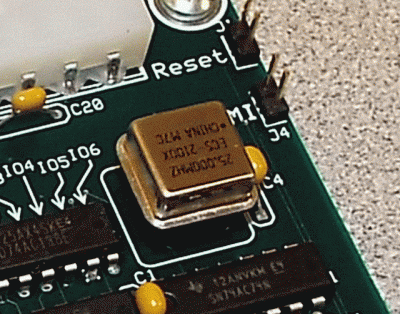
- Half-Can Oscillator in Socket
Re: Starting with my first SBC Project, Plans and Confusions
Posted: Fri Feb 07, 2020 7:52 am
by Proxy
Yea I didn't use one of those because I have a lot of the regular oscillators lying around at my home, and I didn't feel like buying new ones.
Re: Starting with my first SBC Project, Plans and Confusions
Posted: Tue Mar 03, 2020 3:53 pm
by Proxy
Finally! after 5 billion years the PCBs arrived!
here a little montage of me soldering them
and the big question is, does it work?
aaaaand, nope. it doesn't. (but i already know why.)
when i first powered it on and connected it to a PC the FTDI chip wouldn't show up as COM port...
i thought maybe i did something wrong there, like switching the D+ and D- lines, but those were correct...
then i started to check around with my logic probe and noticed the RST line is constantly being held low.
my first suspect was the Reset circuit thingy, maybe the voltage is somehow too low or something, but nope, checking directly at it's pins i read ~4.98V (it resets at below 4.5V)
but then i checked the Reset button... and oh boy
i hooked the Reset button up the wrong way.
basically it's a standard 4 pin push button, here:
and internally the buttons connect the 2 opposite pins to eachother like this:
and i thought they were internally connected like this:
so i also did that on the PCB itself because i didn't want to leave the pins open...
which means that thje GND and RST line are directly connected to eachother Through the internal connections of the Button...
such a stupid mistake... but is should be easy to fix by just cutting 2 traces on the PCB.
i'd post an update once i did that, i just wanted to get a post out saying how i atleast soldered everything already.
Re: Starting with my first SBC Project, Plans and Confusions
Posted: Tue Mar 03, 2020 4:54 pm
by Proxy
ok after cutting the traces the reset line is no longer constantly being pulled low.
plus i was able to test the reset thingy, checking with my logic probe i saw it held the reset line low for a bit after powerup and after (pushing then) letting go of the reset button.
so that works now.
what doesn't works is the FTDI USB Chip. my PC sees that there is a USB Device but it aparently cannot read what it is from the device... which is strange
i checked all pins of the FT240X and none are shorted and all are connected to what they should be.
here a close up of the soldering.
i had to use pretty hard lighting in order to even get these close ups with my phone, so sorry if it looks like there is solder between the pads, it's just the PCB being shiny from the direct light.
but it looks pretty alright to me.
I don't know why it wouldn't work. maybe i killed the chip somehow? the soldering didn't take too long and i used ~250°C with the iron. i tried not to be on the pins/chip for too long
i also tried to clean the flux off after soldering it.
Re: Starting with my first SBC Project, Plans and Confusions
Posted: Tue Mar 03, 2020 4:55 pm
by BigDumbDinosaur
Looks good, with a nicely-organized layout.
Dunno if you know it, but you can attach images and other types of files to your post instead of redirecting the reader to another website. Doing so has the advantages of quicker response and perpetuity. If you attach your pictures to your post they will be here as long as 6502.org is alive. If you don't and the host site for your pictures goes down the above link will be broken.
and the big question is, does it work?
aaaaand, nope. it doesn't. (but i already know why.)...then i started to check around with my logic probe and noticed the RST line is constantly being held low...but then i checked the Reset button... and oh boy...
Welcome to the "I goofed!" club. Most of us have done that at least once. My latest POC toy has an
incorrect LED connection that was drawn in the schematic and faithfully copied to the PCB layout. It's for times like this that X-Acto knifes and bodge wire were invented.
Re: Starting with my first SBC Project, Plans and Confusions
Posted: Tue Mar 03, 2020 4:58 pm
by BigDumbDinosaur
I don't know why it wouldn't work. maybe i killed the chip somehow? the soldering didn't take too long and i used ~250°C with the iron. i tried not to be on the pins/chip for too long i also tried to clean the flux off after soldering it.
250° C won't hurt it. It would be exposed to the same temperature if it had been reflowed.
It's hard to tell from the photos, but it appears there is still some debris between the pins. A small "acid" brush dipped in some acetone should be able to clean out the inter-pin space.
Re: Starting with my first SBC Project, Plans and Confusions
Posted: Tue Mar 03, 2020 5:17 pm
by Proxy
Looks good, with a nicely-organized layout.
Dunno if you know it, but you can attach images and other types of files to your post instead of redirecting the reader to another website. Doing so has the advantages of quicker response and perpetuity. If you attach your pictures to your post they will be here as long as 6502.org is alive. If you don't and the host site for your pictures goes down the above link will be broken.
yes i know of that, i used it for the other images, but i posted the soldering ones on Imgur instead because there were a lot of them and i didn't want the post to be too long.
Welcome to the "I goofed!" club. Most of us have done that at least once. My latest POC toy has an
incorrect LED connection that was drawn in the schematic and faithfully copied to the PCB layout. It's for times like this that X-Acto knifes and bodge wire were invented.
yep, it would've been awesome if i had no mistake in it for the first try, but whatever, atleast it was a small one.
250° C won't hurt it. It would be exposed to the same temperature if it had been reflowed.
It's hard to tell from the photos, but it appears there is still some debris between the pins. A small "acid" brush dipped in some acetone should be able to clean out the inter-pin space.
then i would need to buy some acetone and a brush for it. could i just use a toothbrush like i do with isopropanol?
also i looked online and people really don't recomment using acetone on electronics.
example
but i could try again with more isopropanol tomorrow, i just don't know if a toothbrush is fine enough...
Re: Starting with my first SBC Project, Plans and Confusions
Posted: Tue Mar 03, 2020 7:19 pm
by BigDumbDinosaur
Looks good, with a nicely-organized layout.
Dunno if you know it, but you can attach images and other types of files to your post instead of redirecting the reader to another website. Doing so has the advantages of quicker response and perpetuity. If you attach your pictures to your post they will be here as long as 6502.org is alive. If you don't and the host site for your pictures goes down the above link will be broken.
yes i know of that, i used it for the other images, but i posted the soldering ones on Imgur instead because there were a lot of them and i didn't want the post to be too long.
I wouldn't worry about the length. You can attach up to five pictures per post. I've occasionally used two or even three posts to post all the pictures I wanted to post.
It's hard to tell from the photos, but it appears there is still some debris between the pins. A small "acid" brush dipped in some acetone should be able to clean out the inter-pin space.
then i would need to buy some acetone and a brush for it. could i just use a toothbrush like i do with isopropanol? or does it need to be a very fine brush made for cleaning stuff like that?
Acetone is a more aggressive solvent than isopropyl alcohol and in my experience, does a better job of defluxing.
As for the brush, an "acid" brush is a hardware store item usually used to apply flux to copper pipe prior to soldering. See this
listing on Amazon for an example. What I do with an acid brush to be used for defluxing a PCB is clip off about one half the total length of the bristles to make the brush stiff. When you are defluxing, you dip the brush into the acetone and then immediately brush the area to be cleaned. Acetone is a volatile and flammable chemical, so be sure to use it in an area with plenty of ventilation and no sources of ignition.
when i look for acetone on amazon i mostly find it as "nail polish remover", i assume that works since it says it's pure acetone in the description for most of them.
Do not use nail polish remover, as it is diluted with lanolin and other chemicals. In fact, nail polish remover may not even be formulated with acetone—ethyl acetate is widely used, as it is not as damaging to the skin. Your best bet for unadulterated acetone is a hardware store or paint shop.
Re: Starting with my first SBC Project, Plans and Confusions
Posted: Tue Mar 03, 2020 7:25 pm
by Proxy
sorry i edited the post because i made some research...
and since i don't know how the acetone will react with the PCB and everything else i'd rather not use it.
i'll ask a few more people on other sites to get a few more theories or ideas on why it couldn't work.
Re: Starting with my first SBC Project, Plans and Confusions
Posted: Tue Mar 03, 2020 7:36 pm
by BigDumbDinosaur
and since i don't know how the acetone will react with the PCB and everything else i'd rather not use it.
I've never encountered a situation in which a PCB was harmed in any way by defluxing with acetone, and I've been doing this electronic stuff for some 60 years (yep, I'm that old).