Page 6 of 6
Re: emulator performance on embedded cpu
Posted: Sat Jun 18, 2016 2:11 pm
by BigEd
Better than 5x performance penalty is very good indeed!
Re: emulator performance on embedded cpu
Posted: Thu Aug 18, 2016 7:25 am
by BigEd
I'm not sure if we have a topic for listing dev boards which are suitable for embedded 6502 simulation, so I'll put this here: there's a
pair of new versions of the Teensy boards being kickstarted now, so for under $30 you get a 48 pin DIL-format ARM board with 5V tolerance at 120MHz, or without 5V tolerance and running at 180MHz. Lots of I/Os, lots of RAM, lots of performance, and on-board SD card too. And USB, and ethernet MAC.
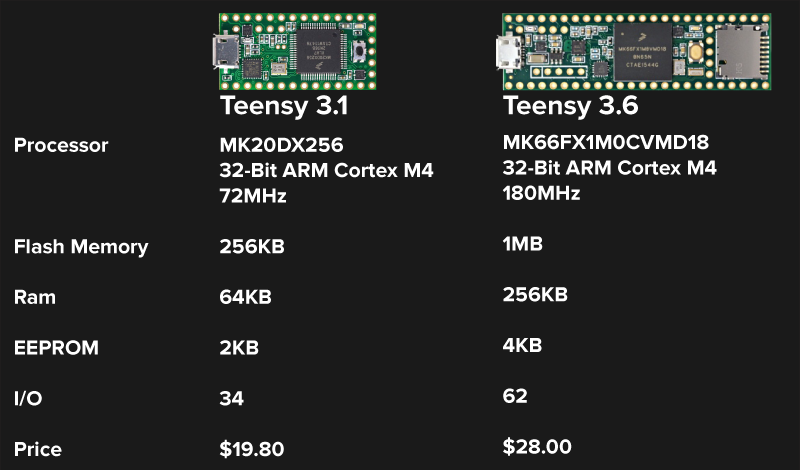
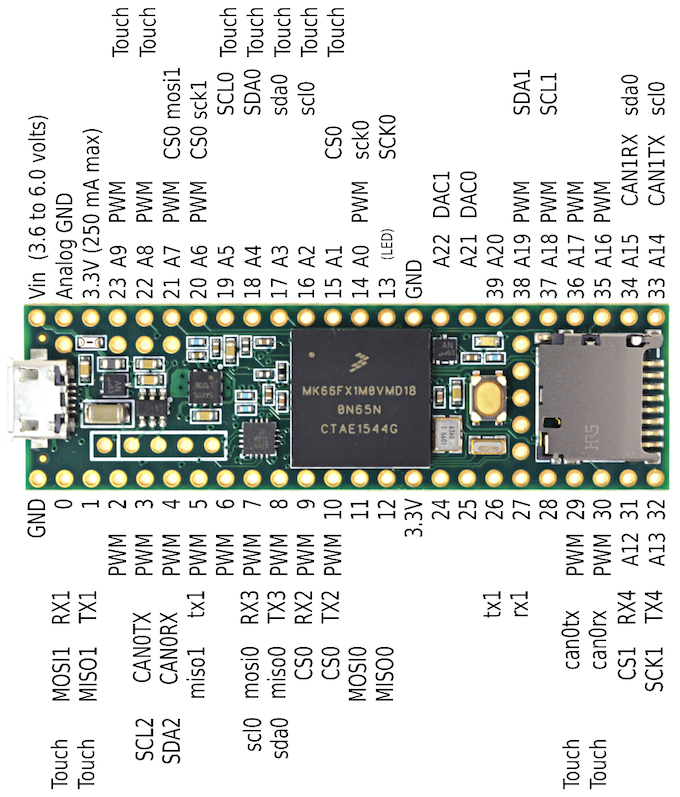
Comparing to previous Teensy boards:
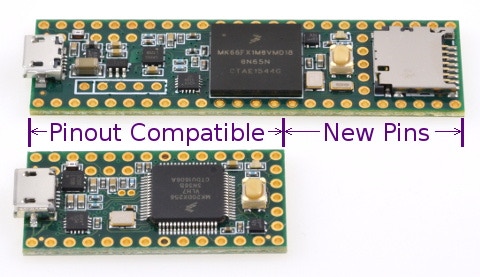
As Teensy is now a long-running and viable product family, I see no special risk in this kickstarter.
Re: emulator performance on embedded cpu
Posted: Sat Oct 22, 2016 7:56 am
by BigEd
I see the Teensy boards are now a stock item, although they do seem to sell out quickly! The 3.5 is the 5V-tolerant one; the 3.6 has the faster CPU and costs a little more:
https://www.pjrc.com/store/teensy35.html
https://www.sparkfun.com/categories/267
http://www.hobbytronics.co.uk/teensy-boards
https://shop.pimoroni.com/products/teensy-3-5-3-6
Re: emulator performance on embedded cpu
Posted: Thu Aug 10, 2017 7:58 am
by BigEd
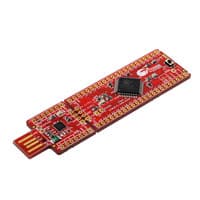
We've had a couple of mentions in other threads of Cypress' PSOC4 devices: it
turns out they do a
£3 dev board, with lots of I/O, a USB interface, and a 48MHz ARM on board. If powered at 5V it's 5V tolerant too. Although 48MHz isn't the fastest, the chip also has a small amount of programmable logic: four byte-wide(?) chunks of logic suitable for interface hardware, programmable in Verilog.
Four programmable logic blocks called universal digital blocks, (UDBs), each with 8 Macrocells and data path.
There are two PLDs in each UDB; each with eight PTs and four macrocells.
[In a PLD] there are 12 inputs which feed across eight product terms (PTs) in the AND array. In each PT, either the true or complement of the input can be selected. The outputs of the PTs are inputs into the OR array. The outputs of the OR gates are fed to macrocells (MC). Macrocells are flip-flops with additional combinatorial logic.
But, it has just 4k of SRAM, and the toolchain is Windows-only (probably runs OK in Wine.)
[Edit: on reflection, 4k is plenty, as there's lots of flash ROM where application and OS can live.]
Re: emulator performance on embedded cpu
Posted: Thu Nov 15, 2018 8:57 am
by BigEd
Nearby some 5V tolerant ARM offerings:
STM32 Nucleo-64 boards cost ca. USD 11, 90% pins are 5V-tolerant. BluePill costs USD 1.7, over 20 5 V tolerant pins. Chinese STM32F407VET board (over 100 pins) is USD 9. :)
We've got plenty of choices when it comes to implementing any retro computer logic in a microcontroller. Note that all these have USB interfaces, which may be used for controlling the device from a PC (status
display, loading HEX files to memory etc.). That's what I did in my SDC design.
Re: emulator performance on embedded cpu
Posted: Sun Nov 18, 2018 11:59 pm
by Mike Naberezny
Nearby some 5V tolerant ARM offerings:
I am working on a hobby project with a 5V ARM microcontroller, the
MKE06Z128VLD4. It's an NXP (Freescale) Kinetis part like on the Teensy boards earlier in this thread. This one is from the KE06 subfamily. It runs on 5V directly and is an LQFP-44 package that is
relatively easy to solder. It features a 48 MHz Cortex M0+, 128K flash, 16K RAM, and many built-in peripherals. It's less than USD $5 at Digi-Key and Mouser. There are also slightly less expensive parts in the KE04 and KE06 subfamilies (less flash and RAM, different peripherals) but still 5V and available in the LQFP-44 package.
You can see a photo of my board below. I've got the MKE06Z128VLD4 soldered to a
PA0093 breakout. At almost USD $11, the PA0093 is far too expensive. Next time I'll use a cheap no-name breakout from eBay. There are only a few connections to wire up (5V power, optional external oscillator, debug connector). There's a cross-platform (Eclipse-based) IDE called
Kinetis Design Studio. I used it to get started but now I'm just using GCC on the command line. I'm flashing and debugging using a
Segger J-Link EDU (non-commerical use only).
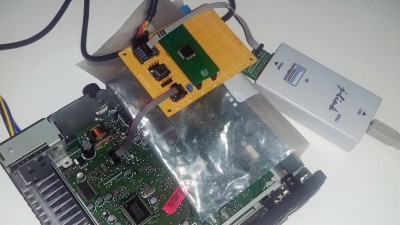
- MKE06Z128VLD4 Board
Re: emulator performance on embedded cpu
Posted: Mon Nov 19, 2018 8:28 am
by BigEd
Actual 5V ARM - a good find!