Issue with Indirect Addressing

Building your first 6502-based project? We'll help you get started here.
User avatar
BigDumbDinosaur
Posts: 9425
Joined: 28 May 2009
Location: Midwestern USA (JB Pritzker’s dystopia)
Contact:

Re: Issue with Indirect Addressing

Post by BigDumbDinosaur »

ChaseHQ85 wrote:
Hey Jeff,
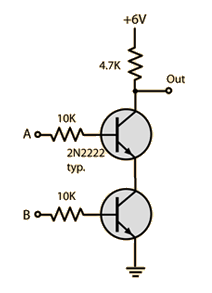
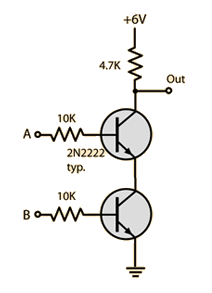
This is the NAND gate I used. Image
The slowness of the above circuit is due to the fact that the series transistors can only sink the output, not source it. You are depending on the 4.7K resistor to drive the output high, which means the RC time-constant of whatever is hooked up to the output will affect rise time and set a limit on how fast the circuit can change state.

Early on in the application of the transistor to digital logic, RTL (resistor-transistor logic) was developed, but soon abandoned, for reasons that you now know. TTL (transistor-transistor logic) was developed to improve switching speeds and to positively drive the output in both directions, leading to the development of the 74-series logic devices during the 1960s.
x86?  We ain't got no x86.  We don't NEED no stinking x86!
User avatar
GARTHWILSON
Forum Moderator
Posts: 8773
Joined: 30 Aug 2002
Location: Southern California
Contact:

Re: Issue with Indirect Addressing

Post by GARTHWILSON »

To add to what BDD said, suppose you have 20pF of capacitance for the 4.7K to charge up. 20pF x 4.7K makes for a 94ns time constant for the rise time! (The time constant is the amount of time it takes for the voltage to go (1-1/e) times the voltage change it will make given an infinite amount of time, meaning approximately 63% of the way to its final voltage, or 3.16V out of 5V.) One thing that would help is to replace the resistor with a current mirror. Take a look at NXP's BCM62B (Thanks Dr Jefyll for alerting me to that), or go to their website and search for "PNP double transistor" (which doesn't seem to be working for me right now). The benefit there is that you can set it for some amount of current, say 5mA, and the current will not diminish significantly until the voltage is pulled up well past a valid logic 1. (The resistor's pull-up current OTOH is proportional to the voltage across it which keeps dropping as the voltage rises.)

A related thing also slowing the transistor down is that there's another RC time constant formed by the input resistors and the transistors' base capacitances, including Miller effect. You can speed that up by putting a 10 or 20pF capacitor across each 10K resistor.

Yet another (and Dr Jefyll alluded to it) is transistor saturation. If you let them get saturated, it takes them longer to turn off. The "S" in "74LS__" basically refers to Schottky diodes put across transistors from collector to base so they turn on and shunt out the base current if the collector gets more than about a quarter of a volt below the base.
http://WilsonMinesCo.com/ lots of 6502 resources
The "second front page" is http://wilsonminesco.com/links.html .
What's an additional VIA among friends, anyhow?
User avatar
Dr Jefyll
Posts: 3525
Joined: 11 Dec 2009
Location: Ontario, Canada
Contact:

Re: Issue with Indirect Addressing

Post by Dr Jefyll »

Image
ChaseHQ85 wrote:
This is the NAND gate I used.
oops -- right. I'm used to seeing FET transistors connected in series (as is the case internally with MOS and CMOS gates), but I tend to forget it works for bipolar transistors, too. BTW, ChaseHQ85, if you like you can attach images to your post. There's no need to use imgur / whatever.
GARTHWILSON wrote:
replace the resistor with a current mirror. Take a look at NXP's BCM62B
From my notes, here's the example circuit which introduced me to the NXP part. Annotations added. See the entire original page here.
constant current src .png
See also Chapter 11 - The Current Mirror on wiki.analog.com.

GARTHWILSON wrote:
Yet another (and Dr Jefyll alluded to it) is transistor saturation.
Yup, I was prompted by BDD's mention of it.
In 1988 my 65C02 got six new registers and 44 new full-speed instructions!
https://laughtonelectronics.com/Arcana/ ... mmary.html
ChaseHQ85
Posts: 38
Joined: 21 Feb 2017

Re: Issue with Indirect Addressing

Post by ChaseHQ85 »

barrym95838 wrote:
Hello again, ChaseHQ85. I'm glad to see that you found your problem. I'm providing an untested re-write of your source, in the hopes of showing you a different way of attacking the specific task you posted. I think that I understood what you were doing with your code, with the exception of your mention of the number "2820" in your comments. :?:

When it is possible to do so, it can be of benefit to fill from higher to lower addresses on the 65xx, especially if the fill area is not an integer multiple of 256, and this is the technique I have employed here. The accumulator and Y register don't have to be initialized inside the loops, because they already have the "correct" value when the loop-backs occur. Not only is the static instruction count lower, but the nested loops execute far fewer instructions, with the net result being a more efficient system. :)

Code: Select all

   PROCESSOR 6502

;-------------------------------------------------
;-------------DANI-I-SYSTEM-ROM-------------------
;-------------------------------------------------

;-------------EQUATES-----------------------------
VRAM:            EQU $8000
VRAM_H:          EQU $80
VRAM_L:          EQU $00
VRAM_CMD:        EQU VRAM + $F00
VRAM_CHARSLOC:   EQU VRAM + $F10
VRAM_CHARSBUF:   EQU VRAM + $F20
;-------------EO-EQUATES--------------------------

    ORG $C000
RESET:
    LDX #$FF            ; Initialize the Stack Pointer
    TXS                 ; Transfer X to Stack
SETUP_BLANKCHAR:
    LDA #$00            ; Store Null in Accu
    LDX #$07            ; Set X to 7
LOOP_BLANKSTORE:   
    STA VRAM_CHARSBUF,X ; Store Accu into VRAM_CHARSBUF+X
    DEX                 ; (filling high to low is more efficient)
    BPL LOOP_BLANKSTORE
    STA VRAM_CHARSLOC   ; Set the Character Store Location
    LDA #$01            ; Set the Character Store Command
    STA VRAM_CMD    
CHECK_CMDCOMPLETE:
    LDA VRAM_CMD        ; Check VRAM_CMD to see if VGA picked up char
    BNE CHECK_CMDCOMPLETE ; Keep checking until it resets to 00
BLANKOUT_START:
    LDA #VRAM_L         ; Load Low Byte of VRAM address
    STA $05             ; Store it in Zero Page 5
    LDY #$B0            ; Last page is only partially filled
    LDA #$00            ; Set Accu To 0 (fill byte)
    LDX #VRAM_H+4       ; Init X to last VRAM page number
LOOP_BL_OUTER:
      STX $06           ; Store it in Zero Page 6
LOOP_BL_INNER:
        DEY             ; (filling high to low is more efficient)
        STA ($05),Y     ; Store the fill byte
        BNE LOOP_BL_INNER ; ... down to the bottom of the page
      DEX               ; Prepare to fill next-lower page
      CPX #VRAM_H       ; Is X < VRAM_H?
      BCS LOOP_BL_OUTER ; No: fill the next page
LOOP_DONE:
    JMP LOOP_DONE       ; Done: "halt" in an infinite loop
VECTORS:
    ORG $FFFA           ; 6502 Starts reading its vectors here
    .word LOOP_DONE     ; NMI
    .word RESET         ; RESET
    .word LOOP_DONE     ; BRK
   
   END
If I messed up anywhere, please let me know, and I'll revise.

Mike B.
Hey Mike,
Quick question to make sure i understand fully what's happening. Wouldn't i need to make the only partially filled page start at B1 instead of B0 because of the DEY prior to the store?

Thanks!
User avatar
barrym95838
Posts: 2056
Joined: 30 Jun 2013
Location: Sacramento, CA, USA

Re: Issue with Indirect Addressing

Post by barrym95838 »

I don't have a memory map of your set-up, but I saw you mention that your video display RAM occupies 1200 ($04B0) bytes, and starts at address $8000. If that is true, then the first byte is at $8000 and the 1200th byte is at $84AF, and my code should perform as advertised, in roughly 58% of the time yours takes to complete, due to the smaller inner loop. You still didn't explain what the "2820" meant in your source comments, so I could be misunderstanding something.

Mike B.
Post Reply