

With some help from Arlet, I've put my sources into place on github - they are LGPL licensed which basically means "open-sourced but if you distribute any designs you also need to distribute the sources". (So any fixes or enhancements should stay out in the open)
The main branch in this project is Arlet's 6502-compatible core. I've staked out a branch called 65Org16-master for my core. As usual with github, take a fork if you'd like to join in the development, or download the source and have a play. (There's a big Downloads button - you can't miss it!)
I hope to add the (simple) assembler shortly.
There's still no RAM in the system-on-FPGA - I didn't get around to doing that today.
Cheers
Ed
First glimpse: 65Org16 (6502 with 32bit addresses)
-
ElEctric_EyE
- Posts: 3260
- Joined: 02 Mar 2009
- Location: OH, USA
Re: 65Org16 is open sourced
BigEd wrote:
With some help from Arlet,...
Cheers
Ed
Cheers
Ed
I really do wish I had time to experiment with this! Maybe soon...
-
ElEctric_EyE
- Posts: 3260
- Joined: 02 Mar 2009
- Location: OH, USA
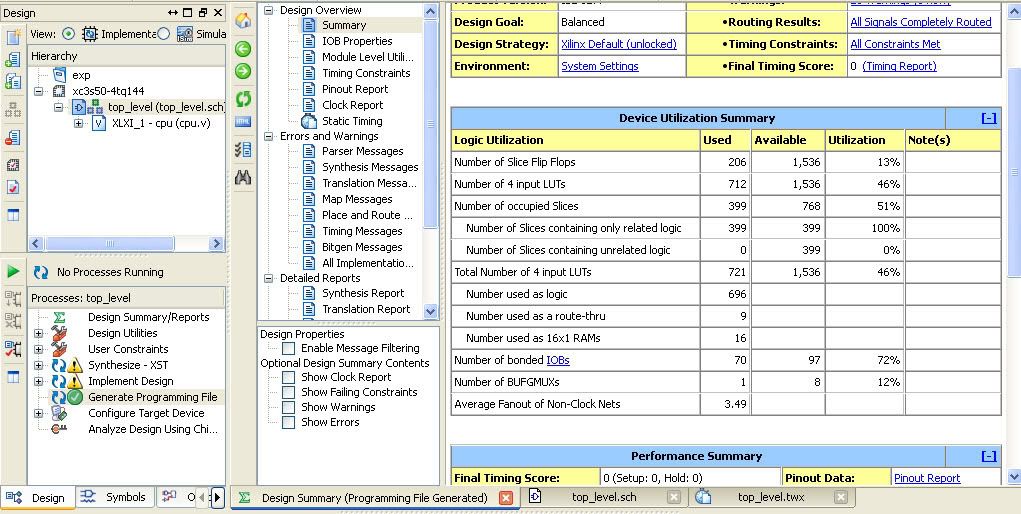
Ok, now I've got a few hours to spare and have downloaded the files, and put them through ISE synth (I'm sure you guys have too). I tried first to fit the 65ORG16 core into the smallest FPGA Xilinx has to offer that can hold RAM & ROM, i.e. the smallest of the Spartan 3 series, the XC3S50 in 100-pin QFP. It did not fit, I think only because it didn't have enough pins. However, it did fit into the XC3S50 144-pin QFP package and here are the passing synthesis results for the core only:
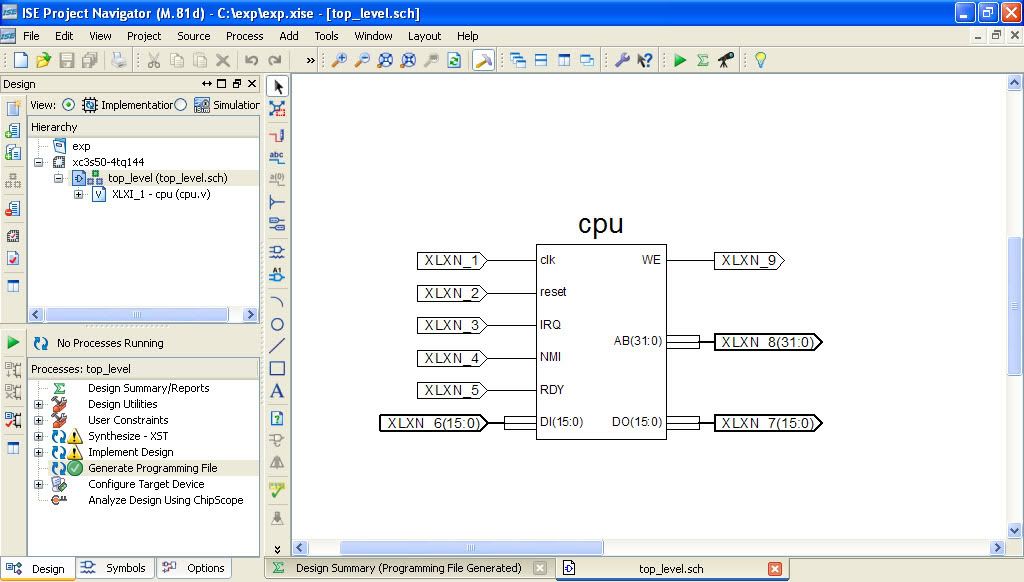
Also, here is the pinout:
I'll tell you what, a while ago I would've considered the MC68000 for a true 16-bit CPU... This 65ORG16 is now on my top shelf for experimentation when it comes to a cpu with a true 16-bit databus...
Also, here is the pinout:
I'll tell you what, a while ago I would've considered the MC68000 for a true 16-bit CPU... This 65ORG16 is now on my top shelf for experimentation when it comes to a cpu with a true 16-bit databus...

-
ElEctric_EyE
- Posts: 3260
- Joined: 02 Mar 2009
- Location: OH, USA
So I would guess the timing for the 65ORG16 core is identical to the original?
Only problem is I wouldn't be able to develop on it, by using it alone, like what I'm attempting to do on the 6502SoC. So much software has been already made for the 6502 and the 68000... However, that isn't such a problem that it would stop me from developing with it. Just waiting for the assembler so I can tinker...
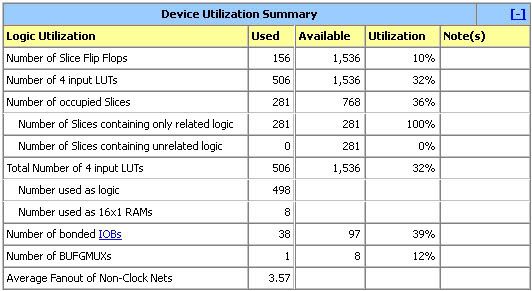
Here's the synthesis results for Arlet's 8-bit original just for comparison...
If I were going to maximize the 144-pin package, I would use the Spartan 3 XC3S400 or the Spartan 6 XC6SLX9.
Only problem is I wouldn't be able to develop on it, by using it alone, like what I'm attempting to do on the 6502SoC. So much software has been already made for the 6502 and the 68000... However, that isn't such a problem that it would stop me from developing with it. Just waiting for the assembler so I can tinker...
Here's the synthesis results for Arlet's 8-bit original just for comparison...
If I were going to maximize the 144-pin package, I would use the Spartan 3 XC3S400 or the Spartan 6 XC6SLX9.
I'm expecting the 16 bit version to be somewhat slower, but if you take out the BCD code (which doesn't work properly in 16 bit mode anyway), the difference should be minimal (16 bit without BCD might even be faster than 8 bit with BCD).
(The problem with the BCD mode is that it is only applied to the bottom 8 bits)
(The problem with the BCD mode is that it is only applied to the bottom 8 bits)
EE:
Yes, the cycle timings are the same, although as Arlet says the clock speed will vary,
I'm hoping for a license update on Dave Beazley's assembler so I can include that in the project - but I should warn you it is basic and non-standard. It is certainly good enough for small test programs, a bootstrap loader, maybe a monitor. It would be fine as the back end to a compiler. But for general use we might need something else: almost certainly it would be best to port an existing 6502 assembler.
If anyone is interested in doing that, it would be good to talk!
(There's also no harm in having more than one. Personally, I need to stay focussed on the hardware side for now: I want to have a development platform with a program loader.)
Yes, the cycle timings are the same, although as Arlet says the clock speed will vary,
I'm hoping for a license update on Dave Beazley's assembler so I can include that in the project - but I should warn you it is basic and non-standard. It is certainly good enough for small test programs, a bootstrap loader, maybe a monitor. It would be fine as the back end to a compiler. But for general use we might need something else: almost certainly it would be best to port an existing 6502 assembler.
If anyone is interested in doing that, it would be good to talk!
(There's also no harm in having more than one. Personally, I need to stay focussed on the hardware side for now: I want to have a development platform with a program loader.)
Hi Arlet, agreed, that will be a good point to get to, and I hope to get there.
At the moment I'm struggling with the block rams. I have them working - in simulation - but only by clocking on the wrong edge. I haven't got the hang of the clocking of the core.
Looking at the detailed post-routing timing reports, I see:
(It seems that the data in arrives really early, and the address bus leaves really late.)
At the moment I'm struggling with the block rams. I have them working - in simulation - but only by clocking on the wrong edge. I haven't got the hang of the clocking of the core.
Looking at the detailed post-routing timing reports, I see:
- clock to clock meets 20ns period
clock to output (address bus) is 25ns
input to clock (data in) is 20ns
input to output (data in to address bus) is 20ns
(It seems that the data in arrives really early, and the address bus leaves really late.)
-
GARTHWILSON

- Forum Moderator
- Posts: 8773
- Joined: 30 Aug 2002
- Location: Southern California
- Contact:
Arlet wrote:
I'm expecting the 16-bit version to be somewhat slower, but if you take out the BCD code (which doesn't work properly in 16-bit mode anyway), the difference should be minimal (16-bit without BCD might even be faster than 8-bit with BCD).
(The problem with the BCD mode is that it is only applied to the bottom 8 bits)
(The problem with the BCD mode is that it is only applied to the bottom 8 bits)
Last edited by GARTHWILSON on Fri May 20, 2011 4:55 pm, edited 1 time in total.
My memory attachment looks like this:
And the ram is implemented like this:
Did you include flip flops on the outputs of the external memories ? They are supposed to be registered, otherwise you can never get decent timing.
Then you'll have a long combinatorial path from the memory data output to the DI port, and through the ALU. Of course, you can cut this path in two by also registering the inputs, but then you'll need to use RDY.
Code: Select all
ram ram( .clk(clk),
         .AB(AB),
         .DO(DI_RAM),
         .DI(DO),
         .WE(WE),
         .vclk(vmem_clk),
         .VAB(vmem_addr),
         .VDO(vmem_data)
);

boot boot( .clk(clk),
         .AB(AB),
         .DO(DI_OS),
         .DI(DO),
         .WE(WE)
);


assign DI = DI_OS | DI_RAM;

cpu cpu( .clk(clk),
         .reset(reset),
         .AB(AB),
         .DI(DI),
         .DO(DO),
         .WE(WE),
         .IRQ(1'b0),
         .NMI(1'b0) );
Code: Select all
wire sel_0000 = (AB[15:10] == 6'b0000_00);
wire sel_8000 = (AB[15:10] == 6'b1000_00);

wire EN = (sel_0000 | sel_8000);

RAMB16_S9_S9 ram_0000_03ff_and_8000_83ff(
        .CLKA( clk ),
        .WEA( WE & EN ),
        .ENA( 1'b1 ),
        .SSRA( ~EN ),
        .ADDRA( {AB[15], AB[9:0]} ),
        .DOA( DO ),
        .DIA( DI ),
        .DIPA( 0 ),

        .CLKB( vclk ),
        .WEB( 1'b0 ),
        .ENB( 1'b1 ),
        .SSRB( 1'b0 ),
        .ADDRB( {1'b1, VAB[9:0]} ),
        .DOB( VDO )
);
Then you'll have a long combinatorial path from the memory data output to the DI port, and through the ALU. Of course, you can cut this path in two by also registering the inputs, but then you'll need to use RDY.
GARTHWILSON wrote:
BCD is applied to 4 bits at a time, and will work fine with any multiple of 4 bits. (I'm not saying it's essential though, as I haven't used it in decades myself.)