Page 2 of 2
Re: ATX PSU for 65C02 SBC
Posted: Wed Aug 20, 2025 2:04 am
by Yuri
Seems overly complicated, even if all you need is a soft switch you can use a 74x74 with denounced push button; no need for a whole complicated ATMega on there.
 I said as much a few posts ago.
Was tired and bleary eyed, I'm sure I missed it.... -_-.... zzzZzzzz....
OK - the MOSFET seems pointless there, you should be able to just connect it to the pin, maybe with a pullup to 5VSB to cover any time after power-on during which the MCU is not driving the pin properly.
Ah good to know, I recall spending quite some time scoring for that info and was turning up empty handed. I figured it might be something like that, but wasn't sure. (And don't currently have the means to test it myself as I don't have a working ATX PSU right now to sacrifice for "science!"
Re: ATX PSU for 65C02 SBC
Posted: Wed Aug 20, 2025 7:41 am
by JohanFr
Wonderful, this is what I was after! And FWIW the Attiny isn't that complicated, sure you will have to write code for it, but I am a programmer at heart so that is not a huge problem. If anything I think it slightly reduces board complexity (putting debouncing and toggling into one chip).
Re: ATX PSU for 65C02 SBC
Posted: Wed Aug 20, 2025 5:29 pm
by BillO
I too am of the opinions that a) the ATX is way overkill and B) SMPS wallwarts are generally trash.
I've taken to use these little Mornsun LM15-23B05 SMPS unit. 5V @ 3A. Sufficient for a very large SBC.
They beat their very good specifications quite handily. About $5 from DigiKey. You would spend more than that on the parts for that schematic you posted.
Re: ATX PSU for 65C02 SBC
Posted: Wed Sep 03, 2025 4:25 am
by Wavicle
I had a need for a low wattage (~5W) ATX-style PSU that could be powered from USB, so I designed my own. All the problems mentioned here - especially low quality "5V" from USB chargers - had to be dealt with and compensated for. In the end, I made something that produces +5VSB, +5V, +12V, -12V, and +3.3V power rails, a 12V fan header, draws less than 5mW when completely unloaded (the limit of the equipment I had on hand to measure was 5mW), and it tolerates pretty severe dips caused by USB chargers that are slow to recover from current increases. It's great when at a show and a USB phone charger battery bank is the most reliable option for power.
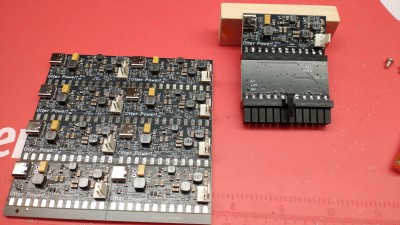
- Otter Power! 5W ATX PSU
Sadly, the cost is close to a modern ATX Pico PSU and considerably more than an LM15-23805. So far it has only seen life with OtterX, Commander X16, and Foenix F256 computers; I'm not aware of any other neo-retro computers with a 24-pin ATX receptacle.
Re: ATX PSU for 65C02 SBC
Posted: Wed Sep 03, 2025 10:02 am
by J64C
BDD’s post above (
viewtopic.php?f=4&t=8426#p113859) nails it for the route I’d take. I’ve been considering a mini ITX desktop case for my project also, if I ever get around to it. At least you know the PSU would be rock solid in comparison with a generic wall charger type of thing, which I’ve had mixed results with.
The better quality the power, the better quality stability. Coming from someone who’s not afraid to push clock speeds to the absolute limits (~40 MHz). Power supply and cleanest possible clock is king. Everything else is secondary. If it runs stable at 30+ MHz, it will be absolutely bulletproof at the prescribed datasheet values.
No need for mosfets or whatever AI wants to spew at you. The PSU’s are 100% fine out of the box, these guys know how to build PSU’s better than any of us could ever attempt. It’s what they do.
Re: ATX PSU for 65C02 SBC
Posted: Wed Sep 03, 2025 7:27 pm
by BigDumbDinosaur
I’ve been considering a mini ITX desktop case for my project also, if I ever get around to it. At least you know the PSU would be rock solid in comparison with a generic wall charger type of thing, which I’ve had mixed results with.
At some point in my POC progression, I will build a unit on a PCB that is the size and shape of a micro-ATX motherboard so it can be mounted into a standard mini-tower case. I already have developed a basic PCB form, with slots, but have not continued with it due to not having reached a “final” POC design (if such a thing actually exists).
The better quality the power, the better quality stability.
I’ve been bleating about that for years. Wall warts are a maximum-cheapness solution to powering things—you have no idea what is in one, how well it was made, what its regulation characteristics are, what it will do if there’s an overvoltage situation on the power line, etc.. Given the amount of time most of us invest in our projects, taking some care in selecting a power source that won’t trash our work seems to be a no-brainer.
Re: ATX PSU for 65C02 SBC
Posted: Wed Sep 03, 2025 8:33 pm
by GARTHWILSON
Wall warts are a maximum-cheapness solution to powering things—you have no idea what is in one, how well it was made, what its regulation characteristics are, what it will do if there’s an overvoltage situation on the power line, etc.. Given the amount of time most of us invest in our projects, taking some care in selecting a power source that won’t trash our work seems to be a no-brainer.
Re: ATX PSU for 65C02 SBC
Posted: Wed Sep 03, 2025 10:14 pm
by Yuri
I’ve been considering a mini ITX desktop case for my project also, if I ever get around to it. At least you know the PSU would be rock solid in comparison with a generic wall charger type of thing, which I’ve had mixed results with.
At some point in my POC progression, I will build a unit on a PCB that is the size and shape of a micro-ATX motherboard so it can be mounted into a standard mini-tower case. I already have developed a basic PCB form, with slots, but have not continued with it due to not having reached a “final” POC design (if such a thing actually exists).
...
The attachment microatx_specs.pdf is no longer available
I've been working on my own microATX board, I'll be using 62pin card edge connectors (same as 8-bit ISA slots), though I plan to place them 1" away from the back so as to prevent a regular ISA from being plugged into them (my pin out will be much different).
For those that are interested, microATX is smaller form factor of ATX.
Re: ATX PSU for 65C02 SBC
Posted: Thu Sep 04, 2025 9:26 am
by J64C
I’ve been bleating about that for years.
Oh I know! And believe me I listened, about both that and clock quality. You were the one I was thinking about when I wrote that.

Re: ATX PSU for 65C02 SBC
Posted: Thu Sep 04, 2025 11:07 am
by drogon
Expanding on the "Wall-Wart" theme - it's true that many of these are "made to a budget". Also, now we're past the "race to the bottom of the barrel" and aiming for bedrock... However there is a solution.
We should stop being cheapskates and buy a decent wall-wart.
Sadly I saw this almost 15 years back when the Raspberry Pi was launched. It was too cheap, so people bought cheap USB PSUs for it - and all sorts of issues then happened (And yes, I'm more than fully aware that the first generation Pi did have some issues, but if you bothered to use a good wall wart then these would never surface for you) The Pi was too cheap IMO.
Today, we have USB Type C. It has a power delivery scheme where the wall-wart or host device can deliver variable voltage (up to 48v and up to 240W in newer systems) to the device through a negotiation means, or, if the device does it properly (no negotiation just a pair of 5.1K resistors) deliver 5v at a maximum of 3 amps. I charge my Dell Laptop through it's USB-C port using a high power 'wall wart'.
Fortunately for us hobbyists there is an easy solution in the form of little boards with the power negotiation widgetry on-board - they're typically called USB-C PD Decoy boards and can be jumperd to various voltages - 5, 9 and 12, 15 and 20v are common. they are a few £/$/€ from ebay.
I'm building a little toy right now using VFD displays that need and 25v, also 5v for the logic so my plan is to use a decoy board to provide 12v then 2 buck/boost units to provide the required voltages.
-Gordon
Re: ATX PSU for 65C02 SBC
Posted: Thu Sep 04, 2025 2:42 pm
by Dr Jefyll
Thanks for explaining about the decoy boards. I haven't been keeping up with this USB-C stuff.
As for your buck/boost scheme, would it be possible to use multiple decoy boards instead? Just curious... Edit: hm, I guess not -- that wouldn't mesh with the negotiation scheme you mentioned.

-- Jeff
Re: ATX PSU for 65C02 SBC
Posted: Thu Sep 04, 2025 2:44 pm
by Dr Jefyll
I had a need for a low wattage (~5W) ATX-style PSU that could be powered from USB, so I designed my own.
Welcome, Wavicle! And nice work on the PSU!
-- Jeff
Re: ATX PSU for 65C02 SBC
Posted: Thu Sep 04, 2025 8:23 pm
by Wavicle
I had a need for a low wattage (~5W) ATX-style PSU that could be powered from USB, so I designed my own.
Welcome, Wavicle! And nice work on the PSU!
-- Jeff
Thank you!
To expand on what several have mentioned re: wall warts, local regulation, and buck/boost - that is what I did with my PSU. Initially I had "+5VSB" the same as "VBUS" (USB power) and that was a *very* bad idea. For one, VBUS would droop to around 2V during the power-on inrush current on cheap USB chargers; for another, VBUS was frequently well above 5 volts when unloaded or lightly loaded, especially on good USB chargers.
One solution to this is a USB PD trigger IC that would negotiate a higher voltage that could then be bucked down to supply the various rails. I decided against this because USB chargers that can negotiate 12-20V to the device are expensive and not that common.
The solution I went with on was multiple switchers in boost/buck configurations and a sequencer circuit for energizing the rails one at a time to reduce the peak inrush current during power on. The PSU maintains all five rails even when VBUS misbehaves and fluctuates between 2V and 6V (as long as it never spends too much time at 2V on wires that cannot handle that much current).
There are about 100 of them out there now, and other than audible coil whine and a "warmer than one would like" 3.3V rail on the first version, there have been no complaints. Both of those issues appear to be fixed on the current version.