Page 2 of 3
Re: Good 74HC parts to have
Posted: Wed Apr 29, 2020 6:44 pm
by BigDumbDinosaur
What frequency would you recommend for the can oscillator that will reliably work on a breadboard? (I'm using a rockwell R65C02 btw)
What Ed said. Start slowly and work your way up. With the WDC MPUs, there is no lower limit to the clock speed. With Rockwell parts, the bottom limit is likely around 100 KHz—consult the data sheet on that, as my memory is fading. Clocking the MPU at 1 MHz should be safe. As the old saying around here goes, you can get away with murder at 1 MHz.
Re: Good 74HC parts to have
Posted: Wed Apr 29, 2020 7:04 pm
by GARTHWILSON
What frequency would you recommend for the can oscillator that will reliably work on a breadboard? (I'm using a rockwell R65C02 btw)
What Ed said. Start slowly and work your way up. With the WDC MPUs, there is no lower limit to the clock speed. With Rockwell parts, the bottom limit is likely around 100 KHz—consult the data sheet on that, as my memory is fading.
Rockwell's R65C02 could be stopped, but only with phase 2 high, not low. The maximum phase-2-low time that's guaranteed to work is 5µs. What surprises me now is that this is the first time I've noticed that Synertek's data book says there's no maximum phase-2-low time for their SY65C02. I thought only WDC could stop the clock with phase 2 low.
Re: Good 74HC parts to have
Posted: Wed Apr 29, 2020 10:05 pm
by BigDumbDinosaur
Rockwell's R65C02 could be stopped, but only with phase 2 high, not low. The maximum phase-2-low time that's guaranteed to work is 5µs. What surprises me now is that this is the first time I've noticed that Synertek's data book says there's no maximum phase-2-low time for their SY65C02. I thought only WDC could stop the clock with phase 2 low.
Dunno about Synertek. I've never looked their parts.
Re: Good 74HC parts to have
Posted: Wed Apr 29, 2020 11:14 pm
by qwertykeyboard
If I wanted to use another 74AC74 to divide the clock further after the output of the first 74AC74, would there be any kind of problems with this? Also I'm wondering as to why to use a 74AC74 instead of a 74HC74?
Re: Good 74HC parts to have
Posted: Wed Apr 29, 2020 11:18 pm
by GARTHWILSON
If I wanted to use another 74AC74 to divide the clock further after the output of the first 74AC74, would there be any kind of problems with this?
No. Do as many cascades stages as you want. (There are two available in a single '74 IC though).
Also I'm wondering as to why to use a 74AC74 instead of a 74HC74?
According to the data sheet, WDC's W65C02 wants a faster rise and fall time than the 74HC might produce.
Re: Good 74HC parts to have
Posted: Wed Apr 29, 2020 11:27 pm
by qwertykeyboard
If I wanted to use another 74AC74 to divide the clock further after the output of the first 74AC74, would there be any kind of problems with this?
No. Do as many cascades stages as you want. (There are two available in a single '74 IC though).
Also I'm wondering as to why to use a 74AC74 instead of a 74HC74?
According to the data sheet, WDC's W65C02 wants a faster rise and fall time than the 74HC might produce.
Does that mean I'd need to use a 74ac14 instead of a 74hc14 for the single cycle circuit (the one that keeps PHI0 high unless the button is pushed) listed on your clock generation primer?
Re: Good 74HC parts to have
Posted: Thu Apr 30, 2020 12:09 am
by BigDumbDinosaur
Does that mean I'd need to use a 74ac14 instead of a 74hc14 for the single cycle circuit (the one that keeps PHI0 high unless the button is pushed) listed on your clock generation primer?
If the output of the single-cycle circuit is directly fed to the microprocessor you should use a74AC14. If it is being fed to the input of a flop the 74HC14 will suffice.
Re: Good 74HC parts to have
Posted: Thu Apr 30, 2020 2:28 am
by qwertykeyboard
The good thing is that discrete logic in PDIP packages is still plentiful and relatively inexpensive. However, it isn't going to stay that way, so a little bit of hoarding now may prove to be a wise thing to do.
I especially like this ^^^^ paragraph. You may find a price break at qty 10. Get plenty of DIP sockets too.
It seems that TI is one of the few manufacturers that still make logic chips. Browsing Digi-Key seems to reveal that, in most cases, with the exception of Toshiba, all other major IC manufacturers have stopped making 74 series chips in DIP.
Once TI stops making these chips we're in real trouble

Re: Good 74HC parts to have
Posted: Thu Apr 30, 2020 4:47 am
by BigDumbDinosaur
It seems that TI is one of the few manufacturers that still make logic chips. Browsing Digi-Key seems to reveal that, in most cases, with the exception of Toshiba, all other major IC manufacturers have stopped making 74 series chips in DIP.
Once TI stops making these chips we're in real trouble
There are others. Try searching Allied and Mouser, as well as Digi-Key. No one vendor has everything.
As I earlier said, PDIP is slowly but surely on its way out. Hardly any commercial products use them anymore, mostly because SMT parts are more economical in terms of materials and labor, especially labor. As the demand for PDIP diminishes manufacturers will discontinue them and it will be all SMT.
Anyone with reasonably good close-up eyesight and a reasonably steady hand can solder SMT devices. My POC units have some SOIC and SOJ parts, all of which were manually soldered. Here's a close-up of a MAX238 in a SOIC24 package on my POC V1.2 unit. SOIC is 50 mil pitch and as can be seen, is easily soldered.
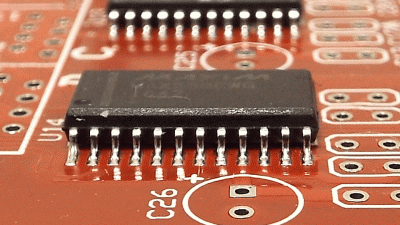
- MAX238 SOIC24 Manually Soldered
SOJ packages are similar. Here's a close-up of the SRAM on my POC V1.2 unit. It's in an SOJ32 package, which is also 50 mil pitch.
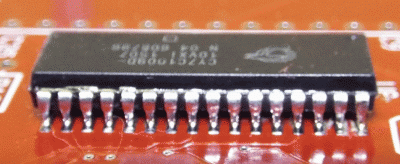
- SRAM SOJ32 Manually Soldered
The really fine pitch stuff, such as TSOP, is more challenging, but hobbyists have manually soldered them.
This video explains the techniques for manually soldering SMT parts. Nothing unusual in the way of tools and supplies is used.
Re: Good 74HC parts to have
Posted: Thu Apr 30, 2020 5:08 am
by GARTHWILSON
LOL, I violate most of the rules he gives in that video!
Re: Good 74HC parts to have
Posted: Thu Apr 30, 2020 6:05 am
by BigDumbDinosaur
LOL, I violate most of the rules he gives in that video!
As the old wheeze goes, rules are meant to be broken. Whatever works...
Re: Good 74HC parts to have
Posted: Thu Apr 30, 2020 6:30 am
by qwertykeyboard
It seems that TI is one of the few manufacturers that still make logic chips. Browsing Digi-Key seems to reveal that, in most cases, with the exception of Toshiba, all other major IC manufacturers have stopped making 74 series chips in DIP.
Once TI stops making these chips we're in real trouble
There are others. Try searching Allied and Mouser, as well as Digi-Key. No one vendor has everything.
As I earlier said, PDIP is slowly but surely on its way out. Hardly any commercial products use them anymore, mostly because SMT parts are more economical in terms of materials and labor, especially labor. As the demand for PDIP diminishes manufacturers will discontinue them and it will be all SMT.
Anyone with reasonably good close-up eyesight and a reasonably steady hand can solder SMT devices. My POC units have some SOIC and SOJ parts, all of which were manually soldered. Here's a close-up of a MAX238 in a SOIC24 package on my POC V1.2 unit. SOIC is 50 mil pitch and as can be seen, is easily soldered.
v1_2_pcb_max238.gif
SOJ packages are similar. Here's a close-up of the SRAM on my POC V1.2 unit. It's in an SOJ32 package, which is also 50 mil pitch.
v1_2_pcb_sram.gif
The really fine pitch stuff, such as TSOP, is more challenging, but hobbyists have manually soldered them.
This video explains the techniques for manually soldering SMT parts. Nothing unusual in the way of tools and supplies is used.
Only thing is that SMD parts aren't as flexible when it comes to prototyping and just whipping something together.
Re: Good 74HC parts to have
Posted: Thu Apr 30, 2020 2:46 pm
by BigDumbDinosaur
Only thing is that SMD parts aren't as flexible when it comes to prototyping and just whipping something together.
Agreed. There are SMT-to-DIP adapters that allow you to mount them on perf boards, as well as other ways.
Re: Good 74HC parts to have
Posted: Thu Apr 30, 2020 6:12 pm
by cjs
If I wanted to use another 74AC74 to divide the clock further after the output of the first 74AC74, would there be any kind of problems with this?
One trick I use when testing out random 6502s is to run an 8 MHz crystal oscillator into a
74LS161 counter, which is basically just a set of JK flip-flops wired together similar to what you'd do above, but in a way that avoids counting spikes (in case you're using multiple clock outputs). I then have, on the four outputs, 4 MHz, 2 MHz, 1 MHz and 0.5 MHz clock signals available.
You can probably do this with other counters, too. I also think that there may be some subtleties about this that I'm unable to think of at the moment, but I'm sure someone else will step in and explain any issues I'm missing with this technique.
Re: Good 74HC parts to have
Posted: Thu Apr 30, 2020 8:58 pm
by qwertykeyboard
I don't own an oscilloscope, so would it be useful to buy a cheap little logic analyzer like this:
https://www.ebay.ca/itm/USB-Logic-Analy ... SwLSBc-btw
to do debugging and that type of stuff.