Let me clarify some of the rules I have set for myself and the reason...
This is all about chip breadboard count, and nothing else.
Imagine being a noob, and only needing to drop down 2 chips.... nice way to begin!
My goal : 10 minutes of work for under $50.00, and you are now coding a real 6502.
You soon see your code come to life in sound and video. No ROMs!
Anyhow, this is a personal challenge, I just wanted to open it up to everyone for fun.
Oh, and about the video... text or graphics.
If a 16x16 pixel display and one tone beeper is all you need to enjoy coding, than that's just fine.
I wasn't going to post anything until the project was at least proven, but I have made some progress...
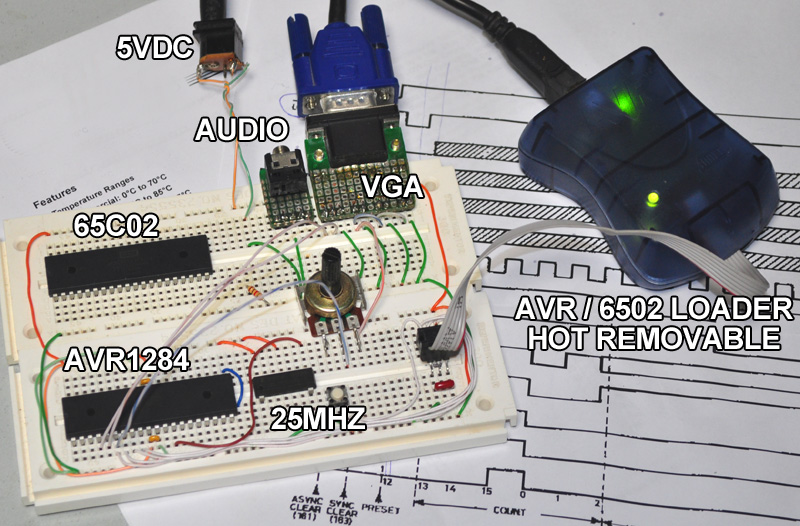 The goal is to make this into a working 6502 Audio / Video Computer!
What is shown above will have nothing else but wires attached from this point on.
The AVR has 128K of Flash Memory and 16K of fast SRAM.
The 6502 will get most of the SRAM for variables, and about 40K for ROM code.
Pins are scarce, so I may only get mono color text and one channel sound.
I have done some very basic video code for the AVR, and although ugly, it does show text...
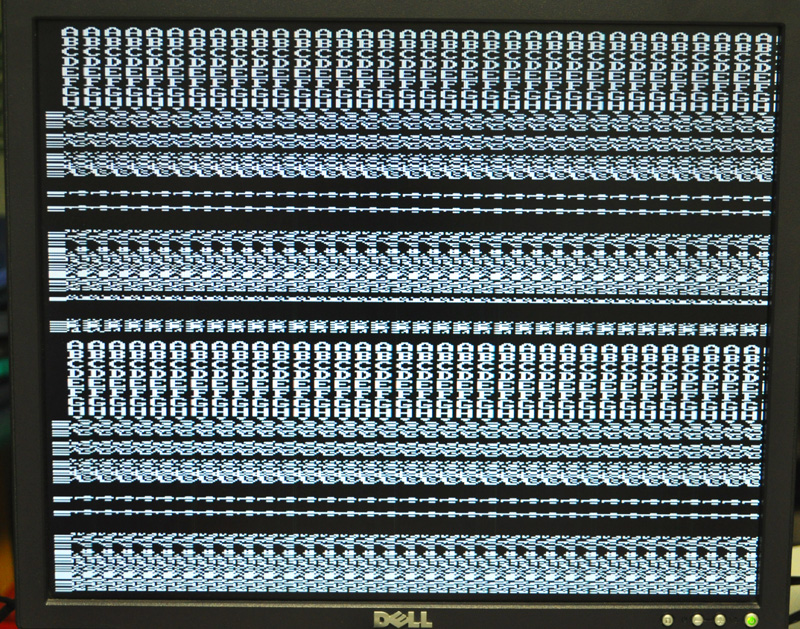 This is a 320x480 pixel display over the 640x480 VGA Standard.
Once I clean up the Text Generator, it will be capable of showing 38 x 60 characters.
I have one more test to do that may bring this up to 40 x 60 characters.
Depending on how the 65C02 agrees with fast tri-stating, I may be able to get 64 colors as well!
Sound will be 2 or 4 mixed voices coming out as a mono signal. Music will certainly be possible.
But the ultimate goal of "Easy to Start with 6502" will be met.
That AVR programmer is under twenty bucks, and the AVR is only 10 bucks.
I wrote a BIN converter so that any 6502 assembler can be used (I am using the Kowalski Assembler).
Once you load through the AVR Programmer, it can be pulled right out... this is a fully stand alone 6502 computer.
The AVR is simply a fancy SRAM & ROM with a built in VGA, Sound, and Clock Generator.
If an FPGA / CPLD exists in DIP form, then for sure someone will blow my version away!
And yes, a faster more colorful 2 chip system would be the winner.
And no soldering down of SMD onto DIP adapters allowed this time... it's all about making it easy for anyone to start!
I will be posting the AVR code, and the Assembler Bridge program as soon as this is ready.
An AVR + Programmer can be purchased at just about any electronics supplier.
the 65C02 can be purchased at the Western Design Center.
I will also add the BOM for the connectors and crystal... all are inexpensive as well.
Good to go!
Brad
 )
)