Page 2 of 3
Re: REFLOW FOR DUMMIES
Posted: Fri Nov 20, 2015 4:57 am
by Arlet
Because there was plenty of paste, it wasn't a problem, but with the nominal amount of paste, you wouldn't want the (bare) vias so close to the pads because they wick down the solder into the hole and can make for a dry joint.
Added: you may be able to get the paste out easier if you cut off part of the nozzle. Alternatively, you can squeeze some paste on a piece of paper, and use a toothpick to apply it to the pads.
Re: REFLOW FOR DUMMIES
Posted: Wed Nov 25, 2015 7:09 am
by BigDumbDinosaur
Because there was plenty of paste, it wasn't a problem, but with the nominal amount of paste, you wouldn't want the (bare) vias so close to the pads because they wick down the solder into the hole and can make for a dry joint.
Those via have a 0.008 inch hole, so while some wicking might have occur it would have been minor. Examination of the board after reflowing showed no evidence of solder in the via when inspected from the bottom under 10 diopter magnification.
In the next day or two I'll put up another post on the results. I've been quite busy with real work, so I'm a bit behind.
Added: you may be able to get the paste out easier if you cut off part of the nozzle. Alternatively, you can squeeze some paste on a piece of paper, and use a toothpick to apply it to the pads.
I thought of cutting the nozzle after the fact, as it is pretty long. The next reflow experiment will involve using stencils to apply the paste, so perhaps the nozzle length will become a non-issue. I'm hoping to get some time on it this upcoming long weekend, which starts with Thanksgiving on Thursday in the USA.
Re: REFLOW FOR DUMMIES
Posted: Fri Nov 27, 2015 9:33 pm
by randallmeyer2000
I have seen this in other places. I always wanted to try it; well, not really. What I really wanted was to breadboard some image sensors, but they were SMT and ran at 25MHz. I figured if I wanted to use the sensors, that I (1) HAD to make a PCB with fine line widths and (2) HAD to find some way of soldering the fine leads.
I guess I was wrong on both counts. And after seeing the Vulcan-74 thread, I probably could have clocked and ran them on a breadboard, with sockets, and with jumper wires too!
Nevertheless, the reflow oven is definitely a thread that belongs here.
Re: REFLOW FOR DUMMIES
Posted: Fri Nov 27, 2015 9:43 pm
by randallmeyer2000
I forget where I bought my stencil (for the aformentioned image sensor project) but it required (1) PCB pattern printed onto transparency (i.e. ink jet printer, NOT laser!), (2) Glass frame (weight), (3) sunlight, (4) photosensitized-mask silkscreen (5) timer, (6) water, and after that step, one just needed to apply screen print ink through the stencil onto the PCB, as an etch resist. I think the pattern came out pretty good.
The link, mentioned above, to a professional/semi-professional stencil maker is appreciated.
Re: REFLOW FOR DUMMIES
Posted: Wed Dec 09, 2015 3:00 pm
by mojo
I've been thinking about getting one of the Chinese IR reflow ovens you can buy fairly cheaply now. They are obviously a lot more expensive than standard kitchen ovens, but are fully automatic and programmable. People convert ordinary ovens with controller boards, but it doesn't seem worth it when you can buy an off-the-shelf IR oven for about the same price and it just works.
The other thing people say to watch out for is uneven heating. With normal ovens it can be an issue; fan helps but isn't perfect. IR is supposed to be a bit better, but you still need to be careful. Placing the board on top of a scrap board that acts as a kind of heat sink, evening the heat out seems to help.
Looking forward to updates.
REFLOW FOR DUMMIES
Posted: Sat Jan 02, 2016 4:04 pm
by BigDumbDinosaur
I'm way behind the eight-ball on this. The relative suddeness at which I had to have eye surgery has made keeping after this stuff difficult. I will get back to it soon.
REFLOW FOR DUMMIES: Post-Process Analysis
Posted: Sat Jan 16, 2016 8:06 pm
by BigDumbDinosaur
——————————————
REFLOW FOR DUMMIES
——————————————
Once my parts had cooled down from reflowing, it was clear that I had a bit of a mess on my hands. As I had noted a few posts ago, it appeared that I had applied too much solder paste and not surprisingly, some of the connections looked more like boogers than solder joints.

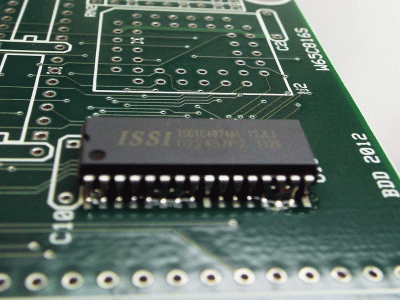
- SRAM after Reflow
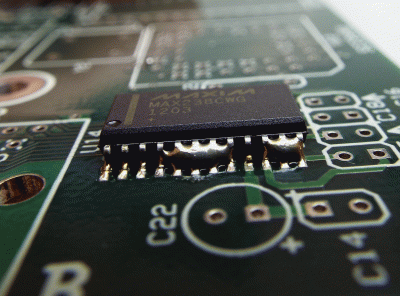
- MAX-238 after Reflow
Above is the SRAM (SOJ32) and MAX-238 (SOIC-24) after reflow. As can be seen, the reflow process did produce some good joints, but also some bridges. As I watched the reflow flow while the board was in the oven I could see that the excess solder paste was developing bridges, but of course, it was too late at that time to do anything about it.
In the past when I have manually soldered these small packages I have been able to successfully use desoldering braid to get rid of bridges. However, the bridges that did occur during manual soldering were not nearly as bad as these bridges. Nevertheless, I figured there was no harm in trying.
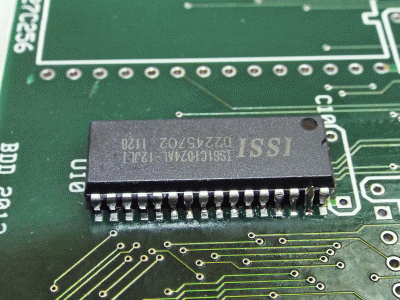
- SRAM after Cleanup
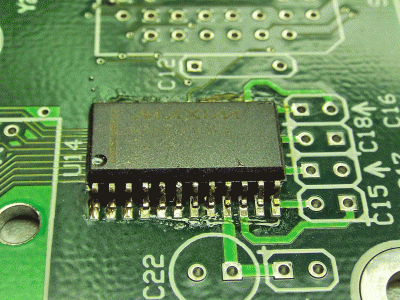
- MAX-238 after Cleanup
Above are the SRAM and MAX-238 after judicious use of desoldering braid. All outward appearances suggest that everything is copacetic, but the DVM tells a different story. The MAX-238 checks out okay but the SRAM has multiple inter-pin shorts. Careful inspection under magnification revealed some tiny bridges under the device—out of reach of the desoldering braid.
The only way to fix under-device bridges to desolder the SRAM, clean up the board and re-reflow it. However, the goal of this project is to be able to successfully reflow without subsequent rework.
Ergo I'm not going to try to fix this mess and instead, will reevaluate my methods to assure that the process will produce a working part on the first try. I've got one blank POC V1.1 board left, so I can take another stab at this.
Fundamentally, my reflow procedure appears to be sound. Where the train went off the track was in the application of solder paste. It is clear that I need to be more sparing with the paste and more accurate in its placement. Also, despite having early said that I didn't think that it's necessary with 50 mil pitch parts, I have decided to use a stencil to assist in applying paste on the next go-around. I'll write about it once my vision is clearer and I can do the close up work that will be required.
Re: REFLOW FOR DUMMIES
Posted: Sat Jan 16, 2016 8:13 pm
by Arlet
One way to fix under-device bridges is to add some more solder (and optionally some flux), so that the molten blob can reach under the device and remove the small bridges. Then use a solder pump to remove the blob (I use an Edsyn Soldapullt, and it does a good job).
Also, when you use braid to remove bridges, I recommend putting some solder on the braid first, so it doesn't suck the pins completely dry.
Re: REFLOW FOR DUMMIES
Posted: Sat Jan 16, 2016 8:22 pm
by BigDumbDinosaur
Also, when you use braid to remove bridges, I recommend putting some solder on the braid first, so it doesn't suck the pins completely dry.
I usually liberally tin the soldering iron tip and that not only aids in the heat transfer, it adds enough solder to the braid so it doesn't suck all the solder off the pins.
Re: REFLOW FOR DUMMIES
Posted: Sat Jan 16, 2016 9:13 pm
by GARTHWILSON
The last ISSI SRAM picture above appears to have open circuits too; but it may just be the camera angle. When I build the SRAM modules, I just make a big bridge all the way down the side of the SRAM, then hold it vertically, and very slowly drag the large soldering iron tip down the side, from top to bottom, and all the excess solder comes off on the iron, leaving the right amount on every pin, and no bridges. The tip covers three pins at once. I know you're ultimately looking to get the right amount of solder paste on there so no rework is necessary though.
Re: REFLOW FOR DUMMIES
Posted: Sat Jan 16, 2016 10:27 pm
by BigDumbDinosaur
The last ISSI SRAM picture above appears to have open circuits too; but it may just be the camera angle.
It's the camera angle. All pins have continuity to the PCB.
I know you're ultimately looking to get the right amount of solder paste on there so no rework is necessary though.
Correct. POC V2's PCB layout creates a number of areas where manually soldering the SRAMs might be tricky.
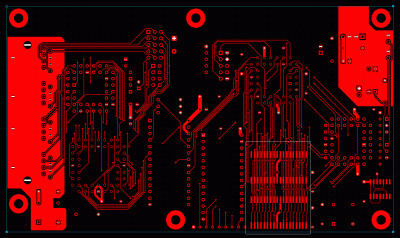
- POC V2 PCB Top Copper
The area demarcated by the white rectangle meets the design rules but results in only a small amount of solder mask between the adjacent pads for the SRAMs, due to the traces passing through that space. I suspect it would take very little to provoke a bridge between one of those traces and a pad, since the solder mask could be accidentally abraded by the solder iron tip.
BTW, here is the PCB layout
en toto.
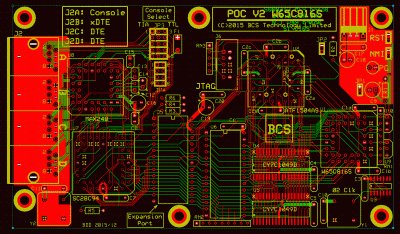
- POC V2 PCB Composite Layout
Some time ago while cleaning up the layout, I realized that with some judicious rearrangement, I could attach two SRAMS instead of one. POC V2 will have 1 MB of RAM instead of the 512KB I originally planned to use. I also added the JTAG port, even though I can program the CPLD in my Atmel test rig.
Re: REFLOW FOR DUMMIES
Posted: Sat Jan 16, 2016 10:35 pm
by GARTHWILSON
The area demarcated by the white rectangle meets the design rules but results in only a small amount of solder mask between the adjacent pads for the SRAMs, due to the traces passing through that space. I suspect it would take very little to provoke a bridge between one of those traces and a pad, since the solder mask could be accidentally abraded by the solder iron tip.
Fortunately, I've found that modern soldermask is extremely tough, at least for the production PCB houses. I haven't tried the super-low-price hobbyist PCB suppliers, but I suspect it's the same story.
Re: REFLOW FOR DUMMIES
Posted: Sun Jan 17, 2016 9:52 am
by cbscpe
Hi BDD,
I think you put too much solder paste and that causes a lot of bridges. I really would consider to use a stencil (metal if possible). Especially with fine pitch TQFP (0.5mm) with only a little too much solder you automatically create bridges. I really look forward to see more results, because I also plan to jump on to the SMD track and I'm also considering to use a reflow oven (perhaps I use a real one as the small ones are really cheap). For the moment I mainly use adapters to be able to use fine pitch devices in my breadboard test setups. All hand soldered for the moment, which may take something like 20 minutes for a TQFP-100 including clean-up and tests.
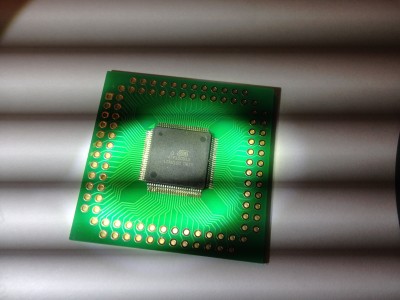
- TQFP-100 ATF1508AS on Test Adapter
But the key was to use a lot of solder flux and only very very little solder. Especially on J-leads
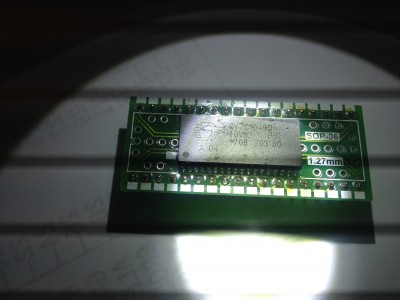
- High-Speed 512kbyte SRAM on Test Adapter
However solder flux is no option for a reflow oven and so the only solution in my opinion is to apply the correct amount of solder from the very beginning using a stencil. One down-side when applying solder with a stencil is that you must be very careful when placing chips with a lot of pins as they must not be bent in any way else the pins that are bent upwards will not solder.
Cheers
Peter
Re: REFLOW FOR DUMMIES
Posted: Sun Jan 17, 2016 10:08 am
by Arlet
Note that the holes in the stencil usually don't match the pads exactly. For TQFP parts, you want the holes slightly narrower than the pad, and a bit shorter. About 75% area coverage would be a good place to start, and then based on your experience and equipment, you can adjust from there. If you have room, making the pads stick out a bit more can also be useful (without covering the extra part in paste)
For larger surface mount pads, such as TO-252, or anything else that gets completely covered by the part, you should aim for 25% coverage, using several small square holes.
For 0603 and 0402 parts, it's okay to use 100% coverage. The excess paste can climb up the sides of the component.
Re: REFLOW FOR DUMMIES
Posted: Sun Jan 17, 2016 12:24 pm
by Aslak3
...l hand soldered for the moment, which may take something like 20 minutes for a TQFP-100 including clean-up and tests.
But the key was to use a lot of solder flux and only very very little solder. Especially on J-leads
I've done similar hand solder adapter attachments (TQFP 144). I ruined one part, but the second one was good. Lots and lots of flux, hardly any solder. Basically just tin the tip. The other thing you need is some very fine tweezers. The hard thing is lining the part up. I can see from your photo that the pins are off by maybe 20% of a pin pitch. Luckily you'll get away with that.

The USB microscopes are very handy for inspection, and they are cheap these days, though I would love a nice overhead scope rig. I also used a loupe, the headband type, which worked quite well.
I've still not really warmed myself up to using SMT parts "seriously" though. I'm still at the stage of begrudgingly including SMT parts, preferably SOIC and always hand soldered, on my boards if there is no other option. I'd love to get myself setup for reflow, though it looks intimidating. BDD's experiments are very encouraging though!