Page 2 of 2
Re: Demonstration of bootstrapping a ROMless machine (not 65
Posted: Sun Dec 01, 2013 2:59 pm
by HansO
And here I found the manual of the OSI 300:
http://osiweb.org/manuals/OSI_300.pdf
I do remember the top IC is a 7402, the bottoms are 7417. The SRAM is a 6810
Re: Demonstration of bootstrapping a ROMless machine (not 65
Posted: Sat May 30, 2015 12:59 pm
by HansO
And now it is completely clear: the re engineered circuit diagram appeared online!
http://randomvariations.com/category/osi-300-trainer/
Re: Demonstration of bootstrapping a ROMless machine (not 65
Posted: Sat May 30, 2015 1:34 pm
by BigEd
Re: Demonstration of bootstrapping a ROMless machine (not 65
Posted: Tue Jun 23, 2015 12:28 pm
by BigEd
Worth noting that ChristopherB has used his redrawn schematic and made up a nice working PCB for an OSI 300 remake:
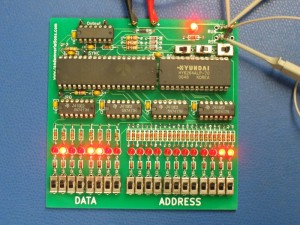 http://randomvariations.com/2015/06/22/ ... -300-mini/
Re: Demonstration of bootstrapping a ROMless machine (not 65
Posted: Fri May 13, 2016 6:19 am
by fastgear
What the tickles me from the youtube video on the altair booting basic from tape is the following:Back then, how did people manage to write there own machine language to paper tape in a form that the altair will boot?
I first assume you could just write the machine language in intel hex form via a teletypewriter. But, when I had a peek at the bootstrap code for basic, I saw the bootstrap was expecting raw binary.
By the looks of it it seems that raw binary is out of the scope of a teletypewriter, since it could only serve bytes up to 127 in value including the parity byte.
Thus, how did they manage to write raw binary to paper tape?
Re: Demonstration of bootstrapping a ROMless machine (not 65
Posted: Fri May 13, 2016 8:21 am
by BigEd
Edit: I was confused! Or even wrong. Please see Tor's post below.
[You're right, paper tape isn't wide enough to hold a byte in each character. But even if it was, you'd still need to run some minimal bootloader on the Altair to read from the serial port and write to memory. So there has to be some toggling in of a tape loader... and in that case, the bootloader can do whatever is convenient to support some encoding of binary into tape-friendly characters. As you say, it could be Intel hex format, but that's probably a more recent invention.]
There's a bootloader, in binary, on this page
http://www.solivant.com/altair_bootload ... rs&pagen=1
which I suppose could be disassembled! (Edit: it doesn't need to be - see page 2 of that link.)
Re: Demonstration of bootstrapping a ROMless machine (not 65
Posted: Fri May 13, 2016 8:43 am
by Tor
Actually the paper tape is wide enough, 8-hole paper tapes could be written (and read) with no parity, and that's how the binary code for Altair BASIC was stored on tape (fastgear is right about that). The Altair bootloader (the one you enter via the front panel) is very short, less than 20 instructions, and Paul Allen wrote it on the flight out to MITS because it wasn't until then he remembered that he didn't have one. That loader reads 8-bit chars from the tape, to load a secondary bootloader which handles the rest of the tape which contains things like start- and end address, and checksum. Still binary, though.
fastgear's question is 'how do you write those 8-bit tapes?', if you only have a teletype that can only handle 7-bit data. The answer is, I think, you can't. The teletype is just a keyboard with a tape reader/writer which can echo what you write on the keyboard, or simulate you writing on the keyboard when you read a tape. Thus, it can only be used to punch characters available on the keyboard. It can't be used to generate tapes with binary code. Well, not entirely true, because it could punch what's dumped from the computer, but its link is 7-bit, as fastgear said.
Instead, you would have to create the paper tape with a proper tape punch unit, and that's how it was done. You can still find some of them on ebay, and some people are making them (although most of them are read-only, to read existing tapes).
(I remember the BASIC tape I sometimes[*] had to load on the school mini back in the seventies.. the roll was at least 9 or ten inches in diameter IIRC.
[*] The machine had core memory, so unless something else had been loaded in the meantime it was just to turn on the power and the BASIC would still be there.. so fortunately it was rare to have to load the tape. But when it was done, it was done with a proper fast paper tape reader (which could punch too, much faster than the teletype. The teletype was only used to store BASIC source in ASCII))
Re: Demonstration of bootstrapping a ROMless machine (not 65
Posted: Fri May 13, 2016 8:58 am
by BigEd
Thanks for the correction and the extra information!
Re: Demonstration of bootstrapping a ROMless machine (not 65
Posted: Fri May 13, 2016 11:34 am
by fastgear
Thanks Ed and Tor!
Re: Demonstration of bootstrapping a ROMless machine (not 65
Posted: Fri May 13, 2016 1:34 pm
by fastgear
For interest sake, I just came across this youtube link also touching on this topic:
https://www.youtube.com/watch?v=bGjTZxRdYD8
Re: Demonstration of bootstrapping a ROMless machine (not 65
Posted: Mon May 30, 2016 3:52 am
by whartung
I've actually worked before on a printing terminal at 110 baud.
Of all things, I was using it for my Freshman Comp english class to write papers. We had a basic RUNOFF clone of sorts on our Cyber 730, and the 110 baud printing terminal simply had the best type quality on campus. RUNOFF was a predecessor to TROFF. It was simpler and was used to format the bulk of DEC documentation.
I would edit the file using the line editor, and then format and print the results.
The teacher let me get away with it, though one time I couldn't get in to the Math lab (that had the terminal), and had to use the generic lab printers. They were nice and fast at 1200 baud, and I simply reversed the Green Bar paper they had in them to print on the white side, and then used a cutter in the library to shear off the tractor feeds and reduce it down to 8.5 x 11.
Interestingly, the faster printers, while lower quality dot matrix, had better descenders.
I was really appreciative that my English teacher accepted my papers this way (though they technically broke the rules in her syllabus). I took another computer "Project Management" class, and there we has to come up with our own silly forms and logos and do everything on typewriters. That was just awful.