6502 Design & concept questions.
- BigDumbDinosaur
- Posts: 9428
- Joined: 28 May 2009
- Location: Midwestern USA (JB Pritzker’s dystopia)
- Contact:
Re: 6502 Memory map considerations.
GARTHWILSON wrote:
Quote:
Regarding the '154 decoder, you should know that it is relatively slow device. Unless you truly need more than eight I/O slots in your design you should consider using the faster (and physically smaller) '138. Naturally, your glue logic should be 74AC or 74HC, not 74LS.
Quote:
...and it has the '154 at about the same speed as the '138, both kind of slow-- but it may not matter much if he's going to run the circuit slowly enough for the SID. The '154 in CMOS is in a .300"-wide skinny DIP, unlike the TTL and LSTTL ones which were wide, so the CMOS one takes about as much room as one and a half 138's.
x86? We ain't got no x86. We don't NEED no stinking x86!
- BigDumbDinosaur
- Posts: 9428
- Joined: 28 May 2009
- Location: Midwestern USA (JB Pritzker’s dystopia)
- Contact:
Re: 6502 Memory map considerations.
Rob Finch wrote:
Quote:
The first 1k or 2k would always be bank 0 while the rest is bankable.
I placed all my I/O high up in memory at the range $FFDxxxxx for my system (32 bits).
It all sounds like way too much complexity to me. Of course, I'm just a curmudgeon...
x86? We ain't got no x86. We don't NEED no stinking x86!
- GARTHWILSON
- Forum Moderator
- Posts: 8775
- Joined: 30 Aug 2002
- Location: Southern California
- Contact:
Re: 6502 Memory map considerations.
BigDumbDinosaur wrote:
GARTHWILSON wrote:
Quote:
Regarding the '154 decoder, you should know that it is relatively slow device. Unless you truly need more than eight I/O slots in your design you should consider using the faster (and physically smaller) '138. Naturally, your glue logic should be 74AC or 74HC, not 74LS.
http://WilsonMinesCo.com/ lots of 6502 resources
The "second front page" is http://wilsonminesco.com/links.html .
What's an additional VIA among friends, anyhow?
The "second front page" is http://wilsonminesco.com/links.html .
What's an additional VIA among friends, anyhow?
Re: 6502 Memory map considerations.
Thanks for all your replies!
yes, I saw that design of yours, I wouldn’t come up with something like that on my own, so I planned some headroom.
I definitely want to include a variable and from software selectable clock.
That was my intention, 32k of program space is way enough for my skills.
I thought I have 2 or 3 lying around doing nothing, so why not using them. But considering all this, I’ll have to agree.
I absolutely agree, programming in ML on the C128 is not that much fun. I’d rather use BASIC V7.0. Well, except for the lack of speed.
You don’t mention 74HCT for a reason?
actually my supplier does have both, .300” and .600” DIP.
Most of you are advising me to use an ‘816. I’m open to that suggestion, but I have some concerns.
First of all, banking would be just a nice addition, certainly not a necessity (to me at least). I’ll be using a Gameduino for VGA out. At startup, I have to write a charset to it.
In order to familiarize myself with the ‘816, I would like to see a few different schematics of some SBC’s. Like yours and BDD’s POC. I don’t know if they are online, but if they do, I’ll find them. Are there any other’s online?
I’ve started to read the ‘816 datasheet and it looks rather impressive.
I’d really like to include a 6581 SID and a 8580 SID, they have to be in there! However, it would be silly to run the whole system with 1MHz. Can they be implemented if the system is running on a higher clock (2,4, or 8MHz.)? I’m pretty sure that PHI2 of the SID has to be (around) 1MHz. What about R/W? I will make a variable clock with a selection register and run it at 1MHz. while using the SID. But that’s not so elegant. Does R/W operate at 2 MHz. at “FAST MODE” on the C128? Does any one of you have a SID in your SBC? I know the KIWI has. It runs at 10MHz but has an E output.
Another concern are MOUSER’s ridicules shipping costs (20 euros). I’m living in the south of the Netherlands near the German border, so I could order from both countries.
I understand for higher clock speeds I need either AC logic or CPLD. My “bug vendor” has only 18 different AC chips and some of them are SMD at 1.27mm pitch. That’s probably doable for me. CPLD wise I’m a total beginner. Just knowing that it can replace TTL and is pretty fast. I’m building a simple CPLD parallel port programmer and a test board with an XC 9572XL PC44 at the moment.
If I’m going to build my SBC (MARC-2) around an ‘816 I’ll be having far more questions than when I choose a 65(C)02. I’d be heavily depending on your help and advice. And progress will in any case be slow due to my illness.
So for my first SBC I’d skip some steps and experiences.
Edit1: found BDD's POC schematics. Nice!
GARTHWILSON wrote:
The keyboard, joystick, beeper, RTC, I²C, and maybe other stuff too can all go on one VIA.
GARTHWILSON wrote:
That's one of the things ElEctric_EyE started with, then he kicked the clock rate up after the copying.
GARTHWILSON wrote:
If you do not try to have program material in multiple banks, the difficulty I mentioned further up goes away.
BigDumbDinosaur wrote:
6502 (which device I don't recommend you use) / Getting back to my comment about not using a 6502, I would not use NMOS hardware on any new design. If you want to stay with the 6502 you should use the more technically advanced W65C02S (not the Rockwell pulls that are floating around on eBay or at Jameco). WDC's CMOS processors are efficient low power, high performance devices that are superior in every respect to the NMOS equivalents. The PDIP-40 version of the 65C02 is a drop-in replacement for the 6502 (with one caveat). Errata in the NMOS parts have been corrected (e.g., the infamous JMP ($xxFF) bug) and new instructions (some very useful, such as PHX and PLY) have been added. Also, the NMOS part has some odd hardware behavior that can cause false chip accesses at inopportune moments if the circuit isn't carefully designed.
BigDumbDinosaur wrote:
The acrobatics required to use banked RAM with the 6502 are considerable. You need only to look at the Commodore 128 to see what I mean.
BigDumbDinosaur wrote:
Naturally, your glue logic should be 74AC or 74HC, not 74LS.
GARTHWILSON wrote:
The '154 in CMOS is in a .300"-wide skinny DIP
Most of you are advising me to use an ‘816. I’m open to that suggestion, but I have some concerns.
First of all, banking would be just a nice addition, certainly not a necessity (to me at least). I’ll be using a Gameduino for VGA out. At startup, I have to write a charset to it.
In order to familiarize myself with the ‘816, I would like to see a few different schematics of some SBC’s. Like yours and BDD’s POC. I don’t know if they are online, but if they do, I’ll find them. Are there any other’s online?
I’ve started to read the ‘816 datasheet and it looks rather impressive.
I’d really like to include a 6581 SID and a 8580 SID, they have to be in there! However, it would be silly to run the whole system with 1MHz. Can they be implemented if the system is running on a higher clock (2,4, or 8MHz.)? I’m pretty sure that PHI2 of the SID has to be (around) 1MHz. What about R/W? I will make a variable clock with a selection register and run it at 1MHz. while using the SID. But that’s not so elegant. Does R/W operate at 2 MHz. at “FAST MODE” on the C128? Does any one of you have a SID in your SBC? I know the KIWI has. It runs at 10MHz but has an E output.
Another concern are MOUSER’s ridicules shipping costs (20 euros). I’m living in the south of the Netherlands near the German border, so I could order from both countries.
I understand for higher clock speeds I need either AC logic or CPLD. My “bug vendor” has only 18 different AC chips and some of them are SMD at 1.27mm pitch. That’s probably doable for me. CPLD wise I’m a total beginner. Just knowing that it can replace TTL and is pretty fast. I’m building a simple CPLD parallel port programmer and a test board with an XC 9572XL PC44 at the moment.
If I’m going to build my SBC (MARC-2) around an ‘816 I’ll be having far more questions than when I choose a 65(C)02. I’d be heavily depending on your help and advice. And progress will in any case be slow due to my illness.
So for my first SBC I’d skip some steps and experiences.
Edit1: found BDD's POC schematics. Nice!
Marco
- BigDumbDinosaur
- Posts: 9428
- Joined: 28 May 2009
- Location: Midwestern USA (JB Pritzker’s dystopia)
- Contact:
Re: 6502 Memory map considerations.
GARTHWILSON wrote:
think you gave a link to the TI 74HC138 data sheet before and said it was about 15ns max; but I'm looking at http://www.ti.com/lit/ds/symlink/cd74hc138.pdf (their current 74HC138 data sheet) which says that at 6V, 50pF load, -40 to +85 deg C, the max is 33ns, and http://www.ti.com/lit/ds/symlink/cd74hc154.pdf (their current 74HC154 data sheet) which says that at the same voltage and temperature range the max is 37ns. 5V will make it a tad worse, but 25 deg C will make it a tad better. There will be small variations between brands, but these are approximately what my '88 data book said. I expect they will keep any given family about the same, but as technology advances, they have introduced new families.
x86? We ain't got no x86. We don't NEED no stinking x86!
- GARTHWILSON
- Forum Moderator
- Posts: 8775
- Joined: 30 Aug 2002
- Location: Southern California
- Contact:
Re: 6502 Memory map considerations.
Quote:
See attached, which is a current NXP (formerly Phillips Semiconductors) 'HC138 data sheet.
http://www.ti.com/lit/ds/symlink/cd74ac138.pdf shows the 74AC138 having 10ns worst case at 5V, 50pF, -40 to +85°C, which finally makes the '138 suitable for much higher operating speeds. If there were an ABT138, that'd be the cat's meow, but I haven't found one available. I've been able to find and buy several different ABT's since you alerted us to them, but alas, many in the family are not available in ABT. One I'd sure like to find is the '521 or '688 8-bit equality detector. Address decoding would be a major application.
http://WilsonMinesCo.com/ lots of 6502 resources
The "second front page" is http://wilsonminesco.com/links.html .
What's an additional VIA among friends, anyhow?
The "second front page" is http://wilsonminesco.com/links.html .
What's an additional VIA among friends, anyhow?
- BigDumbDinosaur
- Posts: 9428
- Joined: 28 May 2009
- Location: Midwestern USA (JB Pritzker’s dystopia)
- Contact:
Re: 6502 Memory map considerations.
lordbubsy wrote:
You don’t mention 74HCT for a reason?
Quote:
Most of you are advising me to use an ‘816. I’m open to that suggestion, but I have some concerns.
Quote:
First of all, banking would be just a nice addition, certainly not a necessity (to me at least).
In contrast, the 65C816 can address a full 24 bits of RAM with minimal glue logic (a 74AC573 or 74ABT573 latch to drive A16-A23 from D0-D7 and an out-of-phase clock to gate the '573) and without the need for common RAM areas. Several ways are available to access the entire 16MB space without any special steps, including using a 24 bit direct page (aka zero page) pointer. When an interrupt hits, the '816 will go back to (program) bank $00 to fetch the ISR vector and start executing the ISR without the rest of the hardware having to do anything special. When the ISR RTIs, the '816 will return to the bank in which it was executing when the interrupt hit, again without the system logic having to do anything special. That is all in stark contrast to the hoop-jumping done by the C-128, and is much simpler than trying to make a 65(c)02 address more than 64KB.
That said, you aren't obligated to use the A16-A23 address component at all, and can completely ignore it like I did with my POC V1 units. As long as the glue logic is correctly implemented, the '816 will pretend it only knows about a 16 bit address bus and will behave like a 65C02 on a big dose of steroids. You can run the '816 in emulation mode (the default at power-on or reset) until you get comfortable with your system, and then start exploring native mode and 16 bit programming. Once you get some experience under your belt with this hardware you can design version two with A16-A23 decoding hardware and rig up as much RAM as you want.
Quote:
I’ll be using a Gameduino for VGA out. At startup, I have to write a charset to it.
Quote:
I’ve started to read the ‘816 datasheet and it looks rather impressive.
Quote:
I’d really like to include a 6581 SID and a 8580 SID, they have to be in there! However, it would be silly to run the whole system with 1MHz. Can they be implemented if the system is running on a higher clock (2,4, or 8MHz.)? I’m pretty sure that PHI2 of the SID has to be (around) 1MHz. What about R/W? I will make a variable clock with a selection register and run it at 1MHz. while using the SID. But that’s not so elegant. Does R/W operate at 2 MHz. at “FAST MODE” on the C128? Does any one of you have a SID in your SBC? I know the KIWI has. It runs at 10MHz but has an E output.
Unfortunately, none of the NMOS versions of the 6502 (including the C-128's 8502) will respond to RDY when the current operation is a write. This shortcoming was addressed in the C-128 by implementing a hardware feature referred to as clock-stretching, resulting in all accesses to the I/O block ($D000-$DFFF) occurring at an effective 1 MHz rate, no matter the MPU frequency. Clock stretching temporarily increases the effective clock period to one microsecond during actual chip access, which allowed Commodore to use the 6581 without alteration (also true for the two 6526 CIAs).
As both the 65C02 and 65C816 will halt on a write cycle when RDY is asserted, you can use wait-states to access the SID. The device's Ø2 input would have to be phase-synced with the MPU's Ø2 clock so when the MPU is wait-stated on a SID access the latter's clock is in a high state. You could do this with cascaded flip-flops to divide the MPU's Ø2 clock to 1 MHz. The flops would have to be very fast to avoid having the SID's clock get significantly out of phase with the MPU's clock. I envision that you'd have to use programmable logic to achieve all this. Attempting to do it with discrete logic will likely result in too many cascaded propagation delays.
Aside from the timing issues, getting a 6581 (NMOS) or 8580 (HMOS) operating on a bus driven by a CMOS MPU will present a problem or two. As is typical of devices of that era, the SID has weak fanout, so direct connection to a data bus full of other hardware may not work, forcing you to use an octal transceiver to "boost" the SID's output. I don't know if anyone has tried such a thing, so you might be breaking new ground here.
Quote:
Another concern are MOUSER’s ridicules shipping costs (20 euros). I’m living in the south of the Netherlands near the German border, so I could order from both countries.
Quote:
I understand for higher clock speeds I need either AC logic or CPLD.
PLDs are available at 10ns and faster, which is a pin-to-pin prop time (internal gate prop times are not additive in the usual sense). A reasonable system can be built around a 10ns GAL, such as a 22V10, with the GAL handling I/O decoding and wait-states. You'll run out of resources with a GAL if you get much more complicated. That's where a CPLD becomes attractive.
Quote:
My “bug vendor” has only 18 different AC chips and some of them are SMD at 1.27mm pitch.
Quote:
CPLD wise I’m a total beginner. Just knowing that it can replace TTL and is pretty fast. I’m building a simple CPLD parallel port programmer and a test board with an XC 9572XL PC44 at the moment.
Quote:
So for my first SBC I’d skip some steps and experiences.
Quote:
Edit1: found BDD's POC schematics. Nice!
-----------------------
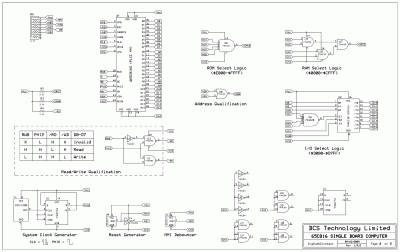
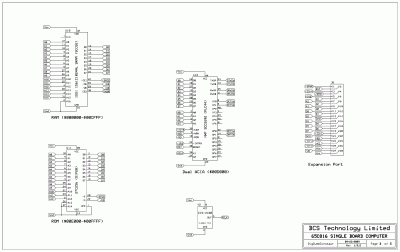
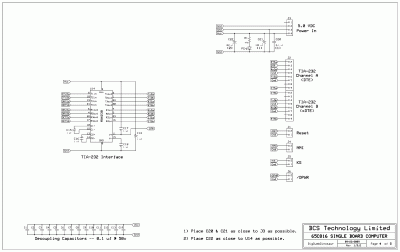
Edit: I attached the schematics for POC V1.1, which are more up to date that the schematics you found. As I said, I need to update the website. I omitted the SCSI host adapter schematic.
-----------------------
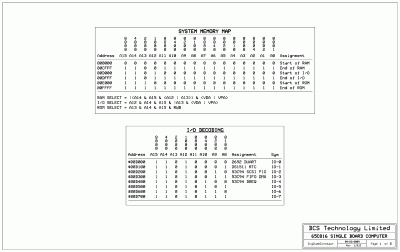
Last edited by BigDumbDinosaur on Mon Oct 07, 2013 5:52 am, edited 2 times in total.
x86? We ain't got no x86. We don't NEED no stinking x86!
- BigDumbDinosaur
- Posts: 9428
- Joined: 28 May 2009
- Location: Midwestern USA (JB Pritzker’s dystopia)
- Contact:
Re: 6502 Memory map considerations.
GARTHWILSON wrote:
Quote:
See attached, which is a current NXP (formerly Phillips Semiconductors) 'HC138 data sheet.
Quote:
http://www.ti.com/lit/ds/symlink/cd74ac138.pdf shows the 74AC138 having 10ns worst case at 5V, 50pF, -40 to +85°C, which finally makes the '138 suitable for much higher operating speeds. If there were an ABT138, that'd be the cat's meow, but I haven't found one available. I've been able to find and buy several different ABT's since you alerted us to them, but alas, many in the family are not available in ABT. One I'd sure like to find is the '521 or '688 8-bit equality detector. Address decoding would be a major application.
x86? We ain't got no x86. We don't NEED no stinking x86!
Re: 6502 Memory map considerations.
The important thing about the 816 is that it's almost pin-compatible and it boots into a 6502 mode.
I'd advise against increasing the scope of your project to accommodate all the features of the 816 - it's the kind of thing which gets in the way of finishing anything (or even starting anything)
So, by all means buy the 816, but do build an 8-bit system first! And stick to 8-bit software, until you have something running.
Cheers
Ed
I'd advise against increasing the scope of your project to accommodate all the features of the 816 - it's the kind of thing which gets in the way of finishing anything (or even starting anything)
So, by all means buy the 816, but do build an 8-bit system first! And stick to 8-bit software, until you have something running.
Cheers
Ed
- BigDumbDinosaur
- Posts: 9428
- Joined: 28 May 2009
- Location: Midwestern USA (JB Pritzker’s dystopia)
- Contact:
Re: 6502 Memory map considerations.
BigEd wrote:
The important thing about the 816 is that it's almost pin-compatible and it boots into a 6502 mode.
I'd advise against increasing the scope of your project to accommodate all the features of the 816 - it's the kind of thing which gets in the way of finishing anything (or even starting anything)
Quote:
So, by all means buy the 816, but do build an 8-bit system first! And stick to 8-bit software, until you have something running.
As I had said, I ran POC V1.0 in eight bit emulation mode for quite some time before switching to native mode and rewriting the BIOS into 16 bit code. I first fired up the unit in December 2009 and didn't permanently switch it to native mode until August 2010, by which time all known hardware errata had been eliminated and most, if not all, bugs in the firmware had been corrected. The switch to native mode operation was also when I recoded the BIOS to take advantage of 16 bit operations. I haven't looked back since.
x86? We ain't got no x86. We don't NEED no stinking x86!
Re: 6502 Memory map considerations.
So, has any one given any thoughts to a 65816 memory map, considering the CPU vectors are at the top of the first data bank.
Lot of talk about a 6502 8 Bit map, but, what were you thinking BDD for v2.0 with 4MB of RAM? Were you planning on leaving Bank 0 alone, or solely for the supervisor, and load all of the user space above it?
Re: 6502 Memory map considerations.
Sorry for the delay but I will respond properly tomorrow...
Marco
Re: 6502 Memory map considerations.
Hrm, 65816 D and S registers are both 16-bit, and constrained to bank 0, so that should be mostly-to-completely RAM... Or something stupid-clever, such as making it ROM for interrupt-vector and code fetches, and RAM for data operations. Mirror the ROM somewhere higher up in the address space as well, and possibly use a resettable latch to control the overlay of the ROM into the RAM space...
The RESET sequence would basically be CLC, XCE, JML to ROM space, then something to hit the latch to allow executing code from RAM. No fuss, a little muss, a contiguous RAM region at the bottom of the address space, a decent-sized ROM region (I'd use sst39sf040 512kx8 ROMs), and there's plenty of open room for I/O.
That's a first approximation, of course, I haven't really thought about it too deeply, or about the consequences of not having I/O in bank zero (where it could be twiddled by dpage instructions), or about precisely how to implement the address decoding logic.
The RESET sequence would basically be CLC, XCE, JML to ROM space, then something to hit the latch to allow executing code from RAM. No fuss, a little muss, a contiguous RAM region at the bottom of the address space, a decent-sized ROM region (I'd use sst39sf040 512kx8 ROMs), and there's plenty of open room for I/O.
That's a first approximation, of course, I haven't really thought about it too deeply, or about the consequences of not having I/O in bank zero (where it could be twiddled by dpage instructions), or about precisely how to implement the address decoding logic.
- GARTHWILSON
- Forum Moderator
- Posts: 8775
- Joined: 30 Aug 2002
- Location: Southern California
- Contact:
Re: 6502 Memory map considerations.
nyef wrote:
Hrm, 65816 D and S registers are both 16-bit, and constrained to bank 0, so that should be mostly-to-completely RAM... Or something stupid-clever, such as making it ROM for interrupt-vector and code fetches, and RAM for data operations. Mirror the ROM somewhere higher up in the address space as well, and possibly use a resettable latch to control the overlay of the ROM into the RAM space...
Note however that direct pages and the hardware stack together do not need very much of bank 0. Even if you have many tasks running at once that have their own DP, as long as they don't need anywhere near a whole page each, those direct pages can overlap without stepping on each other. The same goes for individual tasks' stack spaces.
Quote:
That's a first approximation, of course, I haven't really thought about it too deeply, or about the consequences of not having I/O in bank zero (where it could be twiddled by dpage instructions), or about precisely how to implement the address decoding logic.
http://WilsonMinesCo.com/ lots of 6502 resources
The "second front page" is http://wilsonminesco.com/links.html .
What's an additional VIA among friends, anyhow?
The "second front page" is http://wilsonminesco.com/links.html .
What's an additional VIA among friends, anyhow?
-
clockpulse
- Posts: 87
- Joined: 20 Oct 2012
- Location: San Diego
Re: 6502 Memory map considerations.
I usually just let the I/O decoding appear in all 256 banks. It does waste a 2k or 4k block in each bank but it make access of IO from each bank much easier.