Page 2 of 2
Re: History of Forth on 6502
Posted: Thu Mar 20, 2014 10:40 pm
by chitselb
I've been decompiling this figForth binary, mostly with editor macros and such (read: no automation) and mostly for my own edification. Does anybody know what the legal status of such source code is? Could I put it up on github?
Re: History of Forth on 6502
Posted: Thu Mar 20, 2014 10:57 pm
by Brad R
I'm still looking for my old fig-Forth listings, but I did find the fig-Forth Installation Manual of November 1980. It says:
All publications of the Forth Interest Group are public domain. They may be further reproduced and distributed by inclusion of this credit notice:
"This publication has been made available by the Forth Interest Group, P.O. Box 1105, San Carlos CA 94070"
According to what was the FIG web site,
http://www.forth.org/ , "Although FIG as an organization has dissolved, this website will continue to reflect the on-going interest in Forth." I imagine the P.O. Box 1105 address is no longer valid. I'm sure a notice crediting FIG (
sans address) will still be appreciated.
Re: History of Forth on 6502
Posted: Fri Mar 21, 2014 4:32 am
by White Flame
Technically, these 2 statements are at odds with each other:

All publications of the Forth Interest Group are public domain. They may be further reproduced and distributed by inclusion of this credit notice:
If something is public domain, then there are no prerequisites at all in using it in any way.
Re: History of Forth on 6502
Posted: Fri Mar 21, 2014 12:19 pm
by Brad R
Yes, I did a double-take when I read that as well. Since FIG no longer exists as a corporate entity, I think it's largely a moot point.
Re: History of Forth on 6502
Posted: Sun Mar 23, 2014 1:12 am
by chitselb
I put the mostly decompiled source code for this PET figforth up in a subdirectory of the github.com/chitselb/pettil project. It builds on Ubuntu with the xa65 cross assembler. I haven't figured out how the tape and disk i/o words work yet, working on that.
Re: History of Forth on 6502
Posted: Sun Jul 12, 2020 3:28 am
by GARTHWILSON
I did a little demo video of its operation, at http://wilsonminesco.com/calcs/TapeDriveDemo.mp4 . Pardon the shaky picture. The little camera is awfully hard to hold still with one hand and doesn't have image stabilization. Cutting back on the caffeine might help too.  A few points of interest:
- Looking carefully, you can see the the reels turn. Each little burst is 256 bytes. You'll hear the whir of the motors as well, especially when it fast-forwards or rewinds. The program file I'm storing is 2065 bytes long. It took less time to record the file than it did to check and update the FAT. It's a BASIC program for simulating a high-pass 5th-order active filter.
- In the video, the HP-71 computer has one of my hand-written keyboard overlays on it, for one of my sets of custom key assignments. I have another for my text editor, and another for my Forth work. Without a keyboard overlay, it looks like this:
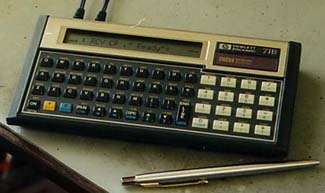
This is the first computer I used Forth on (although this particluar program was not in Forth).
- The spin out to the first available space to put the file on the tape was short, since I just formatted the tape and this was the first file. You can specify how many files you want room for in the FAT, but if you don't, the default is 128 files. No subdirectories. It spins so fast that going clear to the other end of the tape only takes a few seconds, and it stops on a dime when it reaches its destination.
- The system lets you have as many mass-storage devices connected on the interface loop as you could want; but in this case I only had one, so there was no need to specify a device number or volume label.
I suppose this is getting off the Forth topic, but the Hobbit sounds like the Hewlett-Packard HP82161A HPIL microcassette drive, which I have two of for my HP hand-held computers.
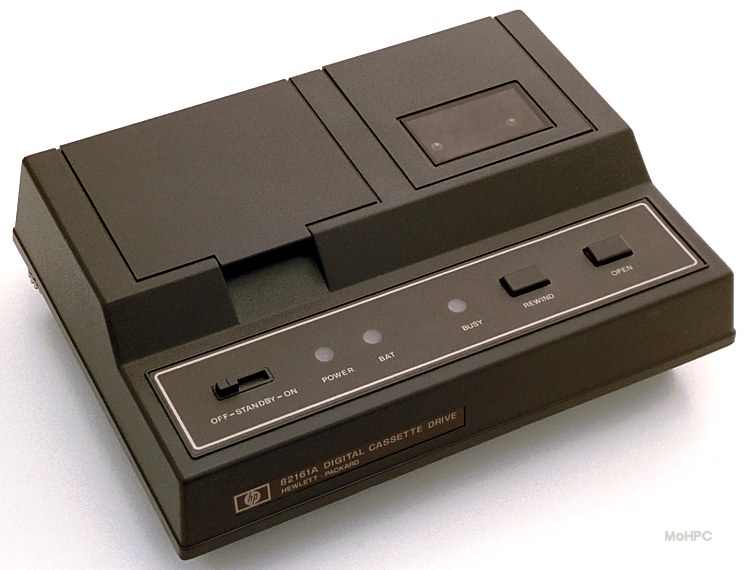
The picture shows it approximately actual size on my monitor. It was tiny compared to the separate disc drives of the day. The microcassette being used is under the door on the right, and the door on the left holds two more microcassettes side by side. Data transfer speed was about 400 bytes per second, going in 256-byte start-stop bursts. There is no capstan. It is my understanding that the spooling motors were direct-drive (no belts or gears) and had coreless armatures to reduce mass so it could spin up instantly and stop on a dime, which is rather impressive to watch when it searches the FAT and then spins out to the desired file, reads or records data, and spins back. Other than fast-forwarding or rewinding, the only time it runs at an even, continuous speed is when it's formatting a tape. Otherwise it goes in those bursts. A $10 tape holds about 128KB IIRC! I had data arrays bigger than that, but my typical file size meant that dozens of files fit on one tape.
Re: Re:
Posted: Wed Jul 15, 2020 8:35 pm
by JimBoyd
It is pretty clear that this Forth doesn't use BLOCK with the tapes, and probably no commie Forth ever did, but it does provide words for save/load operations.
If by "commie" you mean Commodore, then 64Forth for the Commodore 64 could use disks or tape. It had 16 block buffers. ( That's right, sixteen buffers! ) plus a communication buffer. 64Forth was a superset of Fig Forth that was on cartridge and started at address $8000. the block buffers were from address $C000 - $FFFF. 64Forth used the communication buffer to access the block buffers by temporarily switching out the I/O and Kernal ROM while copying to/from the communication buffer and one of the block buffers. IIRC all 16 blocks could be read from tape or all 16 could be saved to tape. As for disk blocks, 64Forth used Commodore relative files.
[Edit: I'm so used to 'kernel', I overlooked C64's use of 'kernal'.]